Archives

ECE Seminar Series: Resiliency and Security of the Future Power Grid

ECE title

ECE Seminar Series Fall 2017

(co-sponsor with Eversource Energy Center)

Monday October 16th 1:00-2:00 PM, LH 201

Resiliency and Security of the Future Power Grid

Chen-Ching Liu

Boeing Distinguished Professor
Director, Energy Systems and Innovation Center (ESIC)
School of Electrical Engineering & Computer Science
Washington State University

Abstract: The development of smart grid in the U.S. over the last decade significantly enhanced data acquisition capabilities on the transmission system. For the distribution network, numerous remote control devices and voltage/var control systems have been installed and millions of smart meters are now operational on the customer side. Although the level of automation has been improved, there are great challenges in the grid’s ability to withstand extreme events such as catastrophic hurricanes and earthquakes. Resiliency of the future grid can be achieved by enabling flexible reconfiguration with distributed resources, e.g., microgrid, distributed generations, as well as renewable and storage devices. Advanced and distributed operation and control will be critical for the vision. Fast increasing connectivity of the devices and systems on the power grid also led to a serious concern over the security of the complex cyber-physical system. Progress has been made in developing new technologies for cyber security of the power grid, including monitoring, vulnerability assessment, intrusion detection, and mitigation


Short Bio
: Chen-Ching Liu is Boeing Distinguished Professor at Washington State University (WSU), Pullman, WA. At WSU, Professor Liu served as Director of the Energy Systems Innovation Center. During 1983-2005, he was a Professor of Electrical Engineering at University of Washington, Seattle. Dr. Liu was Palmer Chair Professor at Iowa State University from 2006 to 2008. From 2008-2011, he served as Acting/Deputy Principal of the College of Engineering, Mathematical and Physical Sciences at University College Dublin, Ireland. Professor Liu received an IEEE Third Millennium Medal in 2000 and the Power and Energy Society Outstanding Power Engineering Educator Award in 2004. In 2013, Dr. Liu received a Doctor Honoris Causa from Polytechnic University of Bucharest, Romania. Chen-Ching chaired the IEEE Power and Energy Society Fellow Committee, Technical Committee on Power System Analysis, Computing and Economics, and Outstanding Power Engineering Educator Award Committee. He served on the U.S. National Academies Board on Global Science and Technology. Professor Liu is a Fellow of the IEEE and Member of the Washington State Academy of Sciences.

ECE Seminar Series: A New Look at Optimal Control of Wireless Networks

ECE title

ECE Seminar Series Fall 2017

Friday October 13th 2:30-3:30 PM, ITE 119

A New Look at Optimal Control of Wireless Networks

Eytan Modiano

Laboratory for Information and Decision Systems
Massachusetts Institute of Technology

Abstract: We address the problem of throughput-optimal packet dissemination in wireless networks with an arbitrary mix of unicast, broadcast, multicast and anycast traffic. We start with a review of the seminal work of Tassiulas and Ephremides on optimal scheduling and routing of unicast traffic, i.e., the famous backpressure algorithm. The backpressure algorithm maximizes network throughput, but suffers from high implementation complexity, and poor delay performance due to packets looping inside the network. Moreover, backpressure routing is limited to unicast traffic, and cannot be used for broadcast or multicast traffic. We will describe a new online dynamic policy, called Universal Max-Weight (UMW), which solves the above network flow problems simultaneously and efficiently. To the best of our knowledge, UMW is the first throughput-optimal algorithm for solving the generalized network-flow problem. When specialized to the unicast setting, the UMW policy yields a throughput-optimal, loop-free, routing and link-scheduling policy. Extensive simulation results show that the proposed UMW policy incurs substantially smaller delays as compared to backpressure.


Short Bio
: Eytan Modiano received his B.S. degree in Electrical Engineering and Computer Science from the University of Connecticut at Storrs in 1986 and his M.S. and PhD degrees, both in Electrical Engineering, from the University of Maryland, College Park, MD, in 1989 and 1992 respectively. He was a Naval Research Laboratory Fellow between 1987 and 1992 and a National Research Council Post Doctoral Fellow during 1992-1993. Between 1993 and 1999 he was with MIT Lincoln Laboratory. Since 1999 he has been on the faculty at MIT, where he is a Professor and Associate Department Head in the Department of Aeronautics and Astronautics, and Associate Director of the Laboratory for Information and Decision Systems (LIDS). His research is on communication networks and protocols with emphasis on satellite, wireless, and optical networks. He is the co-recipient of the MobiHoc 2016 best paper award, the Wiopt 2013 best paper award, and the Sigmetrics 2006 Best paper award. He is the Editor-in-Chief for IEEE/ACM Transactions on Networking, and served as Associate Editor for IEEE Transactions on Information Theory and IEEE/ACM Transactions on Networking. He was the Technical Program co-chair for IEEE Wiopt 2006, IEEE Infocom 2007, ACM MobiHoc 2007, and DRCN 2015. He is a Fellow of the IEEE and an Associate Fellow of the AIAA, and served on the IEEE Fellows committee.

ECE Seminar Series: Building-to-Grid Control Framework for Grid Services

ECE title

ECE Seminar Series Fall 2017

Wednesday September 27th 2:30-3:30 PM, KNS 103

Building-to-Grid Control Framework for Grid Services

Sumit Paudyal

Michigan Technological University

Abstract: With the implementation of Smart Grid technologies, such as sensors, smart meters, smart appliances, more than one-fourth of the US total electricity demand could be dispatchable. Coordinated demand dispatch of customers’ loads provides benefits to the customers and the grid both. A complete demand dispatch solution that benefits the customers and the grid involves a large scale optimization problem with underlying complex transmission and distribution grid models. A centralized approach to solve this problem is computationally involving in a practical sized grid with the consideration of comprehensive customer load models and the grid models that include discrete control variables. A practical way to solve this problem is to use hierarchical and distributed computing approaches, where information exchange occurs between the different levels in the hierarchy. This talk presents hierarchical framework to i) optimally dispatch electric vehicle (EV) loads and ii) optimally dispatch commercial building loads in building-to-grid (B2G) interaction. The case studies demonstrate the benefits of optimal demand dispatch of EV and building loads to the customers and grid operations.


Short Bio
: Sumit Paudyal received B.E. in Electrical Engineering from Tribhuvan University in Nepal, in 2003; Msc. degree in Electrical Engineering from the University of Saskatchewan, Saskatoon, Canada, in 2008; and a Ph.D. in Electrical Engineering from the University of Waterloo, Ontario, Canada, in 2012. Currently, Dr. Paudyal is an Assistant Professor at Michigan Technological University. His research expertise includes Smart Distribution Grid Operations, Optimization Techniques in Power Systems, Power System Protection, and Power System Real-time Hardware Simulations.

Embedded System Competition Award


A UConn team of students competed in a MITRE-sponsored embedded systems security capture the flag competition this semester and got first place. The team was led by UG ECE students Brian Marquis and Patrick Dunham with grad student Chenglu Jin and two CSE UG students.

UConn Chapter of HKN wins the Outstanding Chapter Award (2015-2016)

The IEEE-HKN Board of Governors has conferred on the UConn Chapter of HKN (Eta Kappa Nu: the electrical engineering honor society) the 2015-2016 IEEE-HKN Outstanding Chapter Award. This award is presented to IEEE-HKN chapters in recognition of excellence in their chapter administration and programs. Recipients are selected on the basis of their annual chapter report. Winning chapter reports not only showcase their chapter’s activities in an individualized manner, they provided multiple views and instances of their work, which really brought their chapter’s activities to life. Of critical concern to the Outstanding Chapter Awards evaluation committee in judging a chapter are activities to: improve professional development; raise instructional and institutional standards; encourage scholarship and creativity; provide a public service, and generally further the established 

goals of IEEE-HKN.


The UConn Chapter is one of 21 chapters selected for their outstanding performance and the value they bring to their members, peers, and university.

ECE Seminar Series: Seeing invisible biological cells – New horizons in cancer diagnosis and IVF

ECE title

ECE Seminar Series Fall 2016

Friday October 21st 1:30-2:30 PM, ITEB 125

Seeing invisible biological cells – New horizons in cancer diagnosis and IVF

Prof. Natan T. Shaked

Tel Aviv University, Israel

Abstract: One of the major challenges in the field of optical imaging of live cells is to achieve label-free but still fully quantitative measurements, which afford high-resolution morphological mapping at the single cell level. In particular, developing efficient, non-subjective, quantitative optical imaging technologies for single-cell imaging with clinical value is a challenging task. Live biological cells are three-dimensional (3D) dynamic microscopic objects that constantly adjust their sizes, shapes and other biophysical features. Visualizing cellular phenomena requires microscopic techniques that can achieve high data acquisition rates, while retaining both resolution and contrast to observe fine cellular features. However, cells in vitro are mostly-transparent 3D objects with absorbance and reflection characteristics that are very similar to their surroundings, and thus conventional intensity-based light microscopy approaches lack the required sensitivity. Exogenous labelling agents such as fluorescent dyes can be used to improve contrast. However, fluorescent agents tend to photo-bleach, reducing the available imaging time. Other concerns include cytotoxicity and the possibility that the exogenous agents will influence cellular behavior. Still, the widely used methods for detection and diagnosis of medical conditions in the cellular level cancer are based on indirect and subjective histological and cytological examination of tissues or samples from bodily fluids. Alternatively, if the sample has to stay alive, such as in sperm selection for in-vitro fertilization, the cells cannot be well visualized. In this lecture, I will review our latest advances in developing new imaging modalities to achieve affordable label-free but still fully quantitative measurements, which offer high-resolution 3D morphological and mechanical mapping of dynamic cells. These approaches are expected to pave the way to new clinical diagnosis and monitoring tools in the single-cell level. I will review two specific applications with a great clinical value: cancer monitoring and sperm selection in in vitro fertilization (IVF).


Short Bio
: Prof. Natan T. Shaked is an Associate Professor in the Department of Biomedical Engineering at Tel Aviv University, Israel. Till April 2011, Prof. Shaked was a Visiting Assistant Professor in the Department of Biomedical Engineering at Duke University, Durham, North Carolina, USA. In the last 4 year, Prof. Shaked raised more 4 million dollar for research. Prof. Shaked is the coauthor of more than 50 refereed journal papers and 80 conference papers, and several book chapters, patents, and an edited book.

ECE Seminar Series: Maximizing Efficiency for Simulation-based or Sample-based Optimization

ECE title

ECE Seminar Series Fall 2016

Friday November 11th 3-4 PM, ITEB 336

Maximizing Efficiency for Simulation-based or Sample-based Optimization

Chun-Hung Chen

George Mason University

Abstract: Simulation and optimization are two popular engineering design tools. Optimization intends to choose the best element from some set of available alternatives. Stochastic simulation is a powerful modeling and software tool for analyzing modern complex systems that arise in manufacturing, power grids, transportation, healthcare, finance, defense, and many other fields. Detailed dynamics of complex, stochastic systems can be modeled in simulation. This capability complements the inherent limitation of traditional optimization, so the combining use of simulation and optimization is growing in popularity. This seminar discusses how we can integrate these two popular tools together and what computational issues we have to face in this integration. We will give an overview of some existing approaches, including gradient-based and model-based approaches. We will also present our developments based on a new technique called Optimal Computing Budget Allocation, initially developed by the speaker. Our goal is to maximize the efficiency of finding a good decision via optimal control of simulation replications and optimal sampling in design space.


Short Bio
: Chun-Hung Chen received his Ph.D. degree from Harvard University in 1994. He is currently a Professor at George Mason University. Dr. Chen was an Assistant Professor at the University of Pennsylvania before joining GMU. He was also affiliated with National Taiwan University (Electrical Eng. and Industrial Eng.) from 2008-14. Sponsored by NSF, NIH, DOE, NASA, FAA, Missile Defense Agency, and Air Force in US, he has worked on the development of very efficient methodology for simulation-based decision making and its applications. Dr. Chen received several awards such as “National Thousand Talents Award” from China and Eliahu I. Jury Award from Harvard University. He has served as a Department Editor for IIE Transactions, Department Editor for Asia-Pacific Journal of Operational Research, Associate Editor for IEEE Transactions on Automation Science and Engineering, Associate Editor for IEEE Transactions on Automatic Control, Area Editor for Journal of Simulation Modeling Practice and Theory, Advisory Editor for International Journal of Simulation and Process Modeling, and Advisory Editor for Journal of Traffic and Transportation Engineering. Dr. Chen is the author of two books, including a best seller: “Stochastic Simulation Optimization: An Optimal Computing Budget Allocation”. He is an IEEE Fellow.

ECE Seminar Series: A Decade of Compressive Sensing-application in optical sensing and imaging, achievements and challenges

ECE title

ECE Seminar Series Fall 2016

Wednesday October 19th 3-4 PM, ITEB 336

A Decade of Compressive Sensing-application in optical sensing and imaging, achievements and challenges

Adrian Stern

Ben Gurion University of Negev, Israel

Abstract: The theory of compressive sensing (CS) has attracted great attention since it was published a decade ago. CS has found natural applications in imaging and optical sensing sciences, yielding a great number of publications. From a decade perspective, I will present an overview of the main achievements in optical CS engineering and discuss remaining challenges. I will survey the main applications and present representative examples form our and other’s group results. I will highlight the benefits gained from the CS application in optics, present the main implementation challenges of the mathematical CS theory in optical engineering. Finally, future directions will be discussed.


adrian-sternShort Bio: Adrian Stern received his B.Sc., M. Sc. (cum laude) and PhD degrees from Ben-Gurion University of the Negev, Israel, in 1988, 1997 and 2003 respectively, all in Electrical and Computer Engineering. Currently he is an Associate Professor at Electro-Optical Engineering department at Ben-Gurion University in Israel where he serves as department head. During the years 2002-2004 he was a postdoctoral fellow at University of Connecticut. During 2007-2008 he served as senior research and algorithm specialist for GE Molecular Imaging, Israel. In 2014-2015, during his sabbatical leave, he was a visitor scholar and professor at Massachusetts Institute of Technology (MIT). His current research interests include computational imaging and sensing, 3D imaging, compressed imaging, phase-space optics, bio-medical imaging. Dr. Stern has published over 150 technical articles in leading peer reviewed journals and conference proceeding, more than quarter of them being invited papers. Dr. Stern is a Fellow of SPIE, member of IEEE, OSA. He served as editor for Optics Express journal. He is the editor of the first book to be published on optical compressive sensing.

Engineering Alum’s Gift To Help Keep UConn Safe

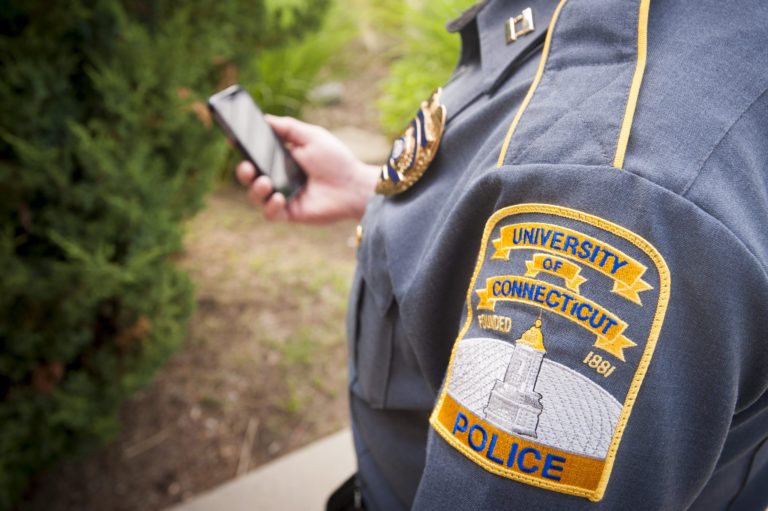
UConn has installed a new system that can detect gunshots and explosions, and send live video feed to officers’ cellphones. (Sean Flynn/UConn Photo)

During active shooter events, the speed with which first responders get information is key to saving lives. Thanks to a donation from a UConn engineering alum, UConn police could learn about an event in a matter of seconds.

Robert Hotaling ’01, an electrical engineering alum and the founder of Verbi Security, is donating an intelligent gunshot detection and IP device unification platform to UConn. His company’s system detects gunshots or explosions, sends information to campus police through an automated system in a matter of seconds and links the location to maps and video cameras.

“That, to me is the difference here; we’re a mobile first solution. We leverage mobile devices to get instant notifications,” Hotaling said.

Hotaling was inspired to donate the system when a student worker made a routine alumni donation call. After considering the request, Hotaling decided to give something more than just money.

“I said ‘I could give you some money, but I’m the founder of this company, I’ve got this tech, and I could make a donation of that tech.’ If it wasn’t for that student, I might not have thought about the donation,” Hotaling said.

The platform, which Hotaling said is worth roughly $175,000, uses military grade intelligent shot detectors to search for specific sounds.

“The sensor listens, but not for the sound of

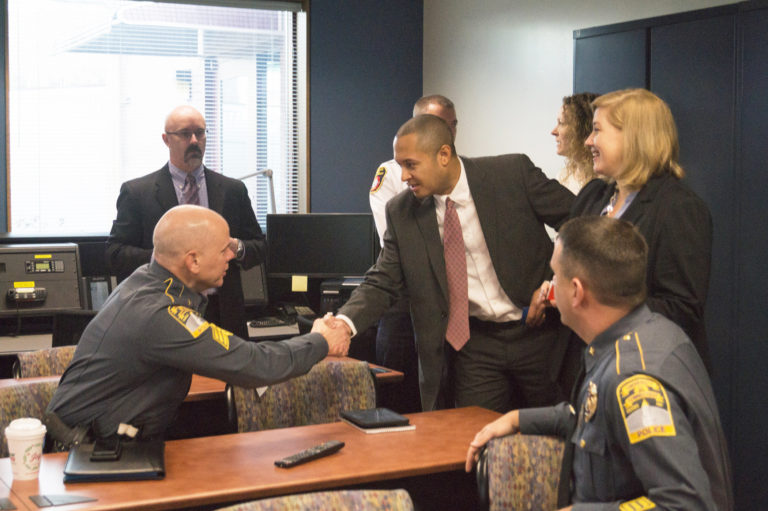
Electrical Engineering Alum Robert Hotaling ’01 meets with members of the UConn Police. (UConn Foundation Photo)

the human voice. The on board processing algorithm uses fuzzy logic to look for the acoustics of a gunshot or an explosion,” Hotaling said.

Hotaling stressed that there won’t be an invasion of privacy with the system.

“There are no privacy concerns here, all it’s doing is looking for the gunshot,” he said.

UConn has not had a problem with shooters, but recognized that the donation could enhance campus security.

“We’re using it to be very proactive,” says Hans Rhynhart, UConn’s interim director of public safety and chief of police. “This is a great opportunity to test a brand new system that has the potential to be really useful to our community.”

The system can notify officers in a variety of ways, including text messages, iPad notifications and text to speech automated phone calls- which officers are trained to look for.

“The officers get the notification, then click on the cameras in the zone and can get a live feed of what’s going on there,” he said.

The system is also capable of sending alerts to students, faculty and UConn employees with the same sort of fast turnaround.

Hotaling said that he’s excited by the chance to give back to UConn.

“I walked those halls,” He said. “I love UConn, I loved my time there, and I’m so happy to be a part of this process.”

Black Hats, Cyber Bots, Zombies, And You

The UConn Comcast Center of Excellence for Security Innovation houses researchers working to combat malicious hackers (Istockphoto).

By Colin Poitras, UConn Communications
This story originally appeared in UConn Magazine.

Cyberattacks come in all shapes and sizes. Experts say it could be only a matter of time before they pose a real threat to our daily lives. The electronic devices in our world today are interconnected like never before. Our cars are no longer machines but rolling PCs with different components constantly talking to one another. Our watches are telephones. Our telephones are high-speed computers. And with all this increased convenience comes greater vulnerability. In the constant rush to get new products to market, security can be an afterthought.

chandyFortunately, a crack team of cybersecurity specialists, led by John Chandy, an electrical and computer engineering professor, and Laurent Michel, an associate professor of computer science and engineering, is working to protect our information. UConn’s Comcast Center of Excellence for Security Innovation is advancing research to strengthen the nation’s electronic information networks and training a new generation of hardware, software, and network security engineers to protect the integrity of everything from small consumer electronics to the complex computer systems running our major industrial, financial, and transportation systems.

Secured behind passcode-protected entry doors, the Comcast lab is embedded deep inside one of UConn’s main academic buildings. Getting there can be an adventure.

If you visit the lab via the building’s main door, you must go down a set of stairs, along a long hallway to the rear of the building, then it’s a quick left, quick right, another left, up a ramp, through some fire doors, past the locked doors of several large humming mechanical rooms, another right, another left, yet another right, and finally a quick left and you are there. Or you might be. It’s hard to be sure because there is absolutely no indication of where the lab is on any of the directional office signs. Even next to the lab’s main door there is only a small 9- by 6-inch plaque in letters slightly larger than what you are reading here.

FBI Alert Number I-031716-PSA: Motor Vehicles are Increasingly Vulnerable to Remote Exploits
“researchers could gain significant control over vehicle functions remotely by exploiting wireless communications vulnerabilities”

WHITE HAT HACKERS

Talk to Michel or Chandy for a few minutes and you begin to get a sense of what life is like in their world of electronic espionage. And if you leave feeling a little paranoid, well, that’s to be expected.

Michel will tell you that the world is filled with hackers and malicious machines

known as zombies, or computer bots, which hackers have seized via remote control and without their owners’ knowledge or permission. Those machines are constantly scouring the Internet trying to steal information from your, my, and everyone else’s computers. From the moment you open your laptop and connect to the Internet, your computer is likely getting assaulted by malicious attacks, Michel says. If your computer’s security is good and you keep current with all the latest security updates, chances are you’re successfully fending off most of them… for now. But hackers are a relentless and mischievous bunch. All it takes is one click on a bogus email, one click on an infected website, and the black hat hackers are in.

The good news is that amid the piles of green motherboards, electrical wiring, testing equipment, and computer consoles, Chandy, Michel, and a team of about a half-dozen very talented graduate and undergraduate students are playing the role of said hackers. Here, however, they are the good guys. Michel likes to describe the team as “ethical hackers,” white hats probing ever deeper into Comcast’s hardware and computing systems to expose potential vulnerabilities.

The battle between the white hats and the black hats is constant. Cybersecurity is an ever-shifting landscape as new technologies, system updates, viruses, worms, and attack strategies emerge on the Internet.

“John and I are constantly on the lookout for what’s happening,” says Michel. “What are the new vulnerabilities? What are the latest attacks? To do this properly, you have to be like a surfer. You have to be on top of the wave, not behind it. You have to keep moving and always stay a little bit ahead.”

If the lab is successful at breaking into a system, that’s a good thing. Exposing a vulnerability in the lab gives vendors the opportunity to correct a problem before a product goes to market or to fix a problem if the product is already in circulation.

If the research team fails to get into a system, well, that’s okay too. That means the system’s designers are on top of their game and did a great job protecting the system’s integrity and locking it tight.

Since it opened, Chandy says the lab has made significant discoveries that helped vendors and saved consumers considerable headache. But because of the often secretive nature of the lab’s work and its basis in security, the limelight of commercial success doesn’t always extend to the lab’s cubicles and workbenches.

When students find a potential vulnerability in a system, the lab immediately notifies the vendor or system provider so the weakness can be addressed. A lot of times, news of the discovery stops there. Chandy recounts a time when he and other lab members heard of a significant system vulnerability being discussed at a national cybersecurity conference. It sounded familiar. Chandy turned to his colleagues and whispered, “Didn’t we find that months ago?” Such is the nature of the business.

“The lab we have here is pretty unique for a university,” says Chandy. “A lot of times, the way we get into these systems is not necessarily through back doors. I would call them testing and debugging phases,” Chandy says. “One of the things a vendor wants to do when they release these systems is they want to test it. So they leave the interfaces open so we can do just that.”


FBI Alert Number I-091015-PSA: Internet of Things poses opportunities for cyber crime
“devices with default passwords or open Wi-Fi connections are an easy target for cyber actors to exploit”


THE INTERNET OF THINGS

Some of the latest technology on the market involves what Chandy calls the Internet of Things. People used to have a personal computer that did one job. A watch that did another. A telephone that had its uses and a TV or thermostat with separate functions. Now, with the Internet of Things, all of those devices are capable of interacting and talking to one another. You can turn up your home thermostat from work using your smart phone. You can check your email on your watch and pay your bills through your TV.

But with all that convenience and interconnectivity comes increased vulnerability. Keeping your information safe on all those different platforms is this team’s task.

“We’re mainly looking at things from a hardware level, those devices that are going out in the field and whether they are properly protected. We try to come up with scenarios that make sense from an attacker’s perspective,” says Chandy. “We take on the role of the hacker because if we can do it, that means a hacker can do it, too.”

As an academic lab, the Comcast Center is also a place of learning. The testing that is done here is not a matter of repetitive trial-and-error assaults, but a more deliberative, targeted, scientific process.

“Think of it like a game of Clue,” says Michel. “It’s not like we try something just to find out if it works or not. As we attempt an attack, we gather evidence along the way. That evidence may betray something about the platform, the device, the software that we are trying to test. Once we have that information, we regroup and discuss what we have learned and its implications, and then we try to develop more experiments and high-end scenarios so we can learn more. So it’s not like we have this dictionary of twenty different attacks and we try them all sequentially. It’s a much more principled approach.”

The students working in the lab operate in silence. A young woman types away intently on her keyboard. A bearded student in a New York Giants T-shirt sighs heavily, steps away from his computer for a brief break, then returns. Focused. Once again engrossed with the task before him at his work station. Two sage green walls in the rear of the lab are covered with black ink diagrams and hastily scrawled text.

An eviscerated teddy bear sits on a desktop.

“Stress relief, John?” a visitor asks, pointing to the multicolored wires ripped out of the bear’s abdomen.

“Side project,” Chandy answers with a sly grin. Then he explains that even a children’s toy as innocuous as a teddy bear can be a personal security threat. In this case, the interactive bear has a small computer inside that Chandy’s lab found lacked authentication protection. It could be hacked, potentially exposing the owner’s and other bear owners’ personal information with a few strokes of cyber sleight-of-hand.

“The students here are developing skills that none of them had a year ago,” says Chandy. “The skills they are developing would make them great hackers. But it is also making them great engineers.”


Lisa wasn’t looking forward to the confrontation. Her aging mother, bedridden with different ailments and dependent on care, was really angry this time. For months she had suspected Sarah, her live-in nurse, was stealing her money. And now, the latest bank statement confirmed it. On top of it all, Sarah always seemed to be on her iPad when her mother needed her. The chest pains were back. The small automatic defibrillator under her mother’s skin activated twice in the past two months. The stress wasn’t good.

Lisa enters the house. She eyes Sarah, who is standing, her back to her, at the kitchen counter – again, on her computer. Lisa walks into her mother’s room, careful to speak softly so their conversation won’t be overheard. Within a few minutes, Lisa notices her mother’s color start to change. She seems to have trouble breathing. Sweat builds on her upper lip. She tells Lisa she feels strange, like her heart is racing out of control. The device in her chest keeps vibrating, sending sharp shocks into her heart muscles. The shocks are getting stronger. Her mother cries out in pain. Lisa calls frantically for Sarah. No response. Her mother goes limp.

Back in the kitchen, Sarah quietly shuts down her iPad and walks toward the bedroom.


CSI CYBER — UCONN

More than 20 faculty members and more than 100 graduate students in the schools of Engineering and Business are conducting research through the Connecticut Cybersecurity Center at UConn. They are examining cryptography and cryptanalysis; data security and privacy; information fusion and data mining for Homeland Security; and trustable computing systems.

The academic research building that houses the Comcast Center of Excellence for Security Innovation houses two other major cyber- security labs. The Center for Hardware Assurance, Security, and Engineering (CHASE) contains some of the most advanced equipment available to conduct security analysis on nanoelectronics. Its research focuses on counterfeit device detection and preserving the integrity of silicon microchips, the very cornerstones of the worldwide computer industry. The building also is home to the Center for Voting Technology Research (VoTeR Center), which investigates new technologies to ensure the integrity of the electronic voting process.