Archives

Javidi Wins Prestigious Award from The Optical Society

The UConn School of Engineering is pleased to announce that Dr. Bahram Javidi, Board of Trustees Distinguished Professor in Electrical and Computer Engineering, has been awarded the prestigious Joseph Fraunhofer Award / Robert M. Burley Prize from The Optical Society.

The award, given to one person in the country every year, was bestowed upon Javidi for his “seminal contributions to passive and active multi-dimensional imaging from nano- to micro- and macro-scales,” according to the award citation.

The award is one of a long line of accomplishments during his career, which include: Being named one of the top 160 engineers between the ages of 30-45 by the National Academy of Engineering (NAE); the Quantum Electronics and Optics Prize for Applied Aspects by the European Physical Society; the Dennis Gabor Award in Diffractive Wave Technologies from The International Society for Optics and Photonics (SPIE); the John Simon Guggenheim Foundation Fellowship; the Alexander von Humboldt Prize for senior US Scientists in all disciplines; the SPIE Technology Achievement Award; the National Science Foundation Presidential Young Investigator Award; and the George Washington University Distinguished Alumni Scholar Award.

At UConn, he has received the American Association for University Professors (AAUP) Research Excellence Award; the University of Connecticut Board Of Trustees Distinguished Professor Award; the UConn Alumni Association Excellence in Research Award; and the Chancellor’s Research Excellence Award, among others.

He is a Fellow of the Institute of Electrical and Electronics Engineers (IEEE), Fellow of the American Institute for Medical and Biological Engineering (AIMBE), Fellow of the Optical Society of America (OSA), Fellow of the European Optical Society (EOS), Fellow of The International Society for Optics and Photonics (SPIE), Fellow of the Institute of Physics (IoP), and Fellow of The Society for Imaging Science and Technology (IS&T). Javidi has over 900 publications and 19 patents, some of which have been licensed by industry.

Javidi is also the director of the MOSIS Lab (Multidimensional Optical Sensing and Imaging Systems), which is focused on advancing the science and technology of imaging, by centering on the fields of optics, photonics, and computational algorithms and systems, from nano to macro scales. MOSIS works with, and finds solutions for, partners in the defense, manufacturing, healthcare, and cybersecurity industries.

Click here to learn more about the Joseph Fraunhofer Award / Robert M. Burley Prize from The Optical Society.

Remembering Dr. John Enderle, The Educator and The Nurturer


Dr. John Enderle and his wife, Laurie Enderle. (photo courtesy of Laurie Enderle)

Originally by: Heidi Douglas, Director of Alumni Relations, UConn School of Engineering 

Professor Emeritus John D. Enderle, 65, of Ashford, CT passed away on April 2, 2018 after a long and courageous battle with pancreatic cancer.  A loving husband, father, brother, friend, colleague and mentor, Dr. Enderle enjoyed a long and illustrious career as a professor and inspirational leader, admired for his unfailing dedication and support for students, a legacy honored by his family establishing the John Enderle Fund memorial scholarship.

UConn Electrical and Computer Engineering department head from 1995-1997, John was founding director of the undergraduate Biomedical Engineering program in 1997. His passion for research and advising his students are storied with commendations describing him as “the greatest professor,” having a “major influence in my life over the past 20 years,” and “always had patience to help me pursue my goals.”

John earned his B.S., M.E., and Ph.D. degrees in Biomedical Engineering, and an M.E. degree in Electrical Engineering from Rensselaer Polytechnic Institute. He worked at the National Science Foundation (NSF) and was as a professor at North Dakota State University (NDSU) prior to joining UConn.

In addition to his teaching and research, John also served in many capacities for several professional societies, was a member of the Connecticut Academy of Science and Engineering, a former Accreditation Board for Engineering and Technology (ABET) Program Evaluator for Bioengineering Programs and member of the Engineering Accreditation Commission. He was Editor of the NSF Book Series on NSF Engineering Senior Design Projects to Aid Persons with Disabilities. At the time of his death, John was working on a fourth edition of his seminal undergraduate textbook for biomedical engineering, Introduction to Biomedical Engineering.

A particularly metaphorical tribute to John celebrates his passion for gardening. A painting by former student Dr. G. Alexander Korentis depicts an espalier apple tree with John’s name followed by all his Ph.D. students’ names in an upward succession of branches. The frame bears a plaque with a quote from Warren Buffett, “Someone is sitting in the shade today because someone planted a tree a long time ago.”

John Enderle planted a tree for all of his students.

 Donations may be made in memory of John Enderle to the “John Enderle Fund” in the UConn School of Engineering. Please make checks payable to: The UConn Foundation, Inc. and forward to the following address: 2390 Alumni Drive Unit 3206, Storrs, Connecticut 06269.

ECE Seminar Series: Technology Overview at United Technology Research Center(UTRC): Power Electronics and Systems

ECE title

ECE-C2E2 Joint Seminar Spring 2018

April 10, 11am-12noon, ITE 401

Technology Overview at United Technology Research Center(UTRC): Power Electronics and Systems

Suman Dwari and Zak Sorchini

United Technology Research Center

Abstract: United Technologies Research Center (UTRC) is the innovation engine of United Technologies (UTC) and all of its business units, UTC Aerospace, Pratt and Whitney, Otis and UTC Climate Control and Security. These business units recognize UTRC as defining what’s next, and ready to solve the toughest problems. Part of that engine is collaborating with a network of partners to move the world forward. These include not only UTC’s business units, but government agencies, national laboratories, universities, commercial and aerospace companies and private organizations. In this talk, at first the overview of UTRC will be presented which will be followed by discussions on current research activities and projects in Systems and Power Electronics areas. 

Short bio: Dr. Suman Dwari received Ph.D. degree from Rensselaer Polytechnic Institute, NY, in Electrical Engineering. At present, he is a Staff Research Scientist with United Technology Research Center, Hartford, USA. He has been PI or Co-PI of many government research projects for DoD, ESTCP, DOE, DARPA and contributed in the areas of distributed power systems, sustainable energy resources, high performance power electronics systems and control techniques. He has also researched on various commercial applications in the area of very high density power electronics converters using advanced materials and devices. He is author of over 30 publications and has several US patents. His current research interests include: high performance power converters, wireless power transfer, advanced machines, and advanced control of PE systems.

Dr. Zak Sorchini received M.S. and Ph.D. degrees in electrical engineering from the University of Illinois at Urbana-Champaign. He has more than 10 years of power electronics and electric machine industry experience acquired under various roles of increasing responsibility at Delphi Automotive, Caterpillar, GE Aviation and United Technologies Aerospace Systems. Since 2017 he has been with the United Technologies corporate research center as group leader for Power Electronics Systems. Mr. Sorchini holds one U.S. patent.

Designing a Smart Sensor Network for Tracking Submarines

Illustration of network concept. A UConn researcher at the National Institute for Undersea Vehicle Technology is developing a ‘smart sensor network’ that is both energy-efficient and resilient, to track targets such as enemy submarines. (Getty Images)


A team of UConn engineers is developing an energy-efficient “smart sensor network” to track targets of interest, such as the proximity of enemy submarines or ships to Navy vessels.

The U.S. Navy currently uses underwater Intelligence, Surveillance, & Reconnaissance (ISR) sensor networks that run on full power, which can be a problem for long-term operations. The more accurate the sensor, the more power they consume.

The sensor networks currently being used could consist of several multi-modal sensor nodes, called sensor buoys, where each node acts independently and contains a diverse sensor suite, a data-processing unit, a transmitter and receiver, and a GPS device. The sensor suite can be composed of different types of sensors to detect and track targets, such as underwater microphones and active sonars.

Traditionally, these sensor nodes operate on full power, running all devices simultaneously, but the batteries that power them typically burn out within a few days of operation,  just as cell phones suck up more power when running multiple operations. This causes sensing failures which, in turn, leads to holes in coverage and affects tracking performance.

This poses a challenge to the Navy, since it deploys thousands of acoustic sensor networks throughout the ocean, where battery replacement can be time-consuming or impossible.

To address the challenge, Shalabh Gupta, a UConn engineer and researcher at the National Institute for Undersea Vehicle Technology, devised the concept of a “smart sensor network” that is energy-efficient as well as resilient to failures.

 Intelligent Energy-efficient Sensor Network. (Illustration by Hayley Joyal ’18 (SFA))

In a smart sensor network, sensor nodes adapt their sensing modalities based on the information about the targets’ whereabouts. Thus, the nodes around the target, such as a ship or submarine, activate their high-power sensing devices to track the target accurately, pinpointing its location, velocity, and trajectory.

On the other hand, the nodes that are located farther away from the target cycle between low-power sensing and sleep states to minimize energy consumption while still remaining aware.

Thus, if a low-power sensor detects a target, the node switches to high-power sensing to track it. Similarly, the high-power sensing devices that are tracking the target predict the target’s trajectory and alert other sensors within range of the target’s path, so that they switch to high power. Once the target has passed outside of a sensor’s range, it reverts to low-power mode.

The smart sensor networks also provide resilience. If a few nodes in the network fail, then the nodes surrounding the hole in coverage formed by the failed nodes jointly optimize to expand their sensing ranges to cover the gap.

“These networks have to contain built-in, distributed intelligence,” says Gupta, an assistant professor of electrical and computer engineering.

His first research paper on the algorithm, coauthored by graduate student James Hare, was published online in IEEE Transactions on Cybernetics in August 2017.

With this advance, crews on ships and submarines will be able to track enemy watercraft with batteries that last about 60 to 90 percent longer, Gupta says.

Gupta’s lab has prototypes of the sensors for ground use, and has been talking with Navy personnel about using them for the underwater acoustic sensor network.  He is currently seeking funding to build underwater sensors.

How UConn Researchers are Teaching Robots to Think Like Humans

There’s a great scene in the movie “Iron Man” where Robert Downey Jr.’s character Tony Stark (aka Iron Man) is crawling across his lab, desperately trying to reach the small arc reactor he needs to keep his heart beating and stay alive.

Weakened by a run-in with arch villain Obadiah Stane, Stark can’t reach the gizmo where it sits on a tabletop. Defeated, he rolls onto his back, exhausted and pondering his inevitable doom.

But the very moment that we think our intrepid hero’s a goner, a metallic hand appears at Stark’s shoulder, holding the lifesaving device. “Good boy,” Stark says weakly as he takes the device from his robot assistant, Dum-E.

And just like that, our hero is saved.

From the dutiful shuffling of C-3PO to the terrorizing menace of The Terminator, Hollywood has made millions tantalizing audiences with far-out robot technology. Scenes like the one in “Iron Man” make for good entertainment, but they also are based, to some degree, in reality.

Dum-E’s interaction with Stark is called collaborative robotics, where robots with advanced artificial intelligence, or A.I., not only work alongside us humans but also are able to anticipate our actions and even grasp what we need.

Collaborative robotics represents the frontier of robotics and A.I. research today. And it’s happening at UConn.

Three thousand miles away from the klieg lights of Hollywood, Ashwin Dani, director of UConn’s Robotics and Controls Lab, or RCL, stands in the stark fluorescent light of his Storrs office staring at a whiteboard covered in hastily scrawled diagrams and mathematical equations.

Here, in the seemingly unintelligible mishmash of numbers and figures, are the underlying mathematical processes that are the lifeblood of collaborative robotics.

If robots are going to interact safely and appropriately with humans in homes and factories across the country, they need to learn how to adapt to the constantly changing world around them, says Dani, a member of UConn’s electrical and computer engineering faculty.

“We’re trying to move toward human intelligence. We’re still far from where we want to be, but we’re definitely making robots smarter,” he explains.

All of the subconscious observations and moves we humans take for granted when we interact with others and travel through the world have to be taught to a robotic machine.

When you think about it, simply getting a robot to pick up a cup of water (without crushing it) and move it to another location (without spilling its contents or knocking things over) is an extraordinarily complex task. It requires visual acuity, a knowledge of physics, fine motor skills, and a basic understanding of what a cup looks like and how it is used.

“We’re teaching robots concepts about very specific situations,” says Harish Ravichandar, the senior Ph.D. student in Dani’s lab and a specialist in human-robot collaboration. “Say you’re teaching a robot to move a cup. Moving it once is easy. But what if the cup is shifted, say, 12 inches to the left? If you ask the robot to pick up the cup and the robot simply repeats its initial movement, the cup is no longer there.”

Repetitive programs that work so well for assembly-line robots are old school. A collaborative robot has to be able to constantly process new information coming in through its sensors and quickly determine what it needs to do to safely and efficiently complete a task. If that robot is part of an assembly line, the line has to shut down and the robot has to be reprogrammed to account for the change, an inefficient process that costs manufacturers money. Hence the thinking robot this team is trying to create.

While the internet is filled with mesmerizing videos of robots doing backflips, jumping over obstacles, and even making paper airplanes, the UConn team’s effort at controlling robots through advanced artificial intelligence is far less flashy but potentially far more important.

Every move the UConn team wants its test robot to make starts here, says Dani, with control theory, engineering, whiteboards, and math.

“We’re writing algorithms and applying different aspects of control theory to take robot intelligence to a higher level,” says Ravichandar. “Rather than programming the robot to make one single movement, we are teaching the robot that it has an objective — reaching for and grabbing the cup. If we succeed, the robot should be able to make whatever movements are necessary to complete that task no matter where the cup is. When it can do that, now the robot has learned the task of picking something up and moving it somewhere else. That’s a very big step.”

While most of us are familiar with the robots of science fiction, actual robots have existed for centuries. Leonardo da Vinci wowed friends at a Milan pageant in 1495 when he unveiled a robotic knight that could sit, stand, lift its visor, and move its arms. It was a marvel of advanced engineering, using an elaborate pulley and cable system and a controller in its chest to manipulate and power its movements.

But it wasn’t until Connecticut’s own Joseph Engelberger introduced the first industrial robotic arm, the 2,700-pound Unimate #001, in 1961 that robots became a staple in modern manufacturing.

Unimates were first called into service in the automobile industry, and today, automobile manufacturers like BMW continue to be progressive leaders using robots on the factory floor. At a BMW plant in Spartanburg, South Carolina, for example, collaborative robots help glue down insulation and water barriers on vehicle doors while their human counterparts hold the material in place.

The advent of high-end sensors, better microprocessors, and cheaper and easily programmable industrial robots is transforming industry today, with many mid-size and smaller companies considering automation and the use of collaborative robots.

Worldwide use of industrial robots is expected to increase from about 1.8 million units at the end of 2016 to 3 million units by 2020, according to the International Federation of Robotics. China, South Korea, and Japan use the most industrial robots, followed by the United States and Germany.

Anticipating further growth in industrial robotics, the Obama administration created the national Advanced Robotics Manufacturing Institute, bringing together the resources of private industry, academia, and government to spark innovations and new technologies in the fields of robotics and artificial intelligence. UConn’s Robotics and Controls Lab is a member of that initiative, along with the United Technologies Research Center, UTC Aerospace Systems, and ABB US Corporate Research in Connecticut.

Manufacturers see real value in integrating collaborative robots into their production lines. The biggest concern, clearly, is safety.

There have been 39 incidents of robot-related injuries or deaths in the U.S. since 1984, according to the federal Occupational Safety and Health Administration. To be fair, none of those incidents involved collaborative robots and all of them were later attributed to human error or engineering issues.

The first human known to have been killed by a robot was Robert Williams in 1979. Williams died when he got tired of waiting for a part and climbed into a robot’s work zone in a storage area in a Ford Motor plant in Flat Rock, Michigan. He was struck on the head by the robot’s arm and died instantly. The most recent incident happened in January 2017, when an employee at a California plastics plant entered a robot’s workspace to tighten a loose hose and had his sternum fractured when the robot’s arm suddenly swung into action.

“When you have a human and a robot trying to do a joint task, the first thing you need to think about of course is safety,” says Dani. “In our lab, we use sensors that, along with our algorithms, not only allow the robot to figure out where the human is but also allow it to predict where the human might be a few seconds later.”

One way to do that is to teach robots the same assembly steps taught to their human counterparts. If the robot knows the order of the assembly process, it can anticipate its human partners’ next moves, thereby reducing the possibility of an incident, Dani says. Knowing the process would also allow robots to help humans assemble things more quickly if they can anticipate an upcoming step and prepare a part for assembly, thus improving factory efficiency.

“Humans are constantly observing and predicting each other’s movements. We do it subconsciously,” says Ravichandar. “The idea is to have robots do the same thing. If the robot sees its human partner performing one step in an assembly process, it will automatically move on to prepare for the next step.”

Which brings us back to the whiteboards. And the math.

Failure is always an option. But when the math finally works, Ravichandar says, the success is exhilarating.

“Once you have the math figured out, it’s the best feeling because you know what you want the robot to do is going to work,” Ravichandar says with an excited smile.

“Implementing it is a whole other challenge,” he adds quickly, his passion for his work undiminished. “Things never work the first time. You have to constantly debug the code. But when you finally see the robot move, it is great because you know you have translated this abstract mathematical model into reality and actually made a machine move. It doesn’t get any better than that.”

With an eye on developing collaborative robotics that will assist with manufacturing, Dani and his team spent part of the past year teaching their lab’s test robot to identify tools laid out on a table so it can differentiate between a screwdriver, for example, and a crescent wrench, even when the tools’ initial positions are rearranged. Ultimately, they hope to craft algorithms that will help the robot work closely with a human counterpart on basic assembly tasks.

Another member of the team, Ph.D. candidate Gang Yao, is developing programs that help a robot track objects it sees with its visual sensors. Again, things we humans take for granted, such as being able to tell the difference between a bird and a drone flying above the trees, a robot has to learn.

Building advanced artificial intelligence doesn’t happen overnight. Ravichandar has been working on his projects for more than three years. It is, as they say, a process. Yet the team has learned to appreciate even the smallest of advances, and late last year, he flew to California to present some of the lab’s work to an interested team at Google.

“C-3PO is a protocol droid with general artificial intelligence,” says Ravichandar. “What we are working on is known as narrow artificial intelligence. We are developing skills for the robot one task at a time and designing algorithms that guarantee that whatever obstacles or challenges the robot encounters, it will always try to figure out a safe way to complete its given task as efficiently as it can. With generalized intelligence, a robot brings many levels of specific intelligence together and can access those skills quickly on demand. We’re not at that point yet. But we are at a point where we can teach a robot a lot of small things.”

Inevitably, as robots gain more and more human characteristics, people tend to start worrying about how much influence robots may have on our future.

Robots certainly aren’t going away. Saudi Arabia recently granted a robot named Sophia citizenship. Tesla’s Elon Musk and Deep Mind’s Mustafa Suleyman are currently leading a group of scientists calling for a ban on autonomous weapons, out of concern for the eventual development of robots designed primarily to kill.

Although it doesn’t apply directly to their current research, Dani and Ravichandar say they are well aware of the ethical concerns surrounding robots with advanced artificial intelligence.

Ravichandar says the problem is known in the field as “value alignment,” where developers try to make sure the robot’s core values are aligned with those of humans. One way of doing that, Ravichandar says, is to create a safety mechanism, such as making sure the robot always understands that the best solution it can come up with for a problem might not always be the best answer.

“The time is coming when we will need to have consensus on how to regulate this,” says Ravichandar. “Like any technology, you need to have regulations. But I think it’s absolutely visionary to inject humility into robots, and that’s happening now.”

That’s good news for the rest of us, because killer robots certainly are not the droids we’re looking for.


originally written by Colin Poitras

Zhang and His Students Look To Advance Power Systems Into The Future

Peng with the members of his Power and Energy Systems Lab. (UConn Photo/Christopher Larosa)

Over 350 million people in the United States depend on the reliability and consistency of the 450,000 miles of high-voltage lines that form the U.S. power grid to do important daily tasks. With stronger weather events and an increasing number of cyber-attacks, reliable safeguards and technologies are needed to protect this very important utility. The Power and Energy Systems Laboratory, run by Dr. Peng Zhang, F.L. Castleman Associate Professor of Electrical and Computer Engineering and his graduate students, aims at tackling these important issues.

The lab, which focuses on smart grid technology, microgrids, and sustainable energy, has worked on several crucial projects over the past several years, including a dedicated approach to networking the grid system, determining risk assessment models for unintentional islanding of power generators, using ocean waves to generate a sustainable power source, and many other related areas of research.

The lab’s most recent research, which focuses on national infrastructure, is looking to enhance the connectedness of the fractured U.S. grid system:  

“The goal of our research is to make our nation’s energy infrastructure resilient, reliable, secure, and sustainable,” Zhang said. “One of our main areas of focus now is large systems power stability, which is important, because there are no tools available to really assess and predict the status of the system. This tool is highly needed, especially for connected systems.”

That tool, which is being developed from a $1.05 million Department of Energy grant, is being worked on by Zhang and Ph.D. student Yan Li. The idea for the grant was inspired by the learnings Zhang and his students gathered from studying the tools used by local utility company, Eversource Energy:

“The whole U.S. and Canadian grid are connected together, and it’s a huge system, so it’s  therefore very difficult to monitor, assess and control its stability ,” Zhang said. “If you look at Connecticut, companies like Eversource, for the most part, use off-line tools which run many scenarios and only look at snapshots of the system, but that kind of work is not great for analysis, it needs to be monitored and assessed in real-time.”

In particular, Li and Zhang will be forming a formal theory with mathematical rigor, which will be established for computing the bounds of all possible trajectories and estimating the stability margin for the entire system, including the integrated transmission and distribution network.

Furthermore, a new open-source tool via reachable set computations will be developed for real-time dynamic analysis and stability margin calculations. It will be applicable for not only forecasting and monitoring grid performance, but also formally verifying various resiliency enhancement strategies, such as new schemes for system integrity protection and automation to adapt to this evolution of electric networks. 

Zhang and his students are also making significant contributions to knowledge advancement in the state of Connecticut and the region, with their work at the Eversource Energy Center at UConn, which conducts research related to advancing energy technology, as well as performs significant consulting work with Eversource Energy.

Zhang and his students have specifically performed work on research related to unintentional islanding, which is a phenomenon in which a distributed generator continues to be electrified and running, even when the electrical grid surrounding it is no longer active. Traditional methods of detection can often be fooled to think that grid conditions are normal, especially when multiple power generation devices are connected to the same line. 

(UConn Photo/Christopher Larosa)

This kind of scenario is very dangerous to field workers, as the lack of knowledge could cause them to be electrocuted. Zhang said that the research that’s currently being done by himself and his team addresses the creation a risk assessment model to safely avoid danger:

“This kind of research is using machine learning to predict risk in the non-detection zone,” Zhang said. “By non-detection we mean that when an island occurs, there are certain scenarios where the utility company, but with this new risk assessment model, we’ll be able to accurately predict when this scenario is likely to occur.”

Most importantly though, Zhang is happy that the graduate students that he is mentoring, and providing hands-on opportunities to, are getting the necessary experience needed to launch their careers in research and academia.

Ph.D. student Taofeek Orekan, one of the members of the lab, is one of the students that will be using that experience, as he looks for post-grad opportunities in the next few months:

“This is a great lab to start off in,” Orekan said. “I know that any lab that I launch during my career in academia will absolutely be an extension of this lab.”

For more information on the lab, visit http://power.engr.uconn.edu. 

Remembering Charles Knapp, an Engineering Icon

Professor Emeritus Charles Harris Knapp, 86, passed away at

Robert (left) and Charles ’53, ’62 Knapp. (Photo courtesy of The UConn Foundation)

home on Thanksgiving Day

surrounded by his family and loving wife of 62 years, Charleen Gaudet Knapp. Over the course of his 40-year career at UConn, Dr. Knapp enriched and shaped the

lives of innumerable students and inspired an imperishable legacy, The Charles H. Knapp Associate Professorship in Electrical Engineering.

Charlie (or “Red” or “Harris,” as he was variously known) was so eminent in his field, that a handwritten note recommending a student to a graduate program at another well-regarded university signed only “Charlie” was sufficient; no letterhead needed. Colleagues and former students remembering Charlie reiterate his traits as an educator, mentor, and researcher calling him “a true gentleman,” showing people “how to treat others,” “the best teacher,” and never seeing “him lose his cool.”

A lifelong Yankees fan, Charlie was born in New York City, but moved with his family to Coventry, CT at an early age. As an Electrical Engineering undergraduate at UConn, he was the first University Scholar from the School of Engineering and member of Tau Beta Phi, Eta Kappa Nu, and Sigma Xi engineering honor societies. Upon graduation in 1953, Charlie served two years of active duty in the U.S. Air Force before earning his Master’s degree from Yale University and working for RCA and IBM. He returned to UConn in 1958 and became the first candidate awarded a Ph.D. in Electrical Engineering.   

Charlie had many interests outside of academia. He began running in his late 20s, was an avid gardener, active member of the Storrs Congregational Church serving in many capacities including his favorite, singing in the choir for more than 40 years, and spending time with his four children and their families.

In 2012, the Knapp children honored their father with a generous donation establishing The Charles H. Knapp Associate Professorship in Electrical Engineering. Explaining the decision to create an associate professorship, typically given to newer, upcoming faculty, Charlie said, “The younger professors have the freshest education and ideas and are looking for places where they can grow. This professorship will give its holder an edge and will be very helpful in retaining the best associate professors. It is important for the university and the college if we can keep them here, and it’s good for local industry, as well.”

During his lifetime, Professor Knapp enriched the lives of countless students and colleagues, family and friends. Through their lives and his eponymous professorship, his legacy and memory will endure for generations.


Donations in his memory may be made to: The Charles H. Knapp Associate Professorship in Electrical Engineering, c/o The UConn Foundation, 2390 Alumni Drive., Unit 3206, Storrs, CT, 06269-3206

ECE Seminar Series: Quantum Dot Channel FETs and Nonvolatile Memories: Fabrication and Modeling

ECE title

ECE Seminar Series Fall 2017

Wednesday November 15th 2:30pm-3:30 PM, GENT 103

Quantum Dot Channel FETs and Nonvolatile Memories: Fabrication and Modeling

Dr. Jun Kondo

Abstract: This talk presents modeling and fabrication of quantum dot channel field effect transistors (QDC-FETs) using cladded Ge quantum dots on poly-Si thin films grown on silicon-on-insulator (SOI) substrtes. HfAlO2 high-k dielectric layers are used for the gate dielectric. QDC-FETs exhibit multi-state I-V characteristics which enable two-bit processing, and reduce FET count and power dissipation, and are expected to make a significant impact on the digital circuit design. Quntum dot channel FETs are also configured as floating gate quatnum dot nonvolatile memories (QDC-QDNVMs). In NVMs, we use floating gate comprising of GeOx-Ge quantum dots. QD nonvolatile memories (QD-NVMs) are fabricated on polysilicon thin films usingn SOI substrates. HfAlO2 high-k insulator laeyrs are used for both tunnel gate oxide as well as conhtrol gate dielectric. QDC-NVMs provide not only significantly higher ID current flow, but also significantly higher threshold voltage shifts which improve the threshold voltage variation, and show the potential for fabricating multi-bit nonvolatile memories.

Award-winning Paper Questions ECG As Secure Biometric

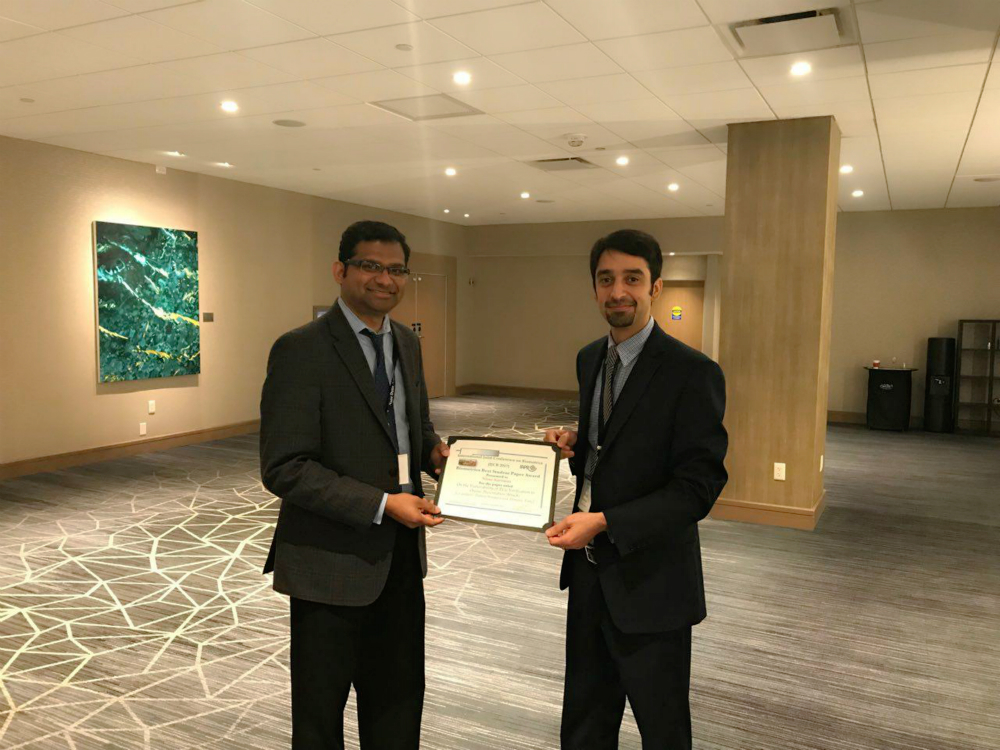
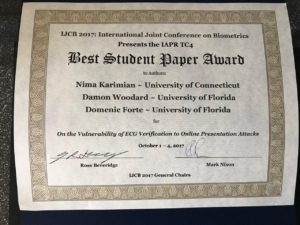
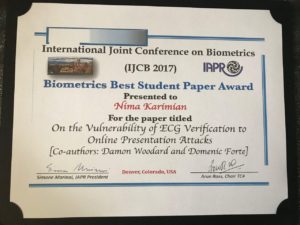
A paper from UConn fourth year PhD student Nima Karimian has won the best student paper award at the recent IJCB 2017 conference in Denver.

The Conference

The International Joint Conference on Biometrics (IJCB 2017) combines two major biometrics research annual conferences, the Biometrics Theory, Applications and Systems (BTAS) conference and the International Conference on Biometrics (ICB). The blending of these two conferences in 2017 is through special agreement between the IEEE Biometrics Council and the IAPR TC-4, and presents an exciting event for the entire worldwide biometrics research community.

The Paper

The paper, “On the Vulnerability of ECG Verification to Online Presentation Attacks,” examined the use of Electrocardiogram (ECG) as a secure biometric modality. ECG has long been regarded as a biometric modality which is impractical to copy, clone, or spoof. However, it was recently shown that an ECG signal can be replayed from arbitrary waveform generators, computer sound cards, or off-the-shelf audio players. The award-winning paper is one of the first in the field to seriously question the security of ECG verification, and goes a long way towards debunking the assumption of its security.

The paper developed a novel presentation attack where a short template of the victim’s ECG is captured by an attacker and used to map the attacker’s ECG into the victim’s, which can then be provided to the sensor using one of the above sources. The authors’ approach involved exploiting ECG models, characterizing the differences between ECG signals, and developing mapping functions that transform any ECG into one that closely matches an authentic user’s ECG. Their proposed approach, which can operate online or on-the-fly, is compared with a more ideal offline scenario where the attacker has more time and resources. In the experiments, the offline approach achieved average success rates of 97.43% and 94.17% for non-fiducial and fiducial based ECG authentication. In the online scenario, the performance is degraded by 5.65% for non-fiducial based authentication, but is nearly unaffected for fiducial authentication.

The work was supported by US Army Research Office (ARO) under award number W911NF16-1-0321.

ECE Seminar Series: Energy Harvesting (EH) Opportunities in 5G

ECE title

ECE Seminar Series Fall 2017

Monday October 16th 11:00am-12:00 PM, ITE 401

Energy Harvesting (EH) Opportunities in 5G

Brian Zahnstecher

PowerRox

Abstract: We have all seen plenty of the marketing hype for what will eventually become 5G in the ~2020 production deployment timeframe. At PowerRox, we have spent the last year trying to shed light on the most critical aspects of the network (from architecture to utilization), which are the paradigm shifts in power electronics and power utilization required to enable 5G. Now, we can investigate further into one of the most interesting, yet highly underappreciated, opportunities in 5G power…energy harvesting (EH). Everyone likes the thought of free, ambient energy, but most think this technology neither produces a usable amount of power nor has a production ecosystem mature enough for a telecom deployment. This talk will not only help to dispel these perceptions, but also help open the eyes of attendees to applications that they might not have otherwise thought were possible and/or applicable to telco applications (with a special focus on 5G).

Energy harvesting (EH) presents a host of interesting and useful applications that can be utilized today as well as provides a roadmap for enhancing/increasing application use cases moving forward. From mW to MW, there are scalable EH technologies to take advantage of nearly every energy source physics affords us (i.e. – kinetic, thermal, RF, photovoltaic, piezoelectric, vibrational, etc.). The major shift from macro towers to heterogeneous networks (HetNets) of many small cells makes 5G an ideal candidate for EH applications. Battery mitigation is a key goal of EH technology initially by supplementing battery power to extend battery life and eventually disposing of them altogether. Even security at many network points from the base station to the grid-level can benefit from EH by achieving grid independence and/or inhibiting undesired network penetration.

This talk will provide attendees with a wealth of knowledge and thought-provoking insight on how EH can be applied to 5G and creative applications beyond. First, we will provide a quick overview of EH sources/technologies, and review the transducers, power management ICs (PMICs)/topologies, energy storage, and test/measurement solutions that make up the production ecosystem. Then, we will deepdive on the implementation of these constituents into practical power electronics solutions and see how we can scale (even μW) to more usable power levels. Finally, we will close with a number of quick case studies on how to apply EH to 5G (and related) applications at all levels of the network from data center to edge. Additionally, we will look at some more unique applications (i.e. – Security) within 5G that EH is a key enabler for.


Short Bio
: Brian Zahnstecher is a Sr. Member of the IEEE, Chair of the IEEE SF Bay Area Power Electronics Society (PELS), and the Principal of PowerRox, where he focuses on power design, integration, system applications, OEM market penetration, and private seminars for power electronics. He has successfully handled assignments in system design/architecting, AC/DC front-end power, EMC/EMI design/debug, embedded solutions, processor power, and digital power solutions for a variety of clients. He previously held positions in power electronics with industry leaders Emerson Network Power, Cisco, and Hewlett-Packard, where he advised on best practices, oversaw product development, managed international teams, created/enhanced optimal workflows and test procedures, and designed and optimized voltage regulators. He has been a regular contributor to the industry as an invited speaker, author, workshop participant, session host, roundtable moderator, and volunteer. He has over 13 years of industry experience and holds Master of Engineering and Bachelor of Science degrees from Worcester Polytechnic Institute.

PowerRox is a firm dedicated to solving power problems for those seeking to establish or enhance their position in the enterprise and consumer power electronics marketplace. We specialize in improving efficiency, increasing reliability, achieving cost reduction through hands-on support and training/seminars/workshops. We can solve problems in power supply design, power system development, system debug and test, cost/performance analysis, marketing, and re-design. We are committed to meeting all deadlines, performing on-budget, debugging/testing solutions to required levels, and doing the highest quality work possible.