Archives

Award-winning Paper Questions ECG As Secure Biometric

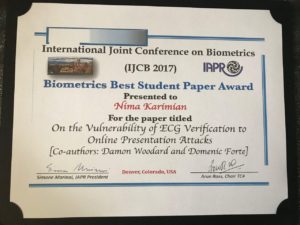
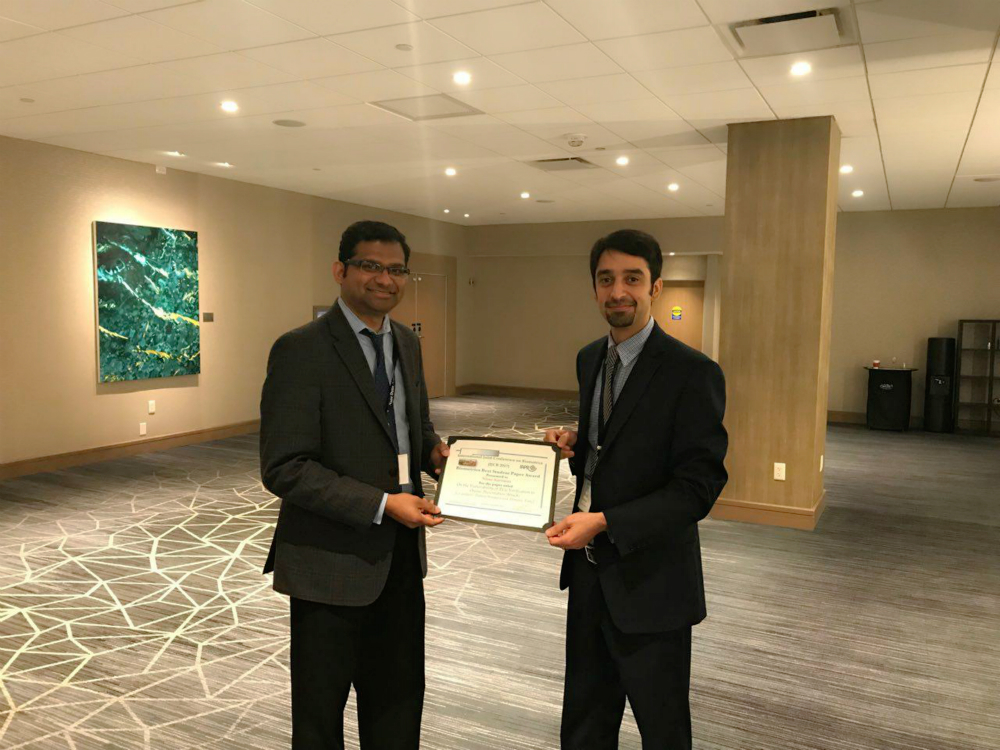
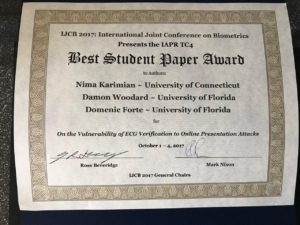
A paper from UConn fourth year PhD student Nima Karimian has won the best student paper award at the recent IJCB 2017 conference in Denver.

The Conference

The International Joint Conference on Biometrics (IJCB 2017) combines two major biometrics research annual conferences, the Biometrics Theory, Applications and Systems (BTAS) conference and the International Conference on Biometrics (ICB). The blending of these two conferences in 2017 is through special agreement between the IEEE Biometrics Council and the IAPR TC-4, and presents an exciting event for the entire worldwide biometrics research community.

The Paper

The paper, “On the Vulnerability of ECG Verification to Online Presentation Attacks,” examined the use of Electrocardiogram (ECG) as a secure biometric modality. ECG has long been regarded as a biometric modality which is impractical to copy, clone, or spoof. However, it was recently shown that an ECG signal can be replayed from arbitrary waveform generators, computer sound cards, or off-the-shelf audio players. The award-winning paper is one of the first in the field to seriously question the security of ECG verification, and goes a long way towards debunking the assumption of its security.

The paper developed a novel presentation attack where a short template of the victim’s ECG is captured by an attacker and used to map the attacker’s ECG into the victim’s, which can then be provided to the sensor using one of the above sources. The authors’ approach involved exploiting ECG models, characterizing the differences between ECG signals, and developing mapping functions that transform any ECG into one that closely matches an authentic user’s ECG. Their proposed approach, which can operate online or on-the-fly, is compared with a more ideal offline scenario where the attacker has more time and resources. In the experiments, the offline approach achieved average success rates of 97.43% and 94.17% for non-fiducial and fiducial based ECG authentication. In the online scenario, the performance is degraded by 5.65% for non-fiducial based authentication, but is nearly unaffected for fiducial authentication.

The work was supported by US Army Research Office (ARO) under award number W911NF16-1-0321.

ECE Seminar Series: Energy Harvesting (EH) Opportunities in 5G

ECE title

ECE Seminar Series Fall 2017

Monday October 16th 11:00am-12:00 PM, ITE 401

Energy Harvesting (EH) Opportunities in 5G

Brian Zahnstecher

PowerRox

Abstract: We have all seen plenty of the marketing hype for what will eventually become 5G in the ~2020 production deployment timeframe. At PowerRox, we have spent the last year trying to shed light on the most critical aspects of the network (from architecture to utilization), which are the paradigm shifts in power electronics and power utilization required to enable 5G. Now, we can investigate further into one of the most interesting, yet highly underappreciated, opportunities in 5G power…energy harvesting (EH). Everyone likes the thought of free, ambient energy, but most think this technology neither produces a usable amount of power nor has a production ecosystem mature enough for a telecom deployment. This talk will not only help to dispel these perceptions, but also help open the eyes of attendees to applications that they might not have otherwise thought were possible and/or applicable to telco applications (with a special focus on 5G).

Energy harvesting (EH) presents a host of interesting and useful applications that can be utilized today as well as provides a roadmap for enhancing/increasing application use cases moving forward. From mW to MW, there are scalable EH technologies to take advantage of nearly every energy source physics affords us (i.e. – kinetic, thermal, RF, photovoltaic, piezoelectric, vibrational, etc.). The major shift from macro towers to heterogeneous networks (HetNets) of many small cells makes 5G an ideal candidate for EH applications. Battery mitigation is a key goal of EH technology initially by supplementing battery power to extend battery life and eventually disposing of them altogether. Even security at many network points from the base station to the grid-level can benefit from EH by achieving grid independence and/or inhibiting undesired network penetration.

This talk will provide attendees with a wealth of knowledge and thought-provoking insight on how EH can be applied to 5G and creative applications beyond. First, we will provide a quick overview of EH sources/technologies, and review the transducers, power management ICs (PMICs)/topologies, energy storage, and test/measurement solutions that make up the production ecosystem. Then, we will deepdive on the implementation of these constituents into practical power electronics solutions and see how we can scale (even μW) to more usable power levels. Finally, we will close with a number of quick case studies on how to apply EH to 5G (and related) applications at all levels of the network from data center to edge. Additionally, we will look at some more unique applications (i.e. – Security) within 5G that EH is a key enabler for.


Short Bio
: Brian Zahnstecher is a Sr. Member of the IEEE, Chair of the IEEE SF Bay Area Power Electronics Society (PELS), and the Principal of PowerRox, where he focuses on power design, integration, system applications, OEM market penetration, and private seminars for power electronics. He has successfully handled assignments in system design/architecting, AC/DC front-end power, EMC/EMI design/debug, embedded solutions, processor power, and digital power solutions for a variety of clients. He previously held positions in power electronics with industry leaders Emerson Network Power, Cisco, and Hewlett-Packard, where he advised on best practices, oversaw product development, managed international teams, created/enhanced optimal workflows and test procedures, and designed and optimized voltage regulators. He has been a regular contributor to the industry as an invited speaker, author, workshop participant, session host, roundtable moderator, and volunteer. He has over 13 years of industry experience and holds Master of Engineering and Bachelor of Science degrees from Worcester Polytechnic Institute.

PowerRox is a firm dedicated to solving power problems for those seeking to establish or enhance their position in the enterprise and consumer power electronics marketplace. We specialize in improving efficiency, increasing reliability, achieving cost reduction through hands-on support and training/seminars/workshops. We can solve problems in power supply design, power system development, system debug and test, cost/performance analysis, marketing, and re-design. We are committed to meeting all deadlines, performing on-budget, debugging/testing solutions to required levels, and doing the highest quality work possible.
ECE Seminar Series: Resiliency and Security of the Future Power Grid

ECE title

ECE Seminar Series Fall 2017

(co-sponsor with Eversource Energy Center)

Monday October 16th 1:00-2:00 PM, LH 201

Resiliency and Security of the Future Power Grid

Chen-Ching Liu

Boeing Distinguished Professor
Director, Energy Systems and Innovation Center (ESIC)
School of Electrical Engineering & Computer Science
Washington State University

Abstract: The development of smart grid in the U.S. over the last decade significantly enhanced data acquisition capabilities on the transmission system. For the distribution network, numerous remote control devices and voltage/var control systems have been installed and millions of smart meters are now operational on the customer side. Although the level of automation has been improved, there are great challenges in the grid’s ability to withstand extreme events such as catastrophic hurricanes and earthquakes. Resiliency of the future grid can be achieved by enabling flexible reconfiguration with distributed resources, e.g., microgrid, distributed generations, as well as renewable and storage devices. Advanced and distributed operation and control will be critical for the vision. Fast increasing connectivity of the devices and systems on the power grid also led to a serious concern over the security of the complex cyber-physical system. Progress has been made in developing new technologies for cyber security of the power grid, including monitoring, vulnerability assessment, intrusion detection, and mitigation


Short Bio
: Chen-Ching Liu is Boeing Distinguished Professor at Washington State University (WSU), Pullman, WA. At WSU, Professor Liu served as Director of the Energy Systems Innovation Center. During 1983-2005, he was a Professor of Electrical Engineering at University of Washington, Seattle. Dr. Liu was Palmer Chair Professor at Iowa State University from 2006 to 2008. From 2008-2011, he served as Acting/Deputy Principal of the College of Engineering, Mathematical and Physical Sciences at University College Dublin, Ireland. Professor Liu received an IEEE Third Millennium Medal in 2000 and the Power and Energy Society Outstanding Power Engineering Educator Award in 2004. In 2013, Dr. Liu received a Doctor Honoris Causa from Polytechnic University of Bucharest, Romania. Chen-Ching chaired the IEEE Power and Energy Society Fellow Committee, Technical Committee on Power System Analysis, Computing and Economics, and Outstanding Power Engineering Educator Award Committee. He served on the U.S. National Academies Board on Global Science and Technology. Professor Liu is a Fellow of the IEEE and Member of the Washington State Academy of Sciences.