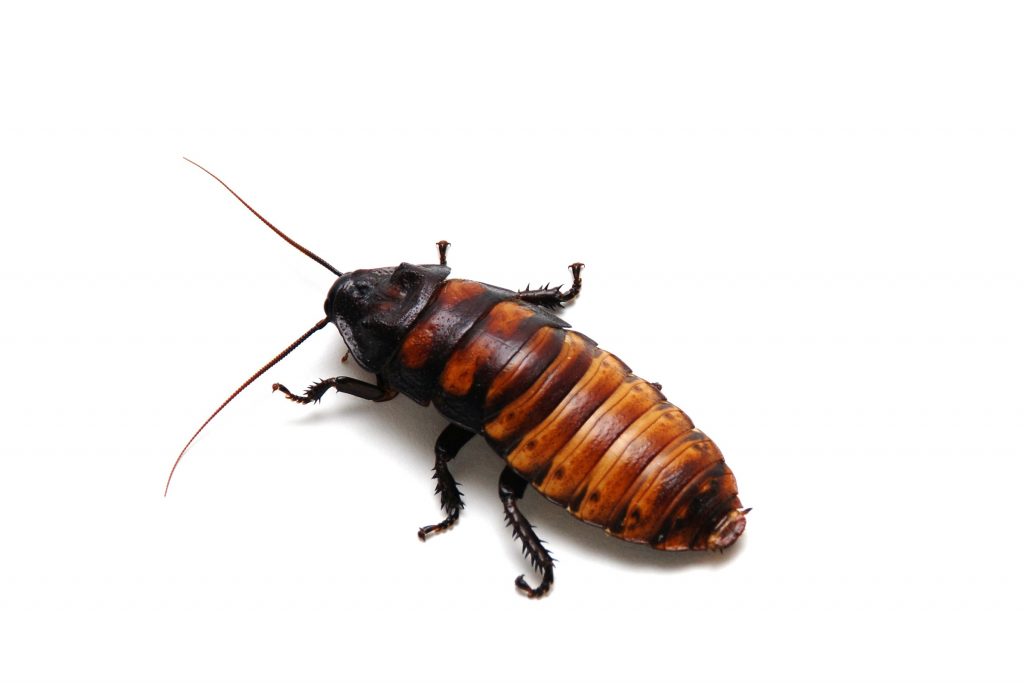
UConn engineers are using insects as platforms for small robots. Their microcircuit could improve control of futuristic biobots. (Getty Images)
A cockroach no bigger than a large paper clip scurries across the floor of Abhishek Dutta’s lab at the University of Connecticut.
Some scientists might be shocked to see such a notorious visitor occupying their research space.
But not Dutta. He watches intently as the roach moves left, and then right, then left again, as it traverses the cool tile floor. His interest is well-founded, for he is the one initiating the tiny creature’s movements with a small handheld device about 15 feet away.
The Madagascar hissing cockroach in this lab is not just any old member of the order Blattodea. It is a robot-roach hybrid, a hardwired biological insect – a cyborg if you will – and its future high-tech brethren may one day save your life.
“The use of insects as platforms for small robots has an incredible number of useful applications, from search and rescue to national defense,” says Dutta, an assistant professor of electrical and computer engineering who specializes in control system optimization and cyber-physical systems.
Cockroach robots aren’t new, however. Researchers have been exploring biorobotic platforms for insects for the better part of the past decade. But building robotic systems at such miniature scale isn’t easy, and the technology seems to work only about half the time.
In a paper soon to be published in Proceedings of the Conference on Cognitive Computational Neuroscience, Philadelphia 2018, Dutta, and undergraduate Evan Faulkner, a junior working in his lab, report their creation of a microcircuit that they say allows more reliable and precise control of robotic insect motion.
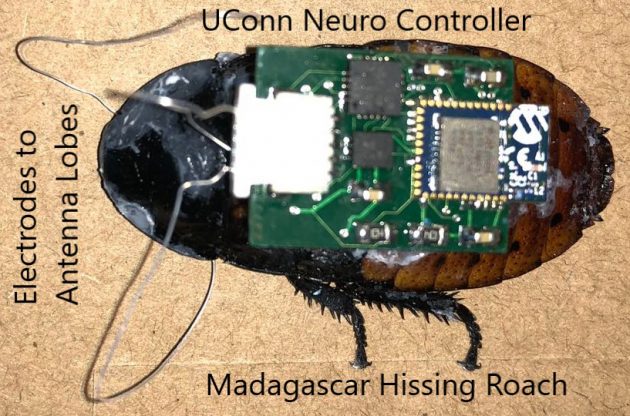
A cockroach with an implanted neurocontroller. (Image courtesy of the Dutta Lab)
To improve control of the insect, Dutta’s microcircuit incorporates a 9-axis inertial measurement unit that can detect the roach’s six degrees of free motion, its linear and rotational acceleration, and its compass heading. Another feature that Dutta and Faulkner added is the ambient temperature surrounding the creature, because tests have shown that the temperature of the environment in which a roach is moving can affect how and where the insect moves. Roaches, for the record, are more likely to go for walks when it’s warm.
The microcircuit Dutta and Faulkner created is part of a small electronic ‘backpack’ that can be strapped to the back of a cockroach. Wires from the device are attached to the insect’s antennae lobes. A tiny Bluetooth transmitter and receiver allows a nearby operator to control the roach’s movements via an ordinary cellphone. Sending tiny electrical impulses to the nerve tissue in the insect’s right or left antenna lobe makes the insect believe it has encountered an obstacle. A small charge to the left antenna makes the insect move away to the right. Likewise, a charge sent to the right antenna makes the insect move left. It’s power steering redefined.
While other labs have developed similar control systems, UConn’s microcircuit is distinctive in that it offers operators a greater degree of control of the insect’s movement, real-time feedback of the insect’s neuromuscular response to artificial stimuli, and multi-channel avenues for stimulating the insect’s nerve tissue. The result is a more informed and precise system of control.
The UConn system’s microcontroller and built-in potentiometer lets operators vary the output voltage, frequency, and cycle of the stimuli sent to the insect. (A potentiometer, if you’re wondering, is the proper name of an electronic device that adjusts voltage. It’s the thing that makes light dimmer switches possible, and allows you to adjust the volume on your stereo.) The stimulus that resulted in the most robust response from the cockroach was around 1.2V amplitude, 55 Hz frequency, and 50 percent duty cycle. (No roaches were hurt by these experiments, by the way.)
One interesting tidbit the researchers noticed was that the roach’s movements left or right in response to artificial stimulation decreased in intensity after the initial stimulus. So if the roach made a hard left after the first electronic pulse hit its right antenna lobe, its turn was less dramatic with each subsequent pulse to that lobe. The researchers aren’t sure why this happens, but it is handy information to know when you’re the one doing the steering.
Most importantly, Dutta says, the system allowed users to utilize the real-time feedback sent over the Bluetooth system to set specific parameters for stimulating the insect’s antennae lobes, and that allowed them to steer the insect in a desired direction.
“Our microcircuit provides a sophisticated system for acquiring real-time data on an insect’s heading and acceleration, which allows us to extrapolate its trajectory,” says Dutta. “We believe this advanced closed loop, model-based system provides better control for precision maneuvering, and overcomes some of the technical limitations currently plaguing today’s micro robots.”
While the new microcircuit is certainly a step forward for robot insect technology, Dutta acknowledges much more research is needed. Insect-driven biobots, you might say, are still in their larval stage. Ongoing advances in micro-hardware design and micro-control systems could lead to a new generation of devices that work even better.
Funding for this research was provided by a UConn startup grant, and in part by the United Technologies Corporation – Institute of Advanced Systems Engineering.
