Archives

UConn Patents Model to Achieve Efficient Electric Motor Drive Systems

Ali Bazzi, assistant professor of electrical and computer engineering at his lab on Dec. 21, 2012. (Peter Morenus/UConn Photo)

While more and more cars are being powered by electricity, all cars rely on electricity as the energy source for their drive systems. In fact, electric motor drive systems account for the largest energy consumption in the U.S. and worldwide in appliances, manufacturing processes, and many other applications. They are flexible and reliable, making them incredibly popular for industrial and commercial uses.

But there is an economic and environmental cost to the ubiquity of these systems. Most electrical energy is generated from fossil fuels, which are costly and non-renewable. Technologies that support reductions in fossil fuel use are advantageous and can support minimizing environmental impacts.

University of Connecticut associate professor of electrical and computer engineering Ali Bazzi, Ph.D. and two of his former graduate students, Yiqi Liu, Ph.D. and  Artur Ulatowski, have been granted a patent for a new method to model power loss in electric motor drive systems that could be used to greatly increase their efficiency.

A modern motor drive system is composed of three parts – a motor, a power electronic drive, and a controller. The motor is the electro-mechanical energy conversion device that rotates to move mechanical loads. The drive and controller control the amount of electrical energy given to the motor to determine its speed or torque, and power.

Current models depend on physics-based equations, which focus on the electro-mechanical energy conversion that drives these systems. However, these types of mathematical models fail to account for all of the other electrical, thermal, magnetic, and mechanical interactions within the motor drive. Thus, these models often ignore or assume certain energy losses or other phenomena which can impact accuracy.

In contrast, Bazzi’s model is fully comprehensive, as it takes all these factors into account, and provides a much more accurate picture of energy consumption.

By providing a more accurate measurement of how much energy these systems are using, Bazzi’s method paves the way for the development of more efficient systems which utilize electric motor drives. His model will enable the creation of systems that can operate with the maximum efficiency in any operating setting.

One of the most innovative features of Bazzi’s model is the ability to incorporate data that companies regularly collect from their electric motor drive systems. With this data, companies can use software, online (real-time) or offline, to determine the optimal operating parameters for a particular system within its unique operating environment.

Because motor drive systems are so widely used, optimization efforts have the potential for tremendous cost savings worldwide and could possibly decrease environmental burden by reducing electrical energy usage, says Bazzi.

“Even small improvements in the operating efficiency of the electric motor drive system would result in billions of dollars in annual energy savings worldwide and decrease the demand for fossil fuels to generate electricity,” Bazzi says.

Prof. Bazzi received his Ph.D. electrical and computer engineering from the University of Illinois Urbana-Champaign. He earned both his bachelor’s and master’s from the American University of Beirut. His research interests include electric motor drives and electro-mechanics, distributed generation with focus on solar photovoltaics and real-time control and optimization of energy systems.

Follow UConn Research on Twitter & LinkedIn.

Javidi Wins 2019 C.E.K. Mees Medal from The Optical Society

(Christopher Larosa/UConn Photo

By: Eli Freund, Editorial Communications Manager, UConn School of Engineering 

The UConn School of Engineering is pleased to announce that Dr. Bahram Javidi, Board of Trustees Distinguished Professor in Electrical and Computer Engineering, has been awarded the prestigious C.E.K. Mees Medal from The Optical Society (OSA), which he will accept in June  2019.

According to OSA, the medal was established in 1961 to honor OSA charter member C. E. K. Mees, who contributed preeminently to the development of scientific photography. The Mees family endowed the medal to recognize achievements that exemplifies the thought that “optics transcends all boundaries,” and recognizes an original use of optics across multiple fields. 

Javidi was specifically chosen for this award “for pioneering multidisciplinary contributions to information-optics with diverse applications in bio-photonics, 3D imaging and displays, photon-counting imaging and cyber-physical security,” according to the award citation.

This award is the second accolade for Javidi from OSA in the past 12 months (he was also the recipient of the Joseph Fraunhofer Award / Robert M. Burley Prize in 2018), and is one of a long line of accomplishments during his career, which include: Being named one of the top 160 engineers between the ages of 30-45 by the National Academy of Engineering (NAE) to attend the Frontiers of Engineering; the Quantum Electronics and Optics Prize for Applied Aspects by the European Physical Society (EPS); the Dennis Gabor Award in Diffractive Wave Technologies from The International Society for Optics and Photonics (SPIE); the John Simon Guggenheim Foundation Fellowship; the Alexander von Humboldt Prize for senior US Scientists in all disciplines; the SPIE Technology Achievement Award; the National Science Foundation Presidential Young Investigator Award; and the George Washington University Distinguished Alumni Scholar Award.

At UConn, he has received the American Association for University Professors (AAUP) Research Excellence Award; the University of Connecticut Board Of Trustees Distinguished Professor Award; the UConn Alumni Association Excellence in Research Award; and the Chancellor’s Research Excellence Award, among others.

He is a Fellow of the Institute of Electrical and Electronics Engineers (IEEE), Fellow of the American Institute for Medical and Biological Engineering (AIMBE), Fellow of the Optical Society (OSA), Fellow of the National Academy of Inventors (NAI), Fellow of the European Optical Society (EOS), Fellow of The International Society for Optics and Photonics (SPIE), Fellow of the Institute of Physics (IoP), and Fellow of The Society for Imaging Science and Technology (IS&T). Javidi has over 1000 publications which have been cited 42000 times, according to Google Scholar, and 19 patents, some of which have been licensed by industry.

Javidi is also the director of the MOSIS Lab (Multidimensional Optical Sensing and Imaging Systems), which is focused on advancing the science and technology of imaging, by centering on the fields of optics, photonics, and computational algorithms and systems, from nano to macro scales. MOSIS works with, and finds solutions for, partners in the defense, manufacturing, healthcare, and cybersecurity industries.

Click here to learn more about the C.E.K. Mees Medal from The Optical Society.

Predicting the Future of Robotics

Research in robotics crosses many engineering disciplines, including electrical engineering. Because of this, some University of Connecticut electrical engineering professors are using their unique perspectives to advance robotics research.

Assistant Professor Abhishek Dutta is just one of these professors who specializes in robotics, with an emphasis in biological robotics.

“My hope is to create a bionic robot, as in a biologically constructed robot,” Dutta said.

Dutta works to create cyborgs, which are micro-circuits interfaced with organisms resulting in a controlled organism, which means he also faces challenges with biology.

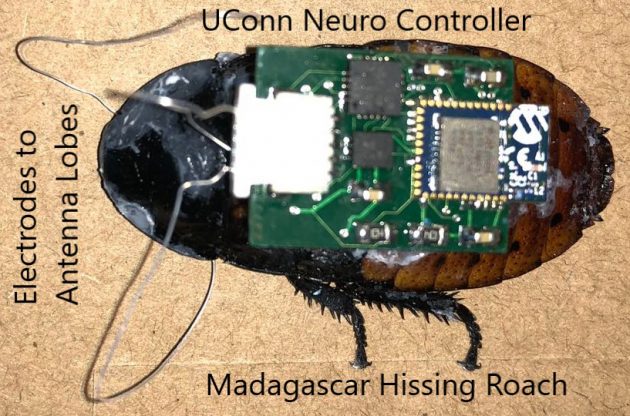
Recently, Dutta released research related to control of cockroaches through the creation of a newly designed microcircuit. Connecting this small electronic “backpack” to the back of the cockroach, Dutta and his graduate students believe that there are unlimited applications, including use in search-and-rescue missions and national defense.

“My biggest challenge is to run this interdisciplinary lab that relies on as much engineering as much as biology,” he said.

Dutta said he hopes that over the next few years robotics research will advance to create more social robots, and ultimately reach human-like cognition.

If robots are going to reach human-level cognition, artificial intelligence and autonomy would also have to advance, and that is where Associate Professor Shalabh Gupta comes into play. Gupta researches how to improve robots autonomy, which has many different aspects, he said.

“The biggest challenge for autonomy is when the robot is in an unknown environment and the robot doesn’t know its surroundings. When you leave a robot in an unknown scenario it has to first learn the scenario and then completely make its own decisions for navigating and performing its tasks. The challenge is to design algorithms that can optimize this decision making process in the robots,” Gupta said.

When it comes to the artificial intelligence of these robots, Gupta said that some of these robots are already smarter than humans. However, integration of the learning process with that of control and decision is still a challenge.

Once you place the robot in an environment with other humans and moving obstacles, the decision-making process becomes more challenging.  

“It has to learn human patterns,” Gupta said, “We are trying to reach how humans think, but we don’t know how to replicate that. The data is big, but we have to figure out how to make sense of that data.”

To learn human patterns, these robots need to be collaborative and safe. Professor Ashwin Dani specializes in this area, and he said he sees big advancements in the collaboration area in the near future.

“Human-robot collaboration, design and development of collaborative and safe robots, building intelligent machines using advances in machine learning and artificial intelligence, are some of the things that are happening in the robotics and automation community,” said Dani.

For challenges in these advancements, Dani cited infrastructure as the main obstacle for robotics advancement.

“For any robotics research, infrastructure is most critical. It takes time to build the right infrastructure and support system to carry out long-term research,” said Dani.


Written by Ryley McGinnis

UConn-Sikorsky Team Engineers Autonomous Firefighting Drone

From left, Kerry Jones ’19 (ENG), Ryan Heilemann ’19 (ENG), and Josh Steil ’19 (ENG) look on as their drone takes off for a test flight on Horsebarn Hill in Storrs. (Christopher Larosa/UConn Photo)

Working with mentors from Sikorsky, three University of Connecticut engineering seniors are translating their classroom education to the field.

Electrical engineering majors Kerry Jones and Joshua Steil, and computer engineering major Ryan Heilemann, are collaborating to build and program an autonomous firefighting drone to battle blazes without a pilot’s guidance.

“In the world today there’s a high prevalence of forest fires, like in California, but the problem is of how to safely put out these fires,” says Steil. “So our project, in essence, is to see if we can start putting out fires without a human driver.”

Once finished, the drone will carry a thermal imaging camera to identify a fire, object avoidance technology to steer clear of any obstacles, and a softball-sized fire-extinguishing ball that will be dropped over the flames. The system’s technology will be tied together through coding language developed by the students, and will operate based on inputted coordinates.

Ryan Heilemann ’19 (ENG), foreground, and Josh Steil ’19 (ENG) check their drone before a recent flight test. (Christopher Larosa/UConn Photo)

While their drone will only be able to put out a campfire-size blaze, the project is meant to prove that this technology is possible, so that much bigger technology can be engineered in the future, says Heilemann.

“The idea is that in the future, on a larger scale, there can be a fleet of unmanned helicopters that can go out and put out forest fires, thereby lowering loss of life,” says Steil.

While drones are currently used by fire departments across the country, all of them so far have a pilot who navigates the drone from a distance, and most are used for observation, not fire suppression.

“The autonomy definitely makes it different,” says Jones, “and the fire-extinguishing ball, for sure.”

Teams in previous years have worked on similar projects with Sikorsky, which provided some guidance on what has worked and what has not.

The team looked back on previous projects’ reports, including last year’s team, which was the first to integrate firefighting capabilities into the drone. While the previous team to work on this project used small thermal sensors called thermopile array sensors, Heilemann says these sensors required the previous drone to be only about six feet from the flames, which was too close for real-world applications. His team decided to use an infrared camera, which allows for more distance from the flames.

This year’s team had the added benefit of working on their project in UConn’s brand new 118,000 square-foot Engineering and Science Building, which features three engineering floors filled with faculty and labs focused on robotics, machine autonomy, and virtual and augmented reality.

At Sikorsky, the team is

The eight-propeller drone flies above Horsebarn Hill in Storrs on a recent test flight. (Christopher Larosa/UConn Photo)

 working with a recent UConn School of Engineering alum, Jason Thibodeau, deputy manager of Sikorsky’s Flight Controls and Autonomous Systems Department.

“He’s really helpful. We have phone meetings every Monday, and we tell him what’s going on, what we’re struggling with, and he reasons with us,” says Jones.

Adds Heilemann, “He really wants us to figure our way through issues we have, instead of just giving us a direct solution.”

Working with Sikorsky also introduced the UConn seniors to new career options. Jones has accepted an offer with Sikorsky after she graduates, in their autonomy lab as part of their Rotary and Mission Systems department.

Steil has accepted a job offer with Sikorsky’s parent company, Lockheed Martin, in Massachusetts after graduation.

“Working with Sikorsky definitely sparked a greater interest looking into the company as a whole,” he says.

Heilemann also decided to go into the aerospace industry, and has found a job doing control and diagnostics at another aerospace company.

Most importantly, the collaboration was a chance to get some experience with a top company.

“In this project, I get to learn so much about Sikorsky and what they do,” says Steil, “and having a company like that so close to home and have them be our sponsor is definitely an added benefit.”


Original Post