Archives

UConn Patents Model to Achieve Efficient Electric Motor Drive Systems

Ali Bazzi, assistant professor of electrical and computer engineering at his lab on Dec. 21, 2012. (Peter Morenus/UConn Photo)

While more and more cars are being powered by electricity, all cars rely on electricity as the energy source for their drive systems. In fact, electric motor drive systems account for the largest energy consumption in the U.S. and worldwide in appliances, manufacturing processes, and many other applications. They are flexible and reliable, making them incredibly popular for industrial and commercial uses.

But there is an economic and environmental cost to the ubiquity of these systems. Most electrical energy is generated from fossil fuels, which are costly and non-renewable. Technologies that support reductions in fossil fuel use are advantageous and can support minimizing environmental impacts.

University of Connecticut associate professor of electrical and computer engineering Ali Bazzi, Ph.D. and two of his former graduate students, Yiqi Liu, Ph.D. and  Artur Ulatowski, have been granted a patent for a new method to model power loss in electric motor drive systems that could be used to greatly increase their efficiency.

A modern motor drive system is composed of three parts – a motor, a power electronic drive, and a controller. The motor is the electro-mechanical energy conversion device that rotates to move mechanical loads. The drive and controller control the amount of electrical energy given to the motor to determine its speed or torque, and power.

Current models depend on physics-based equations, which focus on the electro-mechanical energy conversion that drives these systems. However, these types of mathematical models fail to account for all of the other electrical, thermal, magnetic, and mechanical interactions within the motor drive. Thus, these models often ignore or assume certain energy losses or other phenomena which can impact accuracy.

In contrast, Bazzi’s model is fully comprehensive, as it takes all these factors into account, and provides a much more accurate picture of energy consumption.

By providing a more accurate measurement of how much energy these systems are using, Bazzi’s method paves the way for the development of more efficient systems which utilize electric motor drives. His model will enable the creation of systems that can operate with the maximum efficiency in any operating setting.

One of the most innovative features of Bazzi’s model is the ability to incorporate data that companies regularly collect from their electric motor drive systems. With this data, companies can use software, online (real-time) or offline, to determine the optimal operating parameters for a particular system within its unique operating environment.

Because motor drive systems are so widely used, optimization efforts have the potential for tremendous cost savings worldwide and could possibly decrease environmental burden by reducing electrical energy usage, says Bazzi.

“Even small improvements in the operating efficiency of the electric motor drive system would result in billions of dollars in annual energy savings worldwide and decrease the demand for fossil fuels to generate electricity,” Bazzi says.

Prof. Bazzi received his Ph.D. electrical and computer engineering from the University of Illinois Urbana-Champaign. He earned both his bachelor’s and master’s from the American University of Beirut. His research interests include electric motor drives and electro-mechanics, distributed generation with focus on solar photovoltaics and real-time control and optimization of energy systems.

Follow UConn Research on Twitter & LinkedIn.

Javidi Wins 2019 C.E.K. Mees Medal from The Optical Society

(Christopher Larosa/UConn Photo

By: Eli Freund, Editorial Communications Manager, UConn School of Engineering 

The UConn School of Engineering is pleased to announce that Dr. Bahram Javidi, Board of Trustees Distinguished Professor in Electrical and Computer Engineering, has been awarded the prestigious C.E.K. Mees Medal from The Optical Society (OSA), which he will accept in June  2019.

According to OSA, the medal was established in 1961 to honor OSA charter member C. E. K. Mees, who contributed preeminently to the development of scientific photography. The Mees family endowed the medal to recognize achievements that exemplifies the thought that “optics transcends all boundaries,” and recognizes an original use of optics across multiple fields. 

Javidi was specifically chosen for this award “for pioneering multidisciplinary contributions to information-optics with diverse applications in bio-photonics, 3D imaging and displays, photon-counting imaging and cyber-physical security,” according to the award citation.

This award is the second accolade for Javidi from OSA in the past 12 months (he was also the recipient of the Joseph Fraunhofer Award / Robert M. Burley Prize in 2018), and is one of a long line of accomplishments during his career, which include: Being named one of the top 160 engineers between the ages of 30-45 by the National Academy of Engineering (NAE) to attend the Frontiers of Engineering; the Quantum Electronics and Optics Prize for Applied Aspects by the European Physical Society (EPS); the Dennis Gabor Award in Diffractive Wave Technologies from The International Society for Optics and Photonics (SPIE); the John Simon Guggenheim Foundation Fellowship; the Alexander von Humboldt Prize for senior US Scientists in all disciplines; the SPIE Technology Achievement Award; the National Science Foundation Presidential Young Investigator Award; and the George Washington University Distinguished Alumni Scholar Award.

At UConn, he has received the American Association for University Professors (AAUP) Research Excellence Award; the University of Connecticut Board Of Trustees Distinguished Professor Award; the UConn Alumni Association Excellence in Research Award; and the Chancellor’s Research Excellence Award, among others.

He is a Fellow of the Institute of Electrical and Electronics Engineers (IEEE), Fellow of the American Institute for Medical and Biological Engineering (AIMBE), Fellow of the Optical Society (OSA), Fellow of the National Academy of Inventors (NAI), Fellow of the European Optical Society (EOS), Fellow of The International Society for Optics and Photonics (SPIE), Fellow of the Institute of Physics (IoP), and Fellow of The Society for Imaging Science and Technology (IS&T). Javidi has over 1000 publications which have been cited 42000 times, according to Google Scholar, and 19 patents, some of which have been licensed by industry.

Javidi is also the director of the MOSIS Lab (Multidimensional Optical Sensing and Imaging Systems), which is focused on advancing the science and technology of imaging, by centering on the fields of optics, photonics, and computational algorithms and systems, from nano to macro scales. MOSIS works with, and finds solutions for, partners in the defense, manufacturing, healthcare, and cybersecurity industries.

Click here to learn more about the C.E.K. Mees Medal from The Optical Society.

Predicting the Future of Robotics

Research in robotics crosses many engineering disciplines, including electrical engineering. Because of this, some University of Connecticut electrical engineering professors are using their unique perspectives to advance robotics research.

Assistant Professor Abhishek Dutta is just one of these professors who specializes in robotics, with an emphasis in biological robotics.

“My hope is to create a bionic robot, as in a biologically constructed robot,” Dutta said.

Dutta works to create cyborgs, which are micro-circuits interfaced with organisms resulting in a controlled organism, which means he also faces challenges with biology.

Recently, Dutta released research related to control of cockroaches through the creation of a newly designed microcircuit. Connecting this small electronic “backpack” to the back of the cockroach, Dutta and his graduate students believe that there are unlimited applications, including use in search-and-rescue missions and national defense.

“My biggest challenge is to run this interdisciplinary lab that relies on as much engineering as much as biology,” he said.

Dutta said he hopes that over the next few years robotics research will advance to create more social robots, and ultimately reach human-like cognition.

If robots are going to reach human-level cognition, artificial intelligence and autonomy would also have to advance, and that is where Associate Professor Shalabh Gupta comes into play. Gupta researches how to improve robots autonomy, which has many different aspects, he said.

“The biggest challenge for autonomy is when the robot is in an unknown environment and the robot doesn’t know its surroundings. When you leave a robot in an unknown scenario it has to first learn the scenario and then completely make its own decisions for navigating and performing its tasks. The challenge is to design algorithms that can optimize this decision making process in the robots,” Gupta said.

When it comes to the artificial intelligence of these robots, Gupta said that some of these robots are already smarter than humans. However, integration of the learning process with that of control and decision is still a challenge.

Once you place the robot in an environment with other humans and moving obstacles, the decision-making process becomes more challenging.  

“It has to learn human patterns,” Gupta said, “We are trying to reach how humans think, but we don’t know how to replicate that. The data is big, but we have to figure out how to make sense of that data.”

To learn human patterns, these robots need to be collaborative and safe. Professor Ashwin Dani specializes in this area, and he said he sees big advancements in the collaboration area in the near future.

“Human-robot collaboration, design and development of collaborative and safe robots, building intelligent machines using advances in machine learning and artificial intelligence, are some of the things that are happening in the robotics and automation community,” said Dani.

For challenges in these advancements, Dani cited infrastructure as the main obstacle for robotics advancement.

“For any robotics research, infrastructure is most critical. It takes time to build the right infrastructure and support system to carry out long-term research,” said Dani.


Written by Ryley McGinnis

UConn-Sikorsky Team Engineers Autonomous Firefighting Drone

From left, Kerry Jones ’19 (ENG), Ryan Heilemann ’19 (ENG), and Josh Steil ’19 (ENG) look on as their drone takes off for a test flight on Horsebarn Hill in Storrs. (Christopher Larosa/UConn Photo)

Working with mentors from Sikorsky, three University of Connecticut engineering seniors are translating their classroom education to the field.

Electrical engineering majors Kerry Jones and Joshua Steil, and computer engineering major Ryan Heilemann, are collaborating to build and program an autonomous firefighting drone to battle blazes without a pilot’s guidance.

“In the world today there’s a high prevalence of forest fires, like in California, but the problem is of how to safely put out these fires,” says Steil. “So our project, in essence, is to see if we can start putting out fires without a human driver.”

Once finished, the drone will carry a thermal imaging camera to identify a fire, object avoidance technology to steer clear of any obstacles, and a softball-sized fire-extinguishing ball that will be dropped over the flames. The system’s technology will be tied together through coding language developed by the students, and will operate based on inputted coordinates.

Ryan Heilemann ’19 (ENG), foreground, and Josh Steil ’19 (ENG) check their drone before a recent flight test. (Christopher Larosa/UConn Photo)

While their drone will only be able to put out a campfire-size blaze, the project is meant to prove that this technology is possible, so that much bigger technology can be engineered in the future, says Heilemann.

“The idea is that in the future, on a larger scale, there can be a fleet of unmanned helicopters that can go out and put out forest fires, thereby lowering loss of life,” says Steil.

While drones are currently used by fire departments across the country, all of them so far have a pilot who navigates the drone from a distance, and most are used for observation, not fire suppression.

“The autonomy definitely makes it different,” says Jones, “and the fire-extinguishing ball, for sure.”

Teams in previous years have worked on similar projects with Sikorsky, which provided some guidance on what has worked and what has not.

The team looked back on previous projects’ reports, including last year’s team, which was the first to integrate firefighting capabilities into the drone. While the previous team to work on this project used small thermal sensors called thermopile array sensors, Heilemann says these sensors required the previous drone to be only about six feet from the flames, which was too close for real-world applications. His team decided to use an infrared camera, which allows for more distance from the flames.

This year’s team had the added benefit of working on their project in UConn’s brand new 118,000 square-foot Engineering and Science Building, which features three engineering floors filled with faculty and labs focused on robotics, machine autonomy, and virtual and augmented reality.

At Sikorsky, the team is

The eight-propeller drone flies above Horsebarn Hill in Storrs on a recent test flight. (Christopher Larosa/UConn Photo)

 working with a recent UConn School of Engineering alum, Jason Thibodeau, deputy manager of Sikorsky’s Flight Controls and Autonomous Systems Department.

“He’s really helpful. We have phone meetings every Monday, and we tell him what’s going on, what we’re struggling with, and he reasons with us,” says Jones.

Adds Heilemann, “He really wants us to figure our way through issues we have, instead of just giving us a direct solution.”

Working with Sikorsky also introduced the UConn seniors to new career options. Jones has accepted an offer with Sikorsky after she graduates, in their autonomy lab as part of their Rotary and Mission Systems department.

Steil has accepted a job offer with Sikorsky’s parent company, Lockheed Martin, in Massachusetts after graduation.

“Working with Sikorsky definitely sparked a greater interest looking into the company as a whole,” he says.

Heilemann also decided to go into the aerospace industry, and has found a job doing control and diagnostics at another aerospace company.

Most importantly, the collaboration was a chance to get some experience with a top company.

“In this project, I get to learn so much about Sikorsky and what they do,” says Steil, “and having a company like that so close to home and have them be our sponsor is definitely an added benefit.”


Original Post

ECE Seminar Series: Age of Information in Status Update Systems

ECE title


ECE Seminar Fall 2018

November 26, 1pm-2pm, ITE 336

Age of Information in Status Update Systems

Donald Richard Brown

Worcester Polytechnic Institute

Abstract: Information freshness is of critical importance in a variety of networked monitoring and control systems such as intelligent vehicular systems, channel state feedback, and environmental monitoring. In these types of applications, stale information can lead to incorrect decisions, unstable control loops, and even compromises in safety and security. A recent line of research has considered information freshness from a fundamental perspective under an “Age of Information” (AoI) metric first proposed in 2011. Early work in a simple single-source single-monitor setting showed the somewhat surprising result that there exists an optimal rate at which a source must generate its information to keep its status as timely as possible at the monitor. This rate differs from the rate that maximizes throughput and the rate that minimizes delivery delay. In this talk, we will provide an overview of the concept of AoI, discuss a stochastic hybrid systems (SHS) approach to analyze AoI in certain settings, present recent results on AoI using SHS analysis in a single-source single-monitor setting with a server with energy constraints, and also present recently derived results on the fundamental limits of information freshness in multi-source multi-monitor multi-hop wireless networks with explicit contention.

Short bio: D. Richard Brown III is currently a Professor and the Associate Department Head in the Department of Electrical and Computer Engineering at Worcester Polytechnic Institute, where he has been a faculty member since 2000. He received a PhD in Electrical Engineering from Cornell University in 2000 and MS and BS degrees in Electrical Engineering from The University of Connecticut in 1996 and 1992, respectively. From 1992-1997, he was a design engineer at General Electric Electrical Distribution and Control in Plainville, Connecticut. From August 2007 to June 2008, he held an appointment as a Visiting Associate Professor at Princeton University.  From 2016-2018, he served as a Program Director at the National Science Foundation in the Computing and Communications Foundations (CCF) division of the Directorate for Computer & Information Science & Engineering (CISE). He is also currently serving as an Associate Editor for IEEE Transactions on Wireless Communications.

UCONN PhD Student Yan Li to be Honored with the 2018 Rising Star Award

Hartford, CT (October 10, 2018):  Connecticut Power and Energy Society (CPES) is thrilled to honor Yan Li, a University of Connecticut PhD student, with the 2018 Rising Star award at its 19th annual The Future of Energy: What’s the Deal? Conference and Exposition on Wednesday, October 24, 2018, 7:30 AM – 2:30 PM at the Aqua Turf Club in Southington, Connecticut.

“Yan has helped shape the energy landscape in Connecticut and the New England region by inventing new technologies that have significantly increased the hosting capacity of distributed energy resources (DERs, especially PVs) for CT’s power grids and protected our energy infrastructures against cyber-physical attacks,” said CPES Board Member and UCONN Director of Utility Operations and Energy Management Stanley Nolan.

A gifted young scholar full of creative ideas, Yan has demonstrated strong creativities in important areas including smart grids, cybersecurity, software-defined networking, microgrids, and networked microgrids. She has made outstanding contributions in smart grid and cyber-physical security.

Yan has pioneered two important areas Networked Microgrids and Software-Defined Smart Grids, which are of special interest to the renewables utilization and power grid modernization in Connecticut. Yan has developed a tool for the real-time dynamic analysis of renewable-energy-dominated power system (including networked microgrids) in Connecticut and its stability margin predictions. U.S. Department of Energy (DOE) has granted $1.05 million and U.S. National Science Foundation (NSF) has granted near $1 million to sponsor the aforementioned research.

Counting already eight prestigious research awards, contributions to 28 peer-reviewed publications, and her ability to secure over $3.4 million federal funding for UConn to conduct research in power and energy resilience and cybersecurity; Yan is entering her final year of PhD program with the career goal of being an outstanding female professor in a top university in the New England region.


Original Post: http://www.ctpower.org/uconn-phd-student-yan-li-to-be-honored-with-the-2018-rising-star-award/

ECE Seminar Series: Elements of an Innovation Ecosystem

ECE title


ECE Seminar Fall 2018

October 3, 3pm-4pm, ITE 401

Elements of an Innovation Ecosystem

 Dr. Barry L. Shoop

Electrical Engineering and Computer Science

U.S. Military Academy at West Point

Abstract: Clayton M. Christensen first coined the term disruptive technology in his 1995 article “Disruptive Technologies: Catching the Wave” in which he described disruptive technology as a new technology that unexpectedly displaces an established technology. Later, in his classic text The Innovator’s Dilemma, he asks the question “Why do well-managed companies fail? He concludes that they often fail because the very management practices that have allowed them to become industry leaders also make it extremely difficult for them to recognize and develop the disruptive technologies that ultimately capture their markets. Well-managed companies are excellent at developing sustaining technologies, those technologies that improve the performance of their products in ways that satisfy their customers. Disruptive technologies, however, are distinctly different and fundamentally change the value proposition in a market according to a distinct pathology. In addition to understanding disruptive innovations, we have found that it is equally important to understand the human dimension of technology innovation – how social, cultural, and religious factors impact the acceptance or rejection of technological innovation. To understand these contributing factors we include insights from three classic texts including The Structure of Scientific Revolutions by Thomas S. Kuhn, The Discoverers by Daniel J. Boorstin, and The Two Cultures by C. P. Snow. Beyond the technological and human dimensions, it is equally important to develop both the organizational structure and organizational culture dimensions that encourage and support an ecosystem of innovation. Iconic examples of the consequences of the lack of effective innovation are Blackberry, Nokia, Blockbuster, Borders and Kodak while the world’s most successful innovators such as Apple, Google, General Electric and Procter & Gamble have succeeded in embedding innovation into their very DNA.

Short bio: Barry L. Shoop is Professor of Electrical Engineering and Head of the Department of Electrical Engineering and Computer Science at the U.S. Military Academy at West Point. During his 25 years at West Point he has served in a number of key leadership positions including Director of the Photonics Research Center and Director of the Electrical Engineering Program. Currently as Professor and Head he is responsible for an undergraduate academic department with over 79 faculty and staff supporting ABET accredited programs in electrical engineering, computer science, and information technology. The department engages over 1800 students each year and has 4 affiliated research centers including the Cyber Research Center, Network Science Center, Photonics Research Center and a burgeoning Robotics Program. Dr. Shoop holds 1 patent and has authored or co-authored 8 books and book chapters, and over 146 publications. He received a B.S. from the Pennsylvania State University and Ph.D. from Stanford University, both in electrical engineering. His research interests include optical information processing, neural networks, image processing, disruptive innovations and educational pedagogy. He is a Fellow of the IEEE, OSA and SPIE, and a member of Phi Kappa Phi, Eta Kappa Nu, and Sigma Xi. Dr. Shoop served as the 2016 IEEE President and CEO. He is a licensed Professional Engineer in the Commonwealth of Virginia.

A Cyborg Cockroach Could Someday Save Your Life


UConn engineers are using insects as platforms for small robots. Their microcircuit could improve control of futuristic biobots. (Getty Images)


A cockroach no bigger than a large paper clip scurries across the floor of Abhishek Dutta’s lab at the University of Connecticut.

Some scientists might be shocked to see such a notorious visitor occupying their research space.

But not Dutta. He watches intently as the roach moves left, and then right, then left again, as it traverses the cool tile floor. His interest is well-founded, for he is the one initiating the tiny creature’s movements with a small handheld device about 15 feet away.

The Madagascar hissing cockroach in this lab is not just any old member of the order Blattodea. It is a robot-roach hybrid, a hardwired biological insect  a cyborg if you will  and its future high-tech brethren may one day save your life.

“The use of insects as platforms for small robots has an incredible number of useful applications, from search and rescue to national defense,” says Dutta, an assistant professor of electrical and computer engineering who specializes in control system optimization and cyber-physical systems.

Cockroach robots aren’t new, however. Researchers have been exploring biorobotic platforms for insects for the better part of the past decade. But building robotic systems at such miniature scale isn’t easy, and the technology seems to work only about half the time.

In a paper soon to be published in Proceedings of the Conference on Cognitive Computational Neuroscience, Philadelphia 2018, Dutta, and undergraduate Evan Faulkner, a junior working in his lab, report their creation of a microcircuit that they say allows more reliable and precise control of robotic insect motion.


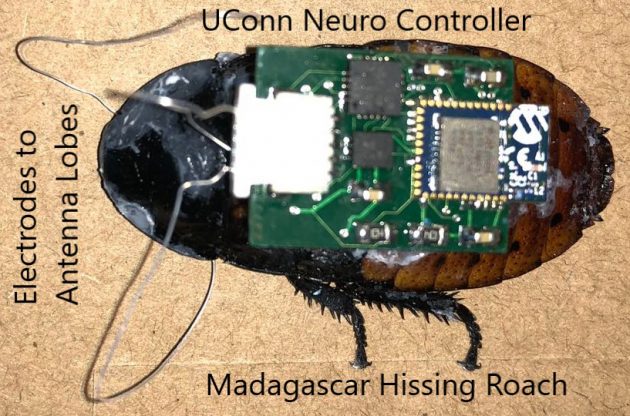
A cockroach with an implanted neurocontroller. (Image courtesy of the Dutta Lab)

To improve control of the insect, Dutta’s microcircuit incorporates a 9-axis inertial measurement unit that can detect the roach’s six degrees of free motion, its linear and rotational acceleration, and its compass heading. Another feature that Dutta and Faulkner added is the ambient temperature surrounding the creature, because tests have shown that the temperature of the environment in which a roach is moving can affect how and where the insect moves. Roaches, for the record, are more likely to go for walks when it’s warm.

The microcircuit Dutta and Faulkner created is part of a small electronic ‘backpack’ that can be strapped to the back of a cockroach. Wires from the device are attached to the insect’s antennae lobes. A tiny Bluetooth transmitter and receiver allows a nearby operator to control the roach’s movements via an ordinary cellphone. Sending tiny electrical impulses to the nerve tissue in the insect’s right or left antenna lobe makes the insect believe it has encountered an obstacle. A small charge to the left antenna makes the insect move away to the right. Likewise, a charge sent to the right antenna makes the insect move left. It’s power steering redefined.

While other labs have developed similar control systems, UConn’s microcircuit is distinctive in that it offers operators a greater degree of control of the insect’s movement, real-time feedback of the insect’s neuromuscular response to artificial stimuli, and multi-channel avenues for stimulating the insect’s nerve tissue. The result is a more informed and precise system of control.

The UConn system’s microcontroller and built-in potentiometer lets operators vary the output voltage, frequency, and cycle of the stimuli sent to the insect. (A potentiometer, if you’re wondering, is the proper name of an electronic device that adjusts voltage. It’s the thing that makes light dimmer switches possible, and allows you to adjust the volume on your stereo.) The stimulus that resulted in the most robust response from the cockroach was around 1.2V amplitude, 55 Hz frequency, and 50 percent duty cycle. (No roaches were hurt by these experiments, by the way.)

One interesting tidbit the researchers noticed was that the roach’s movements left or right in response to artificial stimulation decreased in intensity after the initial stimulus. So if the roach made a hard left after the first electronic pulse hit its right antenna lobe, its turn was less dramatic with each subsequent pulse to that lobe. The researchers aren’t sure why this happens, but it is handy information to know when you’re the one doing the steering.

Most importantly, Dutta says, the system allowed users to utilize the real-time feedback sent over the Bluetooth system to set specific parameters for stimulating the insect’s antennae lobes, and that allowed them to steer the insect in a desired direction.

“Our microcircuit provides a sophisticated system for acquiring real-time data on an insect’s heading and acceleration, which allows us to extrapolate its trajectory,” says Dutta. “We believe this advanced closed loop, model-based system provides better control for precision maneuvering, and overcomes some of the technical limitations currently plaguing today’s micro robots.”

While the new microcircuit is certainly a step forward for robot insect technology, Dutta acknowledges much more research is needed. Insect-driven biobots, you might say, are still in their larval stage. Ongoing advances in micro-hardware design and micro-control systems could lead to a new generation of devices that work even better.

Funding for this research was provided by a UConn startup grant, and in part by the United Technologies Corporation – Institute of Advanced Systems Engineering.


Original Post

ECE Seminar Series: Game-Theoretic Methods for Cyber-Physical Control and Security of Distributed Microgrids

ECE title

ECE Seminar Fall 2018

September 10, 1pm-2pm, ITE 336

Game-Theoretic Methods for Cyber-Physical Control and Security of Distributed Microgrids

Quanyan Zhu

Department of Electrical and Computer Engineering

New York University

Abstract: Game-theoretic methods have been widely used to model interactions of agents in complex systems. This talk aims to provide an overview of game-theoretic applications in the control and cybersecurity of microgrids. The first part of the talk introduces a non-cooperative game-theoretic power flow framework to develop distributed control of renewable-based microgrids. The solution concept of Nash equilibrium characterizes the outcome of distributed generation and plug-and-play integration with the power grid. The game-theoretic analysis leads to a fully distributed PMU-enabled algorithm which only needs local information of voltage angle at the bus. The talk also presents the Stackelberg equilibrium solution to capture the leader-and-follower relationships between the existing grid and the microgrids. The second part of the talk introduces game-theoretic models to understand the Stuxnet-type of threats on the power plants. A Bayesian dynamic game framework is first introduced to model the strategic interactions between an attacker and a defender under incomplete information. The attacker aims to achieve her objective stealthily through a combination of social engineering, lateral movement, and cyber-physical attacks. The defender aims to learn, detect, and mitigate the impact of the attack on the power plant and the consequential cascading failures. The talk will conclude with open questions and general discussions on game-theoretic frameworks for cyber-physical security and resilience.

Short bio: Quanyan Zhu received B. Eng. in Honors Electrical Engineering from McGill University in 2006, M.A.Sc. from University of Toronto in 2008, and Ph.D. from the University of Illinois at Urbana-Champaign (UIUC) in 2013. After a short stint at Princeton University, he joined the Department of Electrical and Computer Engineering at New York University (NYU) as an assistant professor in 2014. His research interest is game theory, smart grid, network security and privacy, resilient critical infrastructures, cyber-physical systems and cyber deception. He is a recipient of best paper awards at the International Conference on Information Fusion (Fusion 2015), ACM CCS Workshop on Managing Insider Security Threats (MIST 2015), and the International Symposium on Resilient Control Systems (ISRCS 2011). He spearheaded INFOCOM Workshop on Communications and Control on Smart Energy Systems (CCSES), Midwest Workshop on Control and Game Theory (WCGT) and New York Multidisciplinary Symposium on Security and Privacy. His current research has been funded by NSF, DOE, DHS, and DARPA.