Web cookies (also called HTTP cookies, browser cookies, or simply cookies) are small pieces of data that websites store on your device (computer, phone, etc.) through your web browser. They are used to remember information about you and your interactions with the site.
Purpose of Cookies:
Session Management:
Keeping you logged in
Remembering items in a shopping cart
Saving language or theme preferences
Personalization:
Tailoring content or ads based on your previous activity
Tracking & Analytics:
Monitoring browsing behavior for analytics or marketing purposes
Types of Cookies:
Session Cookies:
Temporary; deleted when you close your browser
Used for things like keeping you logged in during a single session
Persistent Cookies:
Stored on your device until they expire or are manually deleted
Used for remembering login credentials, settings, etc.
First-Party Cookies:
Set by the website you're visiting directly
Third-Party Cookies:
Set by other domains (usually advertisers) embedded in the website
Commonly used for tracking across multiple sites
Authentication cookies are a special type of web cookie used to identify and verify a user after they log in to a website or web application.
What They Do:
Once you log in to a site, the server creates an authentication cookie and sends it to your browser. This cookie:
Proves to the website that you're logged in
Prevents you from having to log in again on every page you visit
Can persist across sessions if you select "Remember me"
What's Inside an Authentication Cookie?
Typically, it contains:
A unique session ID (not your actual password)
Optional metadata (e.g., expiration time, security flags)
Analytics cookies are cookies used to collect data about how visitors interact with a website. Their primary purpose is to help website owners understand and improve user experience by analyzing things like:
How users navigate the site
Which pages are most/least visited
How long users stay on each page
What device, browser, or location the user is from
What They Track:
Some examples of data analytics cookies may collect:
Page views and time spent on pages
Click paths (how users move from page to page)
Bounce rate (users who leave without interacting)
User demographics (location, language, device)
Referring websites (how users arrived at the site)
Here’s how you can disable cookies in common browsers:
1. Google Chrome
Open Chrome and click the three vertical dots in the top-right corner.
Go to Settings > Privacy and security > Cookies and other site data.
Choose your preferred option:
Block all cookies (not recommended, can break most websites).
Block third-party cookies (can block ads and tracking cookies).
2. Mozilla Firefox
Open Firefox and click the three horizontal lines in the top-right corner.
Go to Settings > Privacy & Security.
Under the Enhanced Tracking Protection section, choose Strict to block most cookies or Custom to manually choose which cookies to block.
3. Safari
Open Safari and click Safari in the top-left corner of the screen.
Go to Preferences > Privacy.
Check Block all cookies to stop all cookies, or select options to block third-party cookies.
4. Microsoft Edge
Open Edge and click the three horizontal dots in the top-right corner.
Go to Settings > Privacy, search, and services > Cookies and site permissions.
Select your cookie settings from there, including blocking all cookies or blocking third-party cookies.
5. On Mobile (iOS/Android)
For Safari on iOS: Go to Settings > Safari > Privacy & Security > Block All Cookies.
For Chrome on Android: Open the app, tap the three dots, go to Settings > Privacy and security > Cookies.
Be Aware:
Disabling cookies can make your online experience more difficult. Some websites may not load properly, or you may be logged out frequently. Also, certain features may not work as expected.
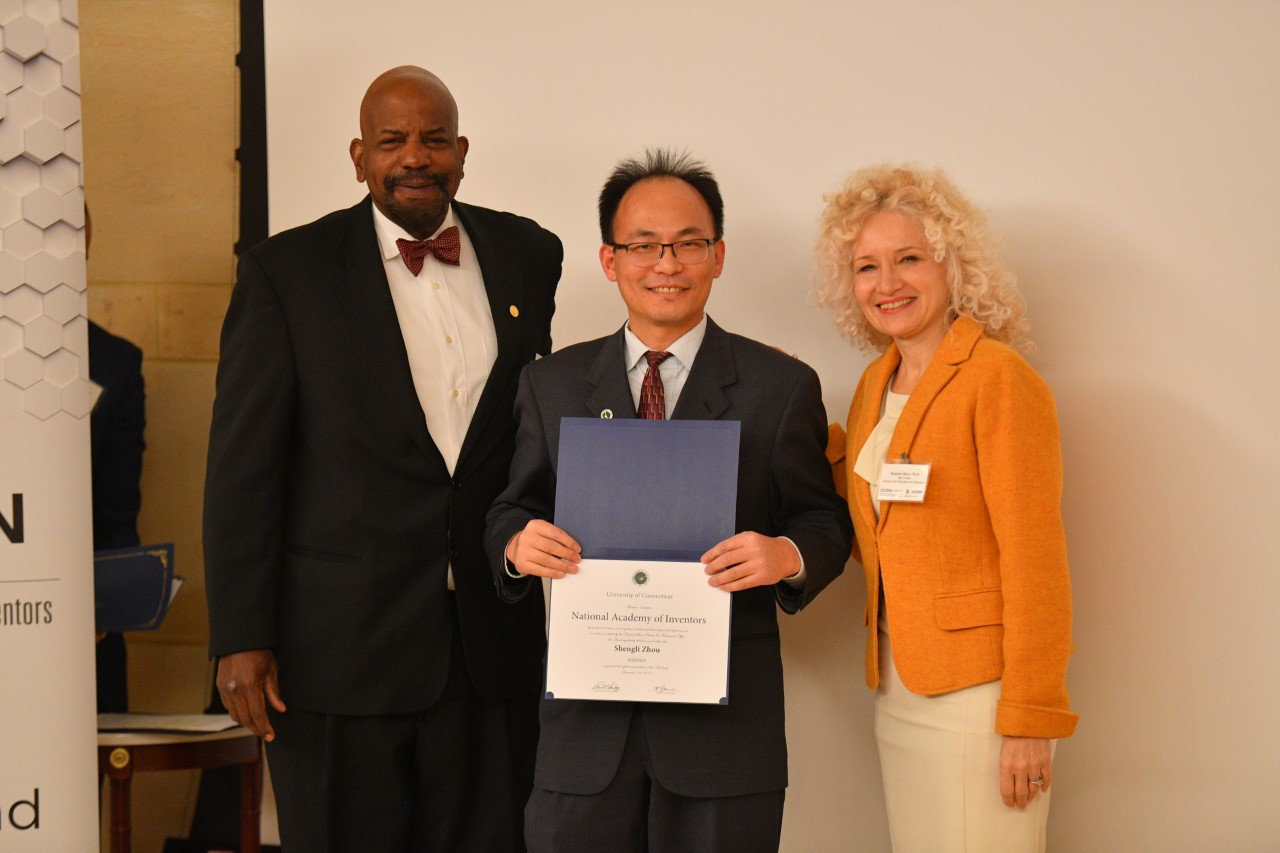
Left to right: Dr. Cato Laurencin (President of UConn chapter of NAI), Prof. Shengli Zhou, and Dr. Radenka Maric (VP for Research, Innovation, and Entrepreneurship)
Profs. Peter Luh and Shengli Zhou were inducted as members of the UConn Chapter of the National Academy of Inventors (NAI) in a ceremony at the Mark Twain House in Hartford on Dec. 18 2019. Prof. Luh was recognized for his record of accomplishments in the field of optimization. Most recently,Prof. Luh received a patent along with Prof. Peng Zhang, colleagues, and students titled “Enabling Resilient Microgrid through Ultra-Fast Programmable Network”. The invention describes systems and methods for integrating ultra-fast programmable networks in microgrid are disclosed to provide flexible and easy-to-manage communication solutions, thus enabling resilient microgrid operations in the face of various cyber and physical disturbances. Prof. Zhou was inducted in recognition of his leadership in underwater acoustic communications.He co-invented the patent “Apparatus, which addresses the problems with systems and methods for enhanced multi-carrier based underwater acoustic communications” addresses the problems with Doppler effects induced by platform motions when communicating with high data rate multi-carrier based acoustic transmissions. The invention uses a two-step approach to mitigate frequency-dependent Doppler drifts and are advantageously applicable for fast-varying underwater acoustic channels.
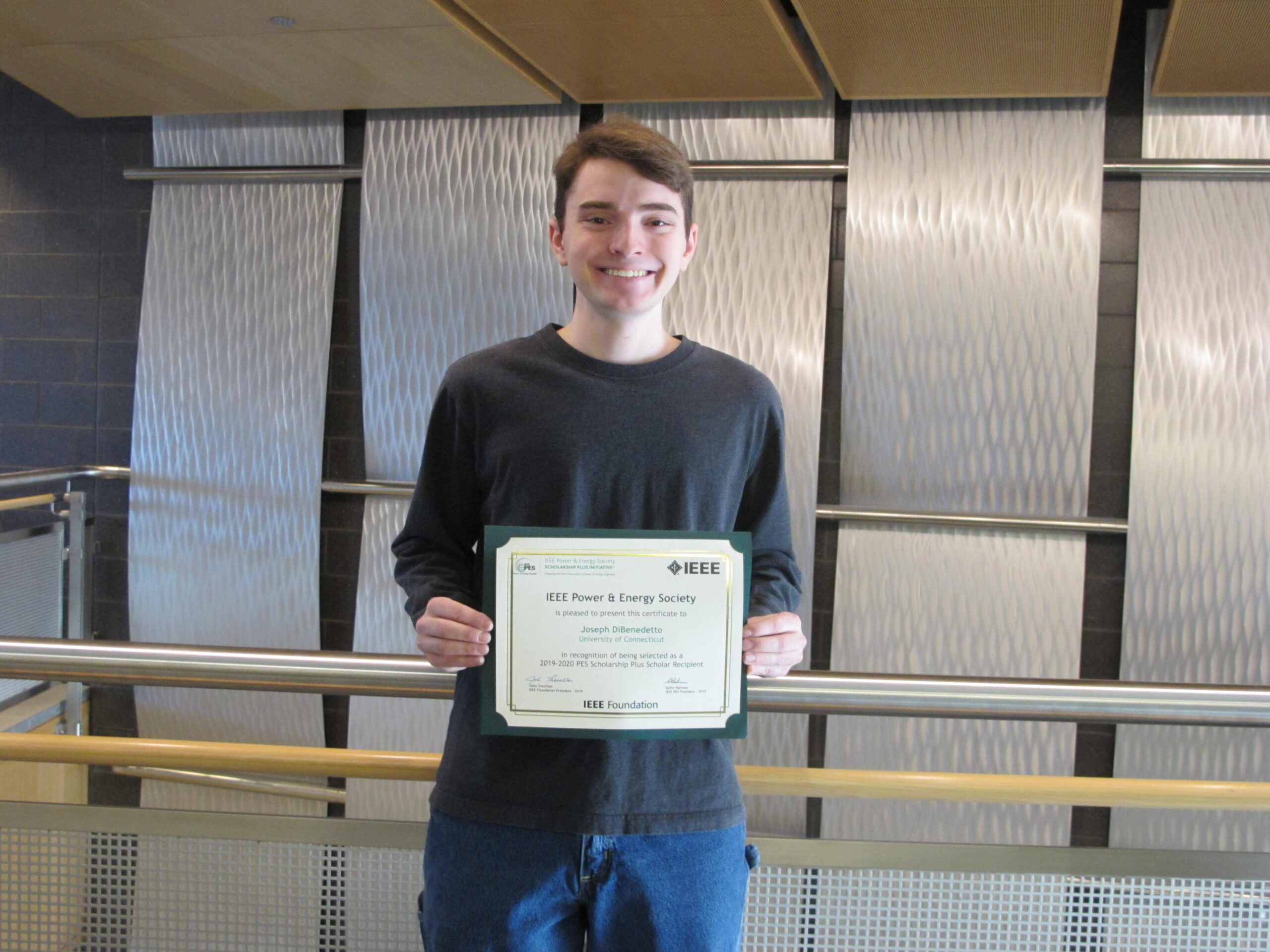
Joseph DiBenedetto, a sophomore in Electrical Engineering, was selected to receive a scholarship as part of the IEEE Power and Energy Society Scholarship Plus Initiative. He will receive $2,000 for being named a PES scholar. Joseph was one among only 135 students selected from 78 U.S. and Canadian universities for the 2019-20 academic year. The initiative recognizes undergraduate students who have declared a major in electrical and computer engineering, are high achievers with strong GPAs with distinctive extracurricular commitments and are committed to exploring the power and energy field.
Over the years, Prof. Rajeev Bansal has been writing columns for two of the IEEE professional magazines (Antennas and Propagation Magazine and Microwave Magazine), where he looks at emerging technologies in a broad societal context. A selection of columns was published by Wiley/IEEE Press (2017) as “From ER to E.T.: How Electromagnetic Technologies Are Changing Our Lives.” Working with his ECE colleagues Profs. Ayers and Silva, he also developed and taught a course (ECE 4099W) for electrical/computer engineering students, where they learn to discuss the larger context of engineering solutions. Recently, Prof. Bansal has become affiliated as a policy research scholar with the Consortium for Science, Policy, and Outcomes (CSPO), a leading Washington DC think tank on technology and policy issues (http://cspo.org/). In a new post for CSPO’s #AsWeNowThink blog, he takes a look at how the federal push for rapid 5G deployment may be sidelining local authorities: http://bit.ly/2M4QRH6.
Crystalline Oxides for Emerging Microelectronic Devices
Maruf Amin Bhuiyan
Yale University
Abstract:
Crystalline oxides are traditionally used for niche applications like thin film transistors, and also for basic scientific studies because of the rich physics they invoke. Recently, the availability of native bulk substrate of a semiconducting crystalline oxide, and the successful synthesis of crystalline-oxide insulators by the atomic layer deposition (ALD) process have opened horizons for these pristine materials to be used in various frontiers of microelectronic technologies, ranging from power electronics to memory applications.
Of the crystalline oxides studied, β-gallium oxide (β-Ga2O3) is a promising semiconducting crystalline oxide for future generations of power electronic devices; ALD grown crystalline magnesium-calcium-oxide (Mg0.25Ca0.75O) and lanthanum oxide (La2O3) have found their applications as high-quality gate dielectrics for gallium-nitride-based (GaN) and gallium-arsenide-based (GaAs) transistors, respectively; on the other hand, polycrystalline hafnium oxides have created a revolution in the field of ferroelectric memory.
This work focusses on electrical characterization of capacitors and transistors based on the aforementioned four types of crystalline oxides. Charge trapping during device operation is one major reliability concern. Significant efforts have been made to understand the charge trapping characteristics of crystalline-oxide-based devices. To reveal the trap characteristics, measurement techniques like constant-voltage stress, constant-current stress, and AC transconductance dispersion methods have been employed.
The potential of using crystalline-oxide-based devices in radiation rich environments, like outer space and high energy particle accelerators, have also been investigated. Radiation-induced damage can also be induced by CMOS chip processing, particularly in advanced technology nodes where extreme UV lithography is employed for patterning. Current-voltage, capacitance-voltage, and gate leakage measurements have been carried out to investigate the impact of total ionizing dose of X-ray radiation on the crystalline-oxide-based device performance. Process improvements and device architecture modifications have been made to improve the radiation hardness of these devices.
Short bio: Maruf is currently working under Professor T. P. Ma in the Electrical Engineering Department at Yale University. He obtained his B. Eng. from National University of Singapore (NUS) and M.S. & M. Phil. from Yale University. He is en-route to Ph.D. degree for May 2019, after which he will join IBM Research. His research works primarily involve fabrication and characterization of MOS devices tailored for high power and radiation harsh environment. He has several peer reviewed publications in journals like IEEE transactions, IEEE Electron Device Letters, Applied Physics Letters and presented in international conferences like IEEE Nuclear and Space Radiation Effects (NSREC) and IEEE Semiconductor Interface Specialist Conference (SISC). He has won awards including IBM PhD Fellowship and Yale Graduate Fellowship.
Prof. Peter Willett has been selected to serve as a member of the National Research Council’s Panel on Information Sciences at the Army Research Laboratory (ARL). The panel consists of research leaders from both academia and industry. The panel is responsible for annual reviews of the scientific and technical quality of ARL’s programs of research and development related to its information science technical area. The panel will provide notes to the Army Research Laboratory Technical Assessment Board, a committee that will prepare the biennial report summarizing its assessment of the ARL. Prof. Willett’s appointment is until December 31, 2019.
Stephen Altschuler (far left) and Samuel Altschuler (far right) with their undergraduate scholarship recipients at a ceremony in 2015. (Christopher Larosa/UConn Photo)
In response to the growing need for cybersecurity experts, two University of Connecticut alumni brothers donated $1 million to launch the university’s cybersecurity instructional lab and develop a curriculum to meet the demands.
Samuel ’50 and Stephen Altschuler ’54, who earned bachelor’s degrees in electrical engineering, will cut the ribbon on the Altschuler Cybersecurity Lab, located on the first floor of the Information Technology Engineering (ITE) Building, this summer.
“We chose to make this gift because of the support we received from UConn when we were engineering students in the early 1950s,” said the brothers in a joint statement. “Our training enabled us to advance our careers to the point where we are financially able to make a gift of this size. Connecticut has been a major focus for us our entire lives, and we are proud to be able to make a meaningful contribution to its flagship university.
“We believe that cybersecurity is among the most critical issues of this age. In order to assure that society will be able to safely continue to use the ever-accelerating advancements of technology, the study of cybersecurity is crucial to the maintenance of peaceful cultures.”
The Altschuler Cybersecurity Lab will be the cornerstone of UConn’s effort to graduate engineers with expertise in cybersecurity, said School of Engineering Dean Kazem Kazerounian, who joined Donald Swinton, director of development for the School of Engineering, in pursuing the lab’s establishment.
“We are in an age where the threat of cyberattacks has gotten more pervasive. As an institution, we need to be training the next generation of engineers to combat this threat, which is why this gift from the Altschuler brothers is so important for the School of Engineering and the University,” said Kazerounian.
When launched, the lab will teach hands-on cybersecurity to all Computer Science and Engineering Department freshmen, as well as additional members of the department’s 800 undergraduate and 150 graduate student population.
A special first-year curriculum will cover such areas as cyber-hygiene in software and hardware; the vulnerabilities in commercial-off-the-shelf devices and Internet-of-Things devices; and ensuring the security and integrity of electronic election and voting systems, smart power-meters and power grid devices. The curriculum will also cover website security, secure configuration of networks and networked systems, and security of network routing.
“The establishment of this cybersecurity laboratory is wonderful news for Connecticut,” said Arthur H. House, the state’s chief cybersecurity officer. “It will enhance UConn’s academic strength and partnership in the ongoing effort to understand and counter evolving cyber threats to the state’s government agencies, businesses, and organizations.”
Mark Raymond, Connecticut’s chief information officer, agrees. “One of the fundamental principles of the state’s cybersecurity strategy is cybersecurity literacy. The strategy calls for all sectors to reduce cybersecurity risks through education and awareness. The laboratory at UConn will play a critical role in developing the next-generation cybersecurity skills required to keep our state’s citizens and business safe.”
After graduating from UConn, Samuel Altschuler earned an MBA from Northeastern University in 1958 and founded Altron, Inc., where he was the chairman and president, until his retirement. Stephen Altschuler went on to earn his master’s in engineering from Yale University in 1955. He is the founder, president, and chairman of Altek Electronics. He also served on UConn’s Board of Trustees from 1986-1993.
“We recognize that Dean Kazerounian and his staff have assembled a first-class faculty to be stewards of the cybersecurity specialty, and we are highly motivated to support it,” said the Altschuler brothers, who have also funded scholarships to UConn’s engineering students.
As faculty in the new lab pursue this work, they will partner with faculty in other areas, such as the state’s Voting Technology Research Center, which evaluates Connecticut’s voting machines and audits results for cyberattacks; and industry partners, such as Synchrony Financial and Comcast companies, which support cybersecurity research and host annual cybersecurity conferences.