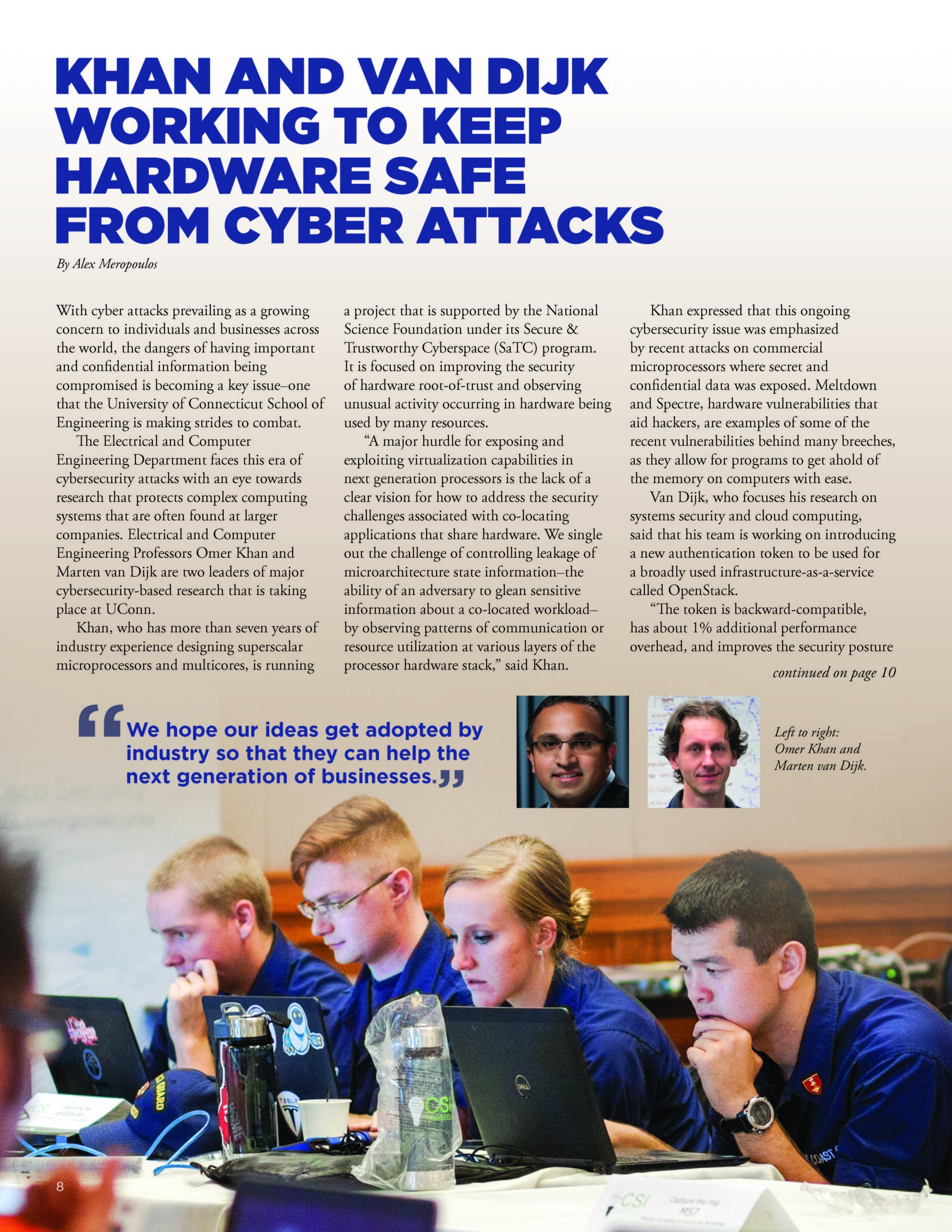
President Katsouleas, Engineering Professor Ki Chon Named National Academy of Inventors Fellows
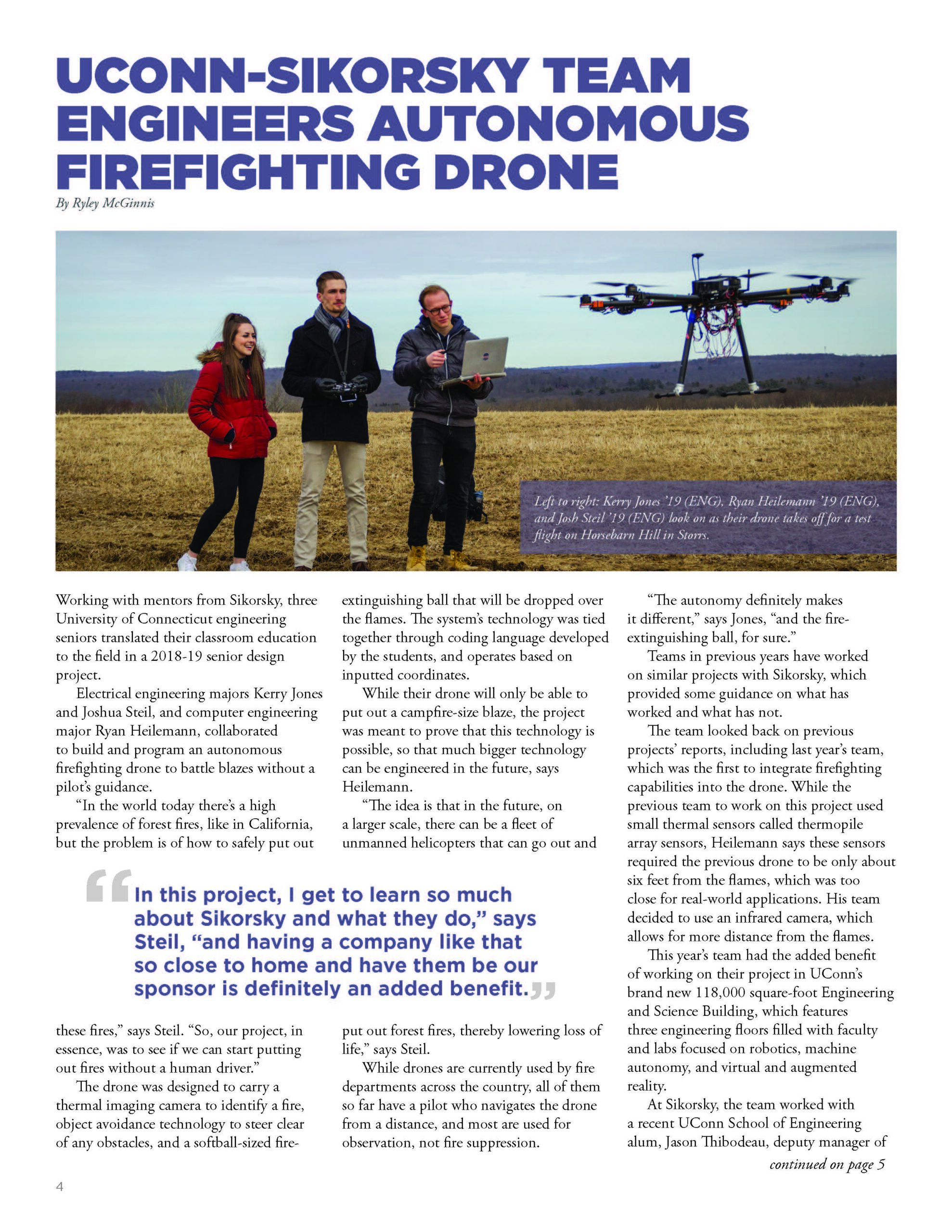
Digital Control of a Robotic Arm
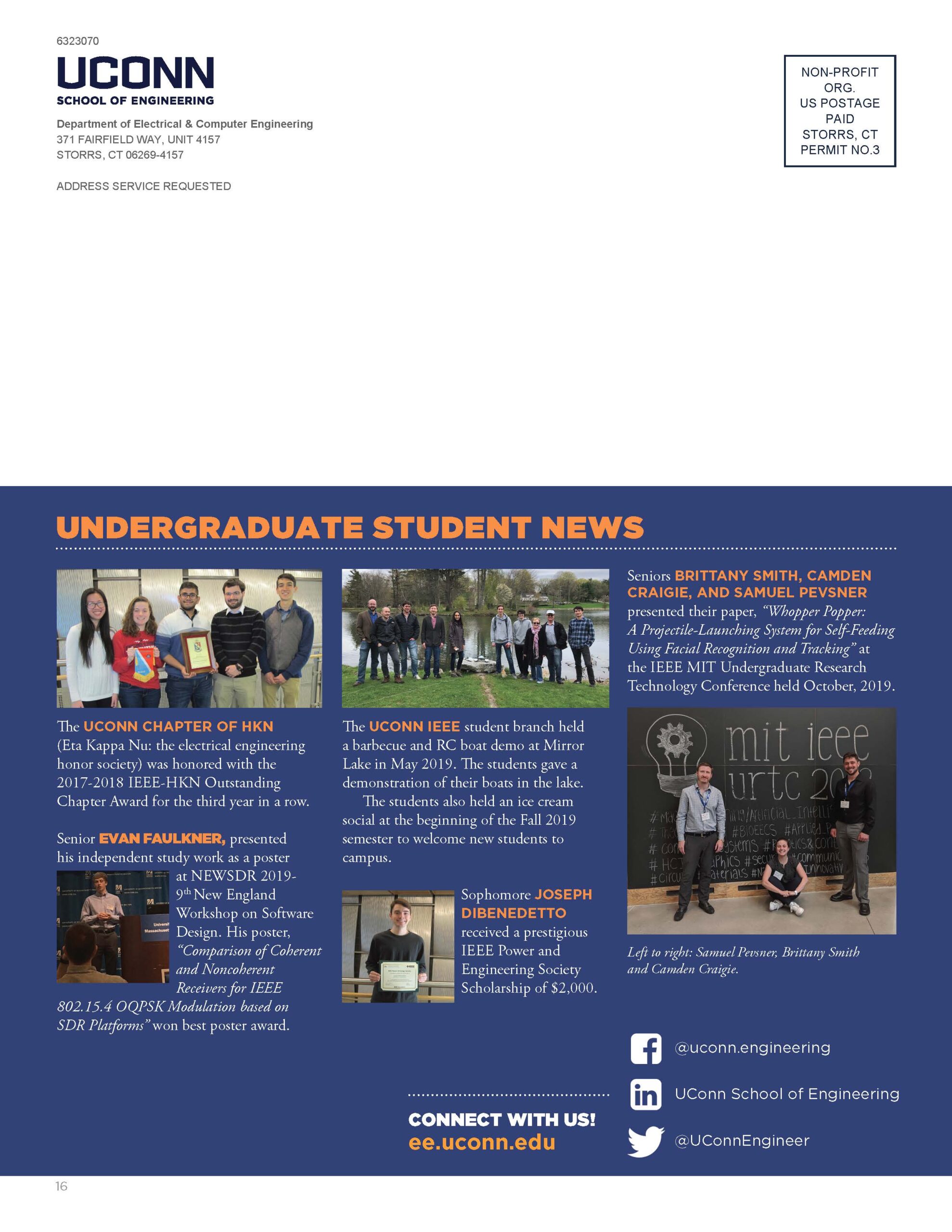
It is in ECE3111 (Systems Analysis) and ECE4121 (Digital Control Systems) that Electrical Engineering students first become exposed to the challenges of creating a stable control system. During the Fall 2019 semester in ECE4121, the five students in the class, Evan Faulkner, John Kaminski, Daniel Osborn, Ben Rattet, and Zacharya Samih, faced those challenges head on as they took it upon themselves to control a robotic arm to behave as a gantry to stabilize a non-inverted pendulum attached to the arm. The controller’s objective was to have the angle of the pendulum reach zero as quickly as possible. Prof. Krishna Pattipati, who was the class instructor, and graduate students, Adam Bienkowski and James Wilson, helped the students with the project.
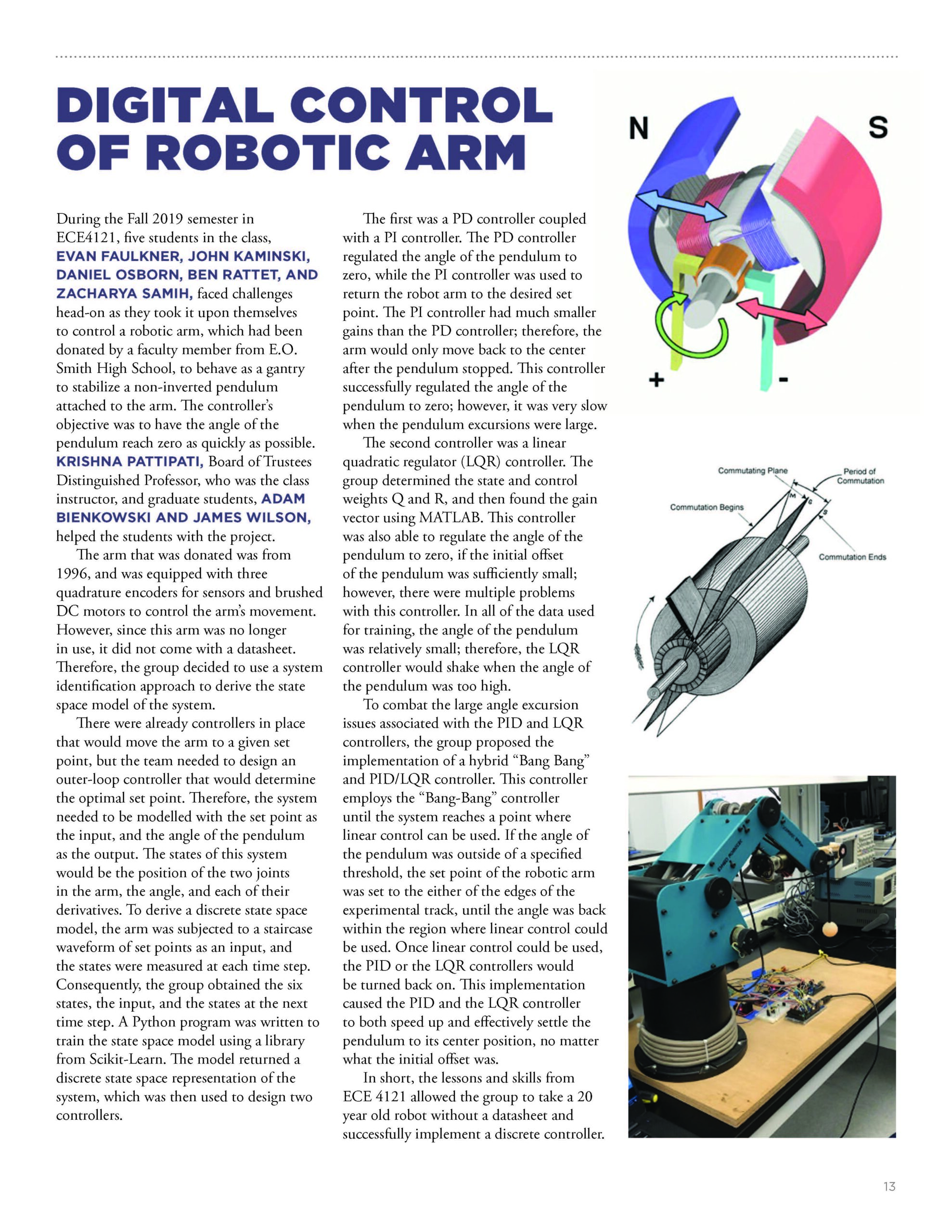
The robotic arm used for this project was given to one of the group members by a faculty member at E. O. Smith High School. 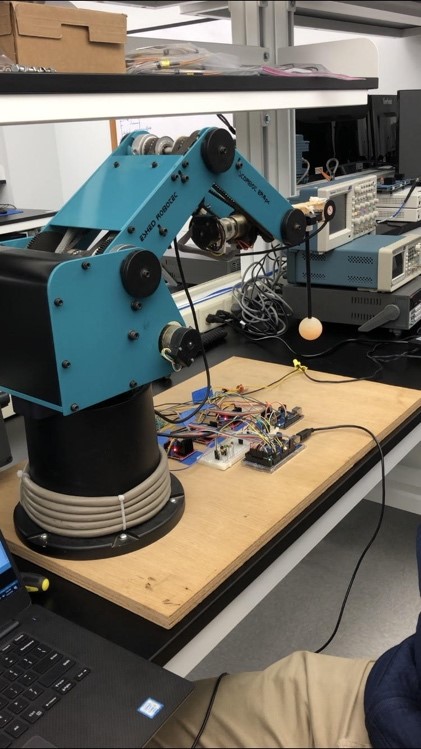 It was first purchased in 1996 and was no longer being used by the school. It was equipped with three quadrature encoders for sensors and brushed DC motors to control the arm’s movement. However, since this arm was no longer in use, it did not come with a datasheet. As a result, the group was unable to model the system using physics-based models, since the parameters of the arm were unknown. Therefore, the group decided to use a system identification approach to derive the state space model of the system.
There were already controllers in place that would move the arm to a given set point, but the team needed to design an outer-loop controller that would determine the optimal set point. Therefore, the system needed to be modelled with the set point as the input, and the angle of the pendulum as the output. The states of this system would be the position of the two joints in the arm, the angle, and each of their derivatives. To derive a discrete state space model, the arm was subjected to a staircase waveform of set points as an input, and the states were measured at each time step. Consequently, the group obtained the six states, the input, and the states at the next time step. 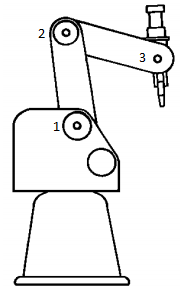 A Python program was written to train the state space model using a library from Scikit-Learn. The model returned a discrete state space representation of the system, which was then used to design two controllers.
The first was a PD controller coupled with a PI controller. The PD controller regulated the angle of the pendulum to zero, while the PI controller was used to return the robot arm to the desired set point. The PI controller had much smaller gains than the PD controller; therefore, the arm would only move back to the center after the pendulum stopped. This controller successfully regulated the angle of the pendulum to zero; however, it was very slow when the pendulum excursions were large.
The second controller was a linear quadratic regulator (LQR) controller. The group determined the state and control weights Q and R, and then found the gain vector using MATLAB. This controller was also able to regulate the angle of the pendulum to zero, if the initial offset of the pendulum was sufficiently small; however, there were multiple problems with this controller. In all of the data used for training, the angle of the pendulum was relatively small; therefore, the LQR controller would shake when the angle of the pendulum was too high.
To combat the large angle excursion issues associated with the PID and LQR controllers, the group proposed the implementation of a hybrid “Bang Bang” and PID/LQR controller. This controller employs the “Bang-Bang” controller until the system reaches a point where linear control can be used. If the angle of the pendulum was outside of a specified threshold, the set point of the robotic arm was set to the either of the edges of the experimental track, until the angle was back within the region where linear control could be used. Once linear control could be used, the PID or the LQR controllers would be turned back on. This implementation caused the PID and the LQR controller to both speed up and effectively settle the pendulum to its center position, no matter what the initial offset was.
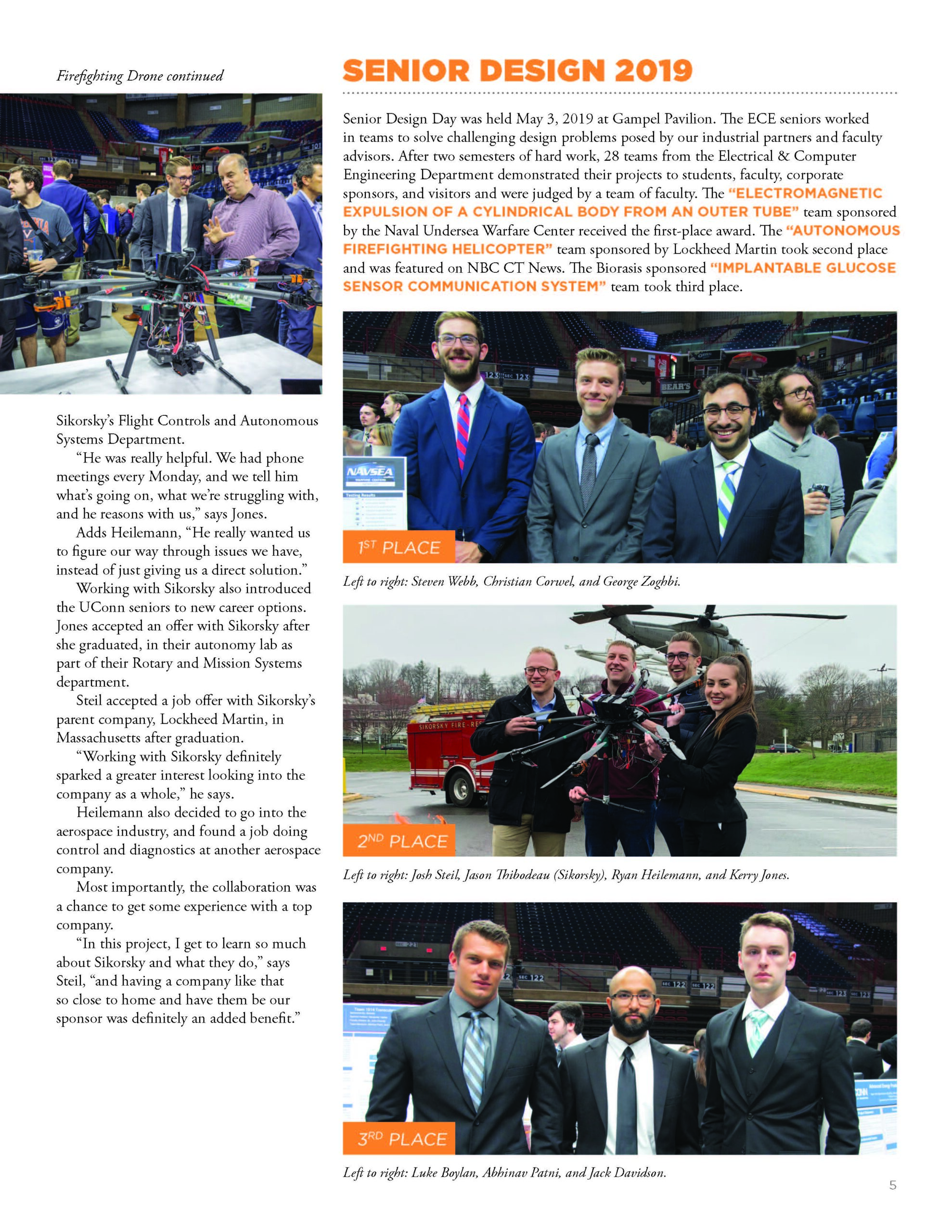
Congratulations to our ECE Senior Design teams. It was a trying semester as the students were forced to complete their projects while working from home. Even under such severe constraints, the students all came through and were able to deliver for the most part on their projects.
Unfortunately, the students could not present their projects at a live demo day, but virtual presentations for all of our senior design projects can be viewed at https://seniordesign-2020.engr.uconn.edu/ece-projects/. Most of them are accompanied with a 5-6 min video. (Please note that a few do not have a video approved by their sponsor for public release.)
The winners for this year’s projects are:
1st place: Team 2013 (Carrier)
Verification Strategy and Tools for IoT Systems (Advisor: Prof. Shalabh Gupta)
Team members: Balsha Maric, Wissam Razouki, Long Phan
2nd place: Team 2032 (Sikorsky)
Autonomous Firefighting Helicopter (Advisor: Prof. Ashwin Dani)
Team members: Francisco Rivera, Joseph Morello, Shivendra Singh, Yinuo Huang
3rd place: Team 2019 (Hartford HSB)
Wireless Motor Sensor (joint with ME. Advisor: Prof. John Chandy)
Team members: Benjamin Hart, Daniel Leclerc, Rasal Talukdar
An official announcement video by Prof. Liang Zhang can be seen at https://youtu.be/5rx946I2DOU
Many thanks to everyone involved in this process, especially during this challenging time: Senior design coordinator Prof. Liang Zhang, all faculty advisors, department administrative staff, lab manager Phil Duncan, and our three faculty judges, Kaipei Yang, Ali Gokirmak and Faquir Jain.
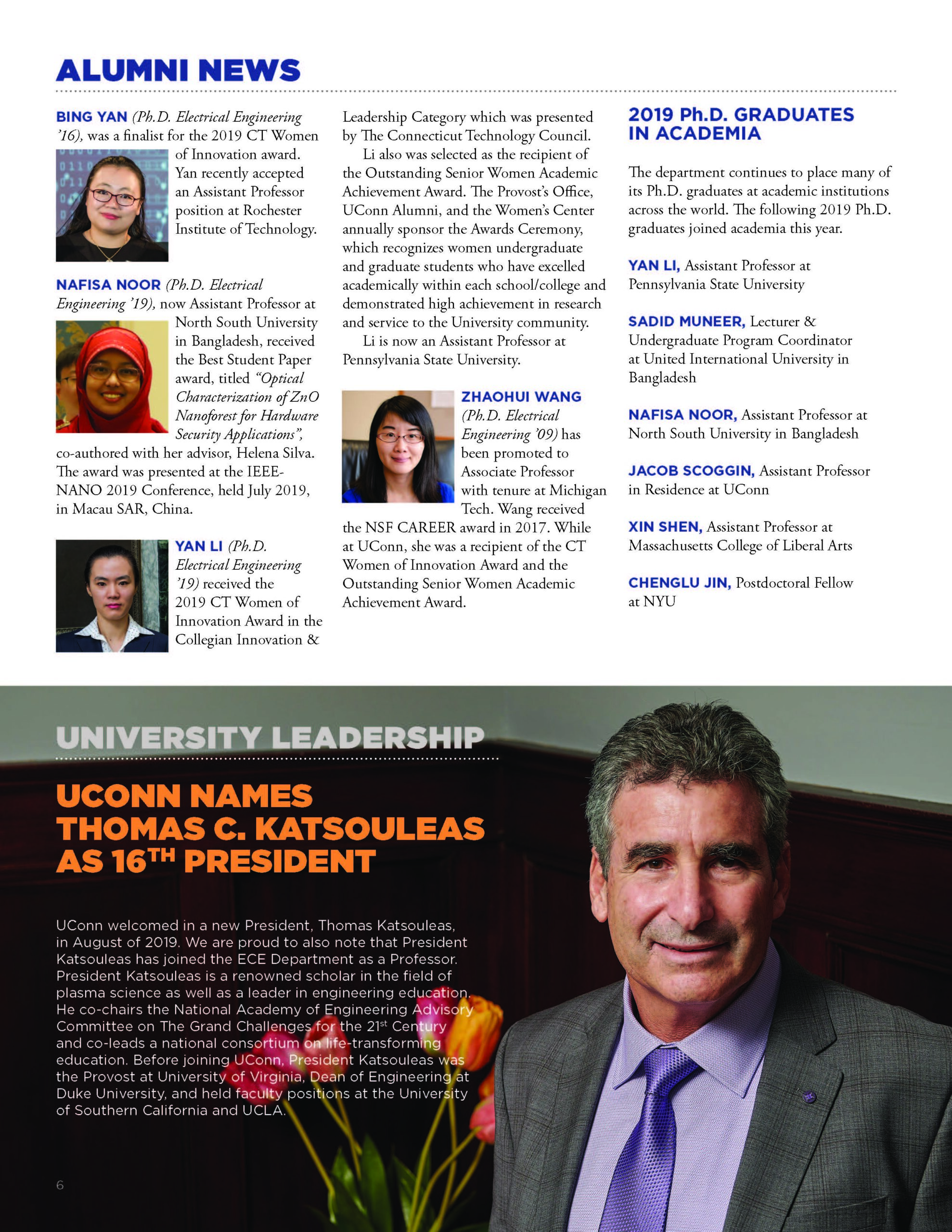
Brittany Smith ’20 (EE) has been awarded the prestigious National Science Foundation Graduate Research Fellowship for 2020. The fellowship provides three years of financial support within a five-year fellowship period, which amounts to a $34,000 annual stipend for graduate study in a STEM field. As an electrical engineering student at UConn, Brittany has been involved in a number of research activities including interning through NREIP, doing nanotechnology research with Prof. Ali Gokirmak, and researching wearable biosensors with Prof. Ki Chon. She worked on an independent project with two other undergraduate students, during which they developed a robot that shoots candy Whoppers into a person’s mouth using facial recognition and tracking. This work was published in a paper at the 2019 IEEE MIT Undergraduate Conference. Brittany has been a member of the Women in Math, Science, and Engineering (WiMSE) learning community for three years, holding mentoring positions during her sophomore and junior years. Over the past two years, she has been a teaching assistant for ECE 2001 and ENGR 1166 and the vice president of the Navy STEM program at UConn. She has also been treasurer for HKN (the ECE honor society) and WiMSE Club. Finally, she has been involved with a number of outreach activities including serving as a UConn tour guide and a member of UConn’s Engineering Ambassadors. This fall, she will be pursuing her PhD at Duke University with research focused on the development and application of biosensors.
See UConn Today for more news about other UConn students receiving the NSF GRF.
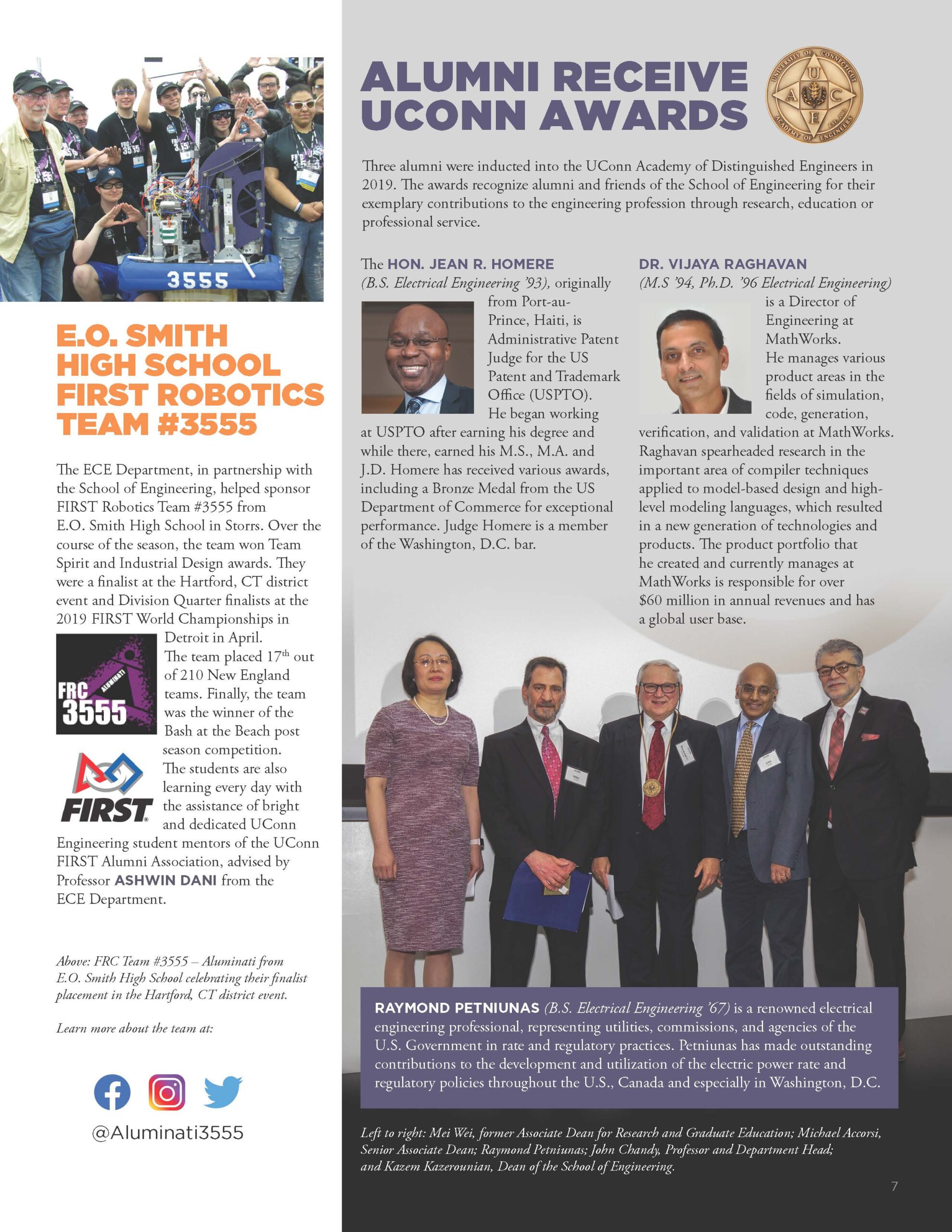
Professor Yang Cao was elected as a new member of the Connecticut Academy of Sciences and Engineering (CASE) for 2020. Dr. Cao was recognized for his expertise in high voltage engineering and energy materials for power and medical devices. He received his Ph.D. from UConn in 2002, joined GE Research in Schenectady, NY, and then returned to UConn in 2013 joining the Electrical Engineering Department faculty. Dr. Cao also holds an appointment in the Institute of Materials Science and serves as Director of the Electrical Insulation Resource Center. His research is supported by funding from NSF, ONR, DOE, NASA, DOD, ARL, GE, and others. Dr. Cao and eight other UConn faculty will be formally inducted at the Academy’s 45th Annual Meeting and Dinner on May 26.