Archives

ECE Seminar Series: Time varying and sparse underwater acoustic response estimation via a hierarchical Gaussian mixture model with application to M-ary orthogonal spread spectrum signaling

ECE title

ECE Seminar Series Fall 2014

Thursday October 2nd, 1-2 PM, ITEB 336

 Time varying and sparse underwater acoustic response estimation via a hierarchical Gaussian mixture model with application to M-ary orthogonal spread spectrum signaling

Paul J. Gendron

University of Massachusetts Dartmouth

Abstract: Recent advances in modeling doubly spread propagation channels have provided solutions for diverse communication applications between mobile platforms and these advances have been extended and have had a positive impact on the particularly challenging underwater acoustic environment. In this talk a hierarchical Gaussian mixture model is proposed to characterize shallow water acoustic response functions that are time-varying and sparse. A particular ocean environment between source and receiver is predicated on a proportion of relatively coherent paths that possess an ensemble frequency-Doppler-beam spectra. Conditioned on the bulk platform speed and ensemble Doppler spread a structured field of Beta variates link the Doppler profile to the probabilities of indicator variables specifying the state of ensonification across channel frequency, Doppler and beam. Conditioned on these indicator variables the amplitude and phase of a particular frequency and Doppler slot is modeled as complex Gaussian. The remaining non-coherent multiple surface scattered paths exhibit a spectrally flat Doppler profile. The hierarchical model is flexible and naturally accommodates diverse platform motion scenarios and array orientations. Accurate estimation of the time-varying acoustic response for the full duration of the broadband transmission facilitates compensation of the bulk time-varying dilation process taking advantage of the correlated coherent paths. The model ameliorates coherence degradation and enhance coherent multi-path combining replacing conventional time recursive Kalman-like schemes for channel estimation and classic PLL structures for phase tracking. A receiver for M-ary orthogonal spread spectrum signaling is built on this model and is tested at very low signal to noise ratios without the aid of pilot symbols. Tests were conducted in shallow water ocean environments in Buzzards Bay MA and St. Margaret’s Bay. Empirical bit error rates are demonstrated at very low SNRs with coherent symbol decisions. Tests were conducted at various spreading gains and bandwidths to achieve rates up to 130 bps at 2 km with a demonstrated probability of bit error less than E-4 with 3 element combining at SNRs less than -20 dB. [This work is funded by the Office of Naval Research, SSC Pacific’s Naval Innovative Science and Engineering Basic and Applied Research Program as well as the University of Massachusetts Dartmouth].


Bio: Paul J. Gendron is an Assistant Professor at the University of Massachusetts Dartmouth. He received his PhD from Worcester Polytechnic Institute, his MS from Virginia Tech and his BS from the University of Massachusetts Amherst, all in Electrical Engineering. His work is broad in the fields of statistical signal processing, detection and estimation theory. His contributions range from seismic event detection and classification where he is the co-developer of the New England Seismic Network’s rapid seismic event detection algorithm to adaptive filtering, underwater acoustic communications and magnetic anomaly detection. In 2000 he was the recipient of an Office of Naval Research Fellowship award for his work with the Acoustics Division at the Naval Research Laboratory and in 2006 he was an Office of Naval Research Visiting Scientist to DRDC-Atlantic, Canada. Paul presently conducts research for the Office of Naval Research and SSC Pacific related to the discovery and invention of enabling technologies for undersea surveillance.


Host: Shengli Zhou, shengli@engr.uconn.edu

Quing Zhu Receives CT Bioscience Innovation Funding

Quing Zhu, professor of Electrical & Computer Engineering and Biomedical Engineering, will receive $500,000 in funding from the Connecticut Bioscience Innovation.

This project involves the development of a handheld near-infrared imager as an add-on unit to commercial ultrasound systems for use in breast imaging. The device is intended to help predict and assess neoadjuvant chemotherapy response.

Neoadjuvant chemotherapy is treatment given before primary therapy, and used in the management of locally advanced breast cancers. A woman may receive neoadjuvant chemotherapy to shrink a tumor that cannot be surgically removed in its current stage. 

Brewing Coffee with Bluetooth

For their Senior Design Project, four UConn electrical and computer engineering students, in collaboration with iDevices, modified a Keurig coffee maker to interact with an Android app using Bluetooth technology. Some of the mobile features they designed include: instructing it to brew on command, scheduling it to brew at a specified time, selecting a flavor of coffee, and selecting a volume to dispense.

Watch this video of another Senior Design Project, a rig that can predict the durability of a bicycle frame. It was designed by four mechanical engineering students, in collaboration with MSH1 Bicycle Works.

Improving the Security of Nanoscale Computer Devices

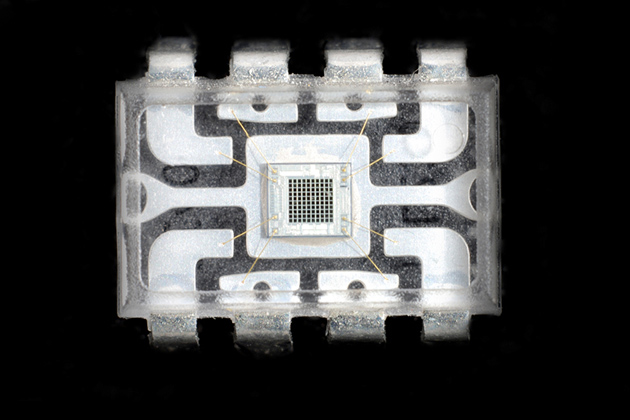
The U.S. Department of Defense has awarded a $7.5 million grant to the University of Connecticut, University of Maryland, and Rice University to support research that will analyze and upgrade security protections for nanoscale computer hardware.A chip used in electronic devices.

UConn’s Center for Hardware Assurance, Security, and Engineering (CHASE), a national leader in computer hardware security research, will anchor the initiative, which involves 10 highly specialized researchers across three institutions.

“UConn’s CHASE center houses some of the most advanced equipment available for nanoscale device characterization and testing,” says associate professor of engineering Mark Tehranipoor, director of CHASE and the project’s lead investigator. “Together with our colleagues from the University of Maryland and Rice University, we have created an exceptional team with unique capabilities in security analysis, nanoelectronics, counterfeit device detection, cryptography, and cyberattack countermeasures.”

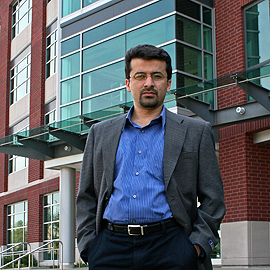
Mohammad Tehranipoor, associate professor of electrical and computer engineering and director of CHASE. (UConn File Photo)

The development of microcomputer processors and semiconductors over the past several decades has been driven by improvements in size and performance, with little attention to security. As a result, there is an immediate need to identify and address the security challenges and vulnerabilities of existing and next-generation nanoscale devices within the semiconductor community, Tehranipoor says.

Nanoscale devices, many thousands of times smaller than the width of a human hair, are increasingly popular in the microelectronics industry and are performing vital functions supporting national security, commerce, energy, and transportation. Nanoscale chips are used in a wide variety of applications from air traffic control computers to medical devices to personal cell phones and the nation’s electric grid and banking system.

“Just as performance and power are the primary focal points of early stage research in device development, this project intends to elevate security as a fundamental design parameter, thereby transforming the way new nanoscale devices are developed in the future,” Tehranipoor says.

New technologies and other innovations generated by the research are expected to reduce the cost of development, enhance the security of military and space applications, and better protect the Department of Defense’s electronic component supply chain from recycled, cloned, or defective computer hardware.

The highly competitive five-year multidisciplinary grant was awarded to the three universities by the Air Force Office of Scientific Research. UConn’s CHASE, housing $3 million in high-end analysis and research equipment, will serve as the lead research lab. UConn’s Nanoelectronics Laboratory and Nanofabrication Facility will support the project.

The University of Maryland’s Cybersecurity Center, Institute for Systems Research, and Electrical and Computer Engineering Department will assist in the research. State-of-the-art equipment contained within Maryland’s Embedded Systems and Hardware Security Lab and Wireless Sensors Lab will allow researchers to study the security vulnerabilities of current system designs, and develop new methodologies for building nanoscale devices. Rice University’s Adaptive Computing and Embedded Systems Laboratory will focus on the development of innovative nanoscale low-power, high-performance processors, and advanced security components, such as unclonable functions and next generation random number generators. Rice researchers will also conduct security system analysis and explore cyberattack countermeasures.

“Nanoscale devices pose both opportunities and challenges,” says University of Maryland professor Ankur Srivastava. “Characterizing and modeling these devices, along with gaining an understanding of likely attacks and developing security properties to foil them, will enable us to create the kinds of devices that will meet the critical needs of the Department of Defense.”

Rice associate professor of electrical and computer engineering and of computer science Farinaz Koushanfar says: “Security has mostly been an afterthought for building computing devices. In conventional integrated circuit technology, once a design is realized and deployed, integrating security is difficult. We are truly excited to have the opportunity to investigate the security properties and vulnerabilities of next-generation nano-devices. We believe this work will lead to a paradigm shift incorporating security fully into the design and development of future generations of nanoscale computing hardware.”

This story was originally shown on UConn Today here

NASA Astronaut Rick Mastracchio to Receive Honorary Degree

Photo Date: June 18, 2013 Location: Building 8, Room 183 - Photo Studio Subject: Individual Astronaut Photo for Rick Mastracchio Photographer: Robert MarkowitzAstronaut and engineer Rick Mastracchio is currently orbiting Earth aboard the International Space Station and, barring a change in schedule, that will be the vantage point from which he accepts an honorary degree on May 10.

Mastracchio ’82 (ENG) is one of nine distinguished individuals who will receive honorary degrees from the University of Connecticut this year.

After earning his bachelor’s degree in electrical engineering and computer engineering at UConn, Mastracchio began his career with Hamilton Standard (now UTC Aerospace Systems) before transferring to Houston, where he applied his engineering knowledge supporting 17 NASA missions as a flight controller. He was accepted into the astronaut corps in 1996.

In the nearly two decades since he became an astronaut, Mastracchio, a Connecticut native, has made four trips to the International Space Station and logged more than 51 hours working outside the orbiting laboratory during space walks. As mission flight engineer on the space station since his arrival in November, Mastracchio has managed a variety of research projects. He also repaired a vital cooling system during several high-risk space walks.

Mastracchio will receive the Doctor of Science from the School of Engineering.

The Board of Trustees recently approved honorary degrees for Mastracchio and the following recipients.

Prof. Tehranipoor Co-authors a New Book

 Integrated Circuit Authentication (2014: Springer) by Prof. M. Tehranipoor, Prof. H. Salmani, and Dr. X. Zhang

This book provides readers with a comprehensive introduction to hardware Trojans. The authors explain the hardware Trojan taxonomy in detail, while delivering deep understanding of the potential impacts throughout the integrated circuit (IC) life cycle. While discussing the shortcomings of current, industrial IC testing techniques for hardware Trojans, the authors describe the details of emerging techniques to detect them and to prevent their insertion into products.

CASE Honors Prof. DeMaria

demariaDr. DeMaria has served as a Distinguished Professor-in-Residence in the Electrical & Computer Engineering Department since 2003.  He founded, and served as chairman and CEO, of DEOS (Bloomfield, CT), a leading manufacturer of sealed-off, RF excited waveguide CO2 lasers for industrial and governmental applications, which was purchased in 2001 by Coherent, Inc. He remained Chief Scientist until his retirement in 2012. 

Dr. DeMaria is an elected member of the National Academy of Engineering (1976) and the National Academy of Science (1997) for his pioneering development of picosecond laser pulse physics.  He is a Fellow of the American Physical Society and IEEE, and a Fellow and past president of the Optical Society of America and SPIE.  In 2004, he received the Connecticut Medal of Technology, and in 1984 he was awarded the IEEE Centennial Medal.