The American Association for the Advancement of Science (AAAS) – the world’s largest general scientific society and publisher of the Science family of journals – has named ECE Professor Bahram Javidi as one of it’s newest fellows. Being selected as a fellow recognizes individuals for their scientifically and socially distinguished achievements. Read more on UConn Today.
Archives
Yaakov Bar-Shalom Earns IEEE Pioneer Award
Professor Yaakov Bar-Shalom has been selected for the 2022 IEEE AESS Pioneer Award. Bar-Shalom has won this award with Henk Blom of the Delft University of Technology, and their award stems from the development of the Interacting Multiple Model (IMM) approach to multi-model estimation and maneuvering target tracking. Read more at UConn Today.
Assoc. Prof. Amy Thompson helps build energy portfolios that enhance sustainability and savings.
Tracking energy use for cities and towns can be more complex than it is for a single homeowner. Assoc. Prof. in Residence Amy Thompson is working with municipalities to helpbuild energy portfolios that lead to improvements in sustainability AND costs savings. Read more on UConn Today.
Prof. Zhao earns IEEE-PES CT chapter Outstanding Engineer award
Congratulations to Prof. Junbo Zhao on earning the 2022 Outstanding Engineer award for the Connecticut chapter of IEEE Power and Energy Society, a division of the Institute of Electrical and Electronics Engineers (IEEE). His award citation is: “For outstanding contributions to the research and development of advanced grid modernization technologies for renewable energy integration and electric reliability and resilience”. For more information about the award, please visit the IEEE PES website.
In Memoriam: Emeritus Engineering Professor Peter Luh
Luh was well known for his research in electrical engineering, his faculty leadership, and his active participation in the UConn community

Peter Luh, an emeritus professor in the University of Connecticut School of Engineering known for his leadership and pioneering research in electrical engineering, passed away on November 28, 2022.
Luh joined the Department of Electrical and Computer Engineering in 1980 after graduating from Harvard University with his doctorate in applied mathematics. He earned his undergraduate degree from the National Taiwan University and a master’s from MIT.
He served as the head of the department from 2006-2009 and as director of the Booth Research Center for Advanced Technology. Luh was recognized as a Board of Trustees Distinguished Professor in 2018. He retired in December 2020, but remained an active contributor to the department and the school.
“Peter’s passing saddens me deeply,” says UConn President Radenka Maric. “He had many outstanding accomplishments as a faculty member at UConn and served as a mentor to numerous students and fellow faculty.”
Luh was well known for his research contributions particularly in optimization for power systems, smart grids, smart buildings, and intelligent manufacturing. His pioneering work has made a lasting impact in the power systems industry.
Even after retirement, he continued his research and advising graduate students. Luh had also taken on numerous leadership positions in the Institute of Electrical and Electronics Engineers (IEEE). He served on numerous societies within IEEE, including control systems, robotics and automation, and the power and energy societies. He was also chair of the IEEE Technical Activities Board Periodicals Committee, overseeing 190 journals and magazines.
Luh was a tireless worker, known for sending emails in the middle of the night, leaving the daytime to focus on his research.
“While we have lost a great colleague and friend, and renowned scientist, we pay tribute and celebrate a life that was well lived,” says Kazem Kazerounian, Dean of the School of Engineering. “Over the last few decades, Peter was a mentor and role model to me personally and to so many of my colleagues.”
Luh was also a leader in the UConn and Storrs community. In the mid-1980s, Luh and other faculty members created the Asian American Cultural Center at UConn and the Asian and Asian American Studies Institute. He was also an avid fan of the UConn men’s and women’s basketball teams and frequently attended their games.
Luh will be remembered as a gentle soul, a true gentleman, and a dear friend. He was a great collaborator to all his colleagues and an outstanding mentor to his numerous graduate students and junior faculty. He is survived by his wife Chwen-hwa, daughter Corene, son Adrian, and four grandchildren.
ECE Prof. Junbo Zhao awarded 4.4 million for storm readiness efforts
Extreme weather continues to cause power outages. But with proper outage predictions (which could accelerate restoration), and with technologies which could store a surplus of solar energy (so one town could share their excess power with another), communities may not have to bear the burdens of energy loss. That is the goal for Prof. Junbo Zhao and his team, which were awarded a 4.4 million grant toward their efforts. Read more about it on UConn Today.
UConn, National Renewable Energy Laboratory Announce Partnership for Research and Innovation
UConn, National Renewable Energy Laboratory Announce Partnership for Research and Innovation
An agreement with the U.S. Department of Energy’s National Renewable Energy Laboratory leverages scientific collaboration to research renewable energy technologies at the Innovation Partnership Building at UConn Tech Park
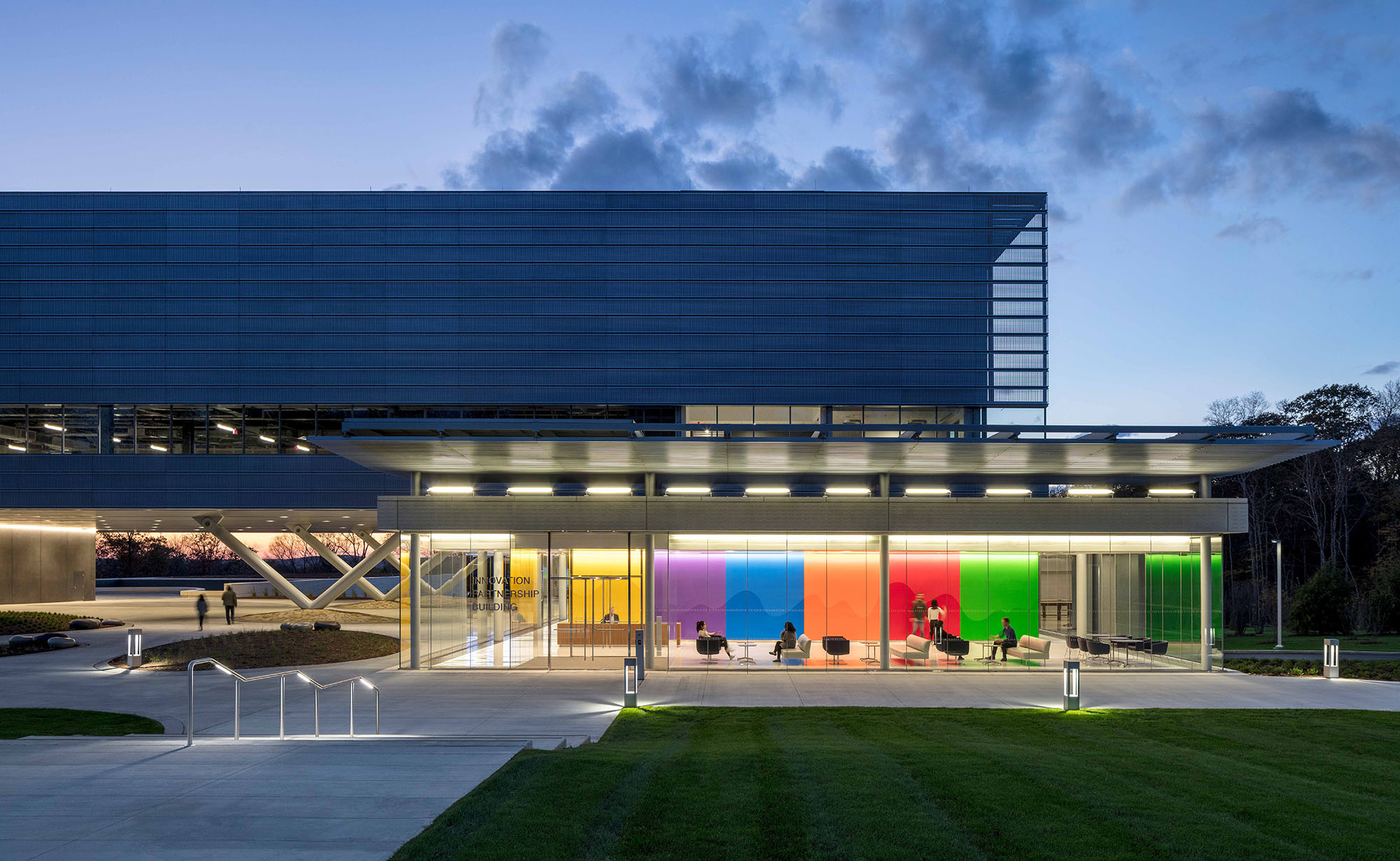
The Innovation Partnership Building will host a research collaboration between UConn and the National Renewable Energy Laboratory through a partnership to jointly address clean energy challenges.
NREL will establish a research collaboration with UConn at the Innovation Partnership Building (IPB) at the UConn Tech Park designed to leverage scientific knowledge and state-of-the-art facilities to address global energy challenges, including energy efficiency and resiliency, renewable energy technologies, and smart grid innovation.
“The partnership between UConn and NREL further builds our university’s reputation as a leader in the field of clean energy research and innovation,” says UConn President Radenka Maric. “Connecticut is known as the birthplace of the fuel cells that provided electricity to the command module in the Apollo moon mission. A great deal of related education, research, training, and demonstration related to fuel cells, hydrogen, and batteries happened and continues to happen at UConn.
“As one of only five research universities to collaborate with NREL in the eastern United States, we are in a select groupof leading institutions whose work will shape the way businesses and governments respond to the energy challenges of the 21st century,” Maric says. “I am proud that UConn is playing an important role in this crucial sector, and I am excited to see the creativity and determination our faculty and students bring to this work.”

NREL is one of 17 DOE national laboratories uniquely focused on creating a clean energy future. Based in Golden, Colo., NREL has a vast network of industry, academic and government partners throughout the world.
UConn is now a member of a prestigious cohort of universities engaged with NREL through its University Partnerships Program. It joins MIT, Princeton, Georgia Tech, and Carnegie Mellon, to name a few, in the eastern half of the country. Through its University Partnership Program, NREL works across disciplines to enhance research, foster an exchange of ideas, mobilize resources and create opportunities for undergraduate and graduate students in cutting-edge fields related to the clean energy economy.
“NREL sees the partnership with UConn as a critical part of achieving clean energy at scale that brings together talent from both institutions to further our collective goals,” says Dr. Ellen Morris, director of University Partnerships at NREL.
Among the many goals of the partnership, UConn and NREL will work together to invest in the development of joint solutions to clean energy challenges in the Northeast and increase funding opportunities not otherwise available to either individual institution. The program enables pathways for undergraduate and graduate students to work jointly with NREL scientists and UConn faculty.
“Partnering with NREL opens UConn to unlimited possibilities and advancements in clean energy research and innovation,” says Dr. Pamir Alpay, UConn’s interim vice president for research, innovation, and entrepreneurship. “We have worked hard to build our reputation as a leader in the field, creating opportunities for students and our faculty to contribute global solutions to meet energy needs and reduce dependency on carbon. NREL brings resources and collaborations that expand our reach, to the benefit of the energy and workforce infrastructure of UConn and the state.”
NREL will support research in the IPB, UConn’s state-of-the-art facility for laboratories and specialized equipment. Several national and international companies and organizations support research centers within the IPB, collectively investing more than $150 million in the UConn Tech Park.
The IPB is the home of highly visible energy centers, including the Eversource Energy Center, a dynamic partnership with New England utility company Eversource Energy that advances leading interdisciplinary research and technology to ensure the reliable provision of clean power and resilience to extreme events; the DOE Southern New England Industrial Assessment Center, which offers energy efficiency audits to small and medium-sized manufactures across the southern New England region; and the Connecticut Center for Applied Separation Technologies, which supports the industry through research and development to identify energy and cost-efficient solutions for separations needs.
The NREL partnership is the latest endeavor for UConn in its growth in clean energy research and innovation. In May, U.S. Secretary of Energy Jennifer M. Granholm visited the IPB and the Center for Clean Energy Engineering, where she called UConn and its Assessment Center an “example of what we want to have happen across the country.”
“It’s just really an exciting time to be in this energy space,” Granholm said during her visit. “We feel like we’re in the middle of history being made. Sometimes it’s hard to tell that you’re making history when you are in the middle of it, but we are right in the thick of just an incredible time.”
IEEE publishes interview with Prof. Yaakov Bar-Shalom

The Institute of Electrical and Electronics Engineers (IEEE) published an interview with Professor Yaakov Bar-Shalom this month. The interview covers many interesting aspects of Prof. Bar-Shalom’s life as well as contributions from his career. IEEE and it’s societies are widely recognized in the industry, and a trusted “voice” for engineering, computing, and technology information around the world.
US Energy Secretary Granholm Visits UConn’s Center for Clean Energy Engineering and CT Industrial Assessment Center
US. Energy Secretary Jennifer M. Granholm visited UConn’s Center for Clean Energy Engineering in May. During remarks in Storrs, Granholm spoke about efforts to fund decarbonization programs, electric vehicle battery storage projects and the emergence of a “clean energy economy.”

In addition, Connecticut’s Industrial Assessment Center, which helps identify unnecessary waste in factory systems, was discussed. Prof. Liang Zhang, of Electrical and Computer Engineering, leads the center. During such assessments, “we look at all the main energy systems and consuming parts in the typical factory,” Zhang said. “Depending on the industry it could vary, but we look at processes [like] heating and cooling, motors, compressed air. Those are the main energy consumers usually on the floor.” Six regional manufacturers had already requested assessments and the program is expected to grow. In addition to federal money, Zhang said the project benefited from about $600,000 in support from utility companies like Eversource and United Illuminating.
Prof. Katsouleas Shapes a Generation of Difference Makers, Receives Prestigious NAE Award

|
When Tom Katsouleas joined Duke University as dean of the Pratt School of Engineering in 2008, he saw an opportunity to not only change the world of engineering and its direction but put it into the hands of the next generation.
Katsouleas, currently a University of Connecticut faculty member in Electrical and Computer Engineering and Physics, picked up the phone during his first week as dean in 2008 and brought together engineering deans Yannis Yortsos at University of Southern California and Richard Miller at Olin College, and asked them a simple question: “Is our older educational pedagogy preparing our students to tackle the grand challenges of this next century?”
The grand challenges that Katsouleas was referring to were the list of “Grand Challenges” from the National Academy of Engineering in 2008 that outlined 14 areas of focus that engineers needed to tackle and advance. Some of the challenges included making solar energy economical, enhancing virtual reality, restoring and improving urban infrastructure, and to secure cyberspace.
“From that conversation, we conceptualized the first Grand Challenges Summit and the Grand Challenges Scholars Program, which was endorsed by the president of the NAE at the time,” Katsouleas said.
The Grand Challenges Summit, which has been organized regionally, nationally, and globally, has significantly shifted the conversation on how to tackle the Grand Challenges. At the first summit, Katsouleas said people were very excited about the Grand Challenges Scholars Program.
“We announced the program at that first summit, and immediately we had 12 schools interested off the bat,” Katsouleas said. “Over time, more and more people started showing interest, including the White House.”
In that call from the White House, they challenged Katsouleas and his collaborators to put together 50 interested schools, which they ultimately did and more, presenting on it to the Obama Administration—putting a major spotlight on the program. In March 2015, President Obama was sent a letter of commitment signed by 122 member schools pledging to educate and enroll 20,000 students in the program by 2025.
The Grand Challenges Scholars Program, well on its way towards that goal, is a curricular and extra-curricular program designed to immerse the student scholars in five core competencies: research/creative project experience, multidisciplinary solutions to the Grand Challenges, knowledge of business/entrepreneurship models that will help advance the Grand Challenges, multicultural issues and how they relate to the Grand Challenges, and social consciousness through service-learning experiences.
When Katsouleas became president at UConn in 2019, he shaped some of his vision for the future of the University from many of those core competencies.
“I saw the effect those competencies had when we applied them to the learning experience of the engineering students at Duke. Multiple studies have been done that show that life transformative experiences, service learning, and an entrepreneurial vision lead to successful students. When I came to UConn, I took a lot of those experiences and learnings with me and applied it more broadly to the entire campus,” Katsouleas said.
In January of this year, the NAE recognized Katsouleas and his collaborators for the impact that the Grand Challenge Scholars Program has made on society through the Bernard M. Gordon Prize, which recognizes trailblazers in engineering education.
When reflecting on the past decade of growth, Katsouleas can’t help but glow thinking about all the students that have benefited.
“When I was an undergraduate, I was interested in physics, but the courses didn’t satisfy me when it came to my desire to make a difference in the world. At the time I didn’t know I was missing something,” Katsouleas said. “So many of the students that have gone through this program got to have that experience and are making a sizable difference in this world.”
For more information on the NAE Grand Challenges Scholars Program, please click here.