News

Designing a Smart Sensor Network for Tracking Submarines

Illustration of network concept. A UConn researcher at the National Institute for Undersea Vehicle Technology is developing a ‘smart sensor network’ that is both energy-efficient and resilient, to track targets such as enemy submarines. (Getty Images)


A team of UConn engineers is developing an energy-efficient “smart sensor network” to track targets of interest, such as the proximity of enemy submarines or ships to Navy vessels.

The U.S. Navy currently uses underwater Intelligence, Surveillance, & Reconnaissance (ISR) sensor networks that run on full power, which can be a problem for long-term operations. The more accurate the sensor, the more power they consume.

The sensor networks currently being used could consist of several multi-modal sensor nodes, called sensor buoys, where each node acts independently and contains a diverse sensor suite, a data-processing unit, a transmitter and receiver, and a GPS device. The sensor suite can be composed of different types of sensors to detect and track targets, such as underwater microphones and active sonars.

Traditionally, these sensor nodes operate on full power, running all devices simultaneously, but the batteries that power them typically burn out within a few days of operation,  just as cell phones suck up more power when running multiple operations. This causes sensing failures which, in turn, leads to holes in coverage and affects tracking performance.

This poses a challenge to the Navy, since it deploys thousands of acoustic sensor networks throughout the ocean, where battery replacement can be time-consuming or impossible.

To address the challenge, Shalabh Gupta, a UConn engineer and researcher at the National Institute for Undersea Vehicle Technology, devised the concept of a “smart sensor network” that is energy-efficient as well as resilient to failures.

 Intelligent Energy-efficient Sensor Network. (Illustration by Hayley Joyal ’18 (SFA))

In a smart sensor network, sensor nodes adapt their sensing modalities based on the information about the targets’ whereabouts. Thus, the nodes around the target, such as a ship or submarine, activate their high-power sensing devices to track the target accurately, pinpointing its location, velocity, and trajectory.

On the other hand, the nodes that are located farther away from the target cycle between low-power sensing and sleep states to minimize energy consumption while still remaining aware.

Thus, if a low-power sensor detects a target, the node switches to high-power sensing to track it. Similarly, the high-power sensing devices that are tracking the target predict the target’s trajectory and alert other sensors within range of the target’s path, so that they switch to high power. Once the target has passed outside of a sensor’s range, it reverts to low-power mode.

The smart sensor networks also provide resilience. If a few nodes in the network fail, then the nodes surrounding the hole in coverage formed by the failed nodes jointly optimize to expand their sensing ranges to cover the gap.

“These networks have to contain built-in, distributed intelligence,” says Gupta, an assistant professor of electrical and computer engineering.

His first research paper on the algorithm, coauthored by graduate student James Hare, was published online in IEEE Transactions on Cybernetics in August 2017.

With this advance, crews on ships and submarines will be able to track enemy watercraft with batteries that last about 60 to 90 percent longer, Gupta says.

Gupta’s lab has prototypes of the sensors for ground use, and has been talking with Navy personnel about using them for the underwater acoustic sensor network.  He is currently seeking funding to build underwater sensors.

How UConn Researchers are Teaching Robots to Think Like Humans

There’s a great scene in the movie “Iron Man” where Robert Downey Jr.’s character Tony Stark (aka Iron Man) is crawling across his lab, desperately trying to reach the small arc reactor he needs to keep his heart beating and stay alive.

Weakened by a run-in with arch villain Obadiah Stane, Stark can’t reach the gizmo where it sits on a tabletop. Defeated, he rolls onto his back, exhausted and pondering his inevitable doom.

But the very moment that we think our intrepid hero’s a goner, a metallic hand appears at Stark’s shoulder, holding the lifesaving device. “Good boy,” Stark says weakly as he takes the device from his robot assistant, Dum-E.

And just like that, our hero is saved.

From the dutiful shuffling of C-3PO to the terrorizing menace of The Terminator, Hollywood has made millions tantalizing audiences with far-out robot technology. Scenes like the one in “Iron Man” make for good entertainment, but they also are based, to some degree, in reality.

Dum-E’s interaction with Stark is called collaborative robotics, where robots with advanced artificial intelligence, or A.I., not only work alongside us humans but also are able to anticipate our actions and even grasp what we need.

Collaborative robotics represents the frontier of robotics and A.I. research today. And it’s happening at UConn.

Three thousand miles away from the klieg lights of Hollywood, Ashwin Dani, director of UConn’s Robotics and Controls Lab, or RCL, stands in the stark fluorescent light of his Storrs office staring at a whiteboard covered in hastily scrawled diagrams and mathematical equations.

Here, in the seemingly unintelligible mishmash of numbers and figures, are the underlying mathematical processes that are the lifeblood of collaborative robotics.

If robots are going to interact safely and appropriately with humans in homes and factories across the country, they need to learn how to adapt to the constantly changing world around them, says Dani, a member of UConn’s electrical and computer engineering faculty.

“We’re trying to move toward human intelligence. We’re still far from where we want to be, but we’re definitely making robots smarter,” he explains.

All of the subconscious observations and moves we humans take for granted when we interact with others and travel through the world have to be taught to a robotic machine.

When you think about it, simply getting a robot to pick up a cup of water (without crushing it) and move it to another location (without spilling its contents or knocking things over) is an extraordinarily complex task. It requires visual acuity, a knowledge of physics, fine motor skills, and a basic understanding of what a cup looks like and how it is used.

“We’re teaching robots concepts about very specific situations,” says Harish Ravichandar, the senior Ph.D. student in Dani’s lab and a specialist in human-robot collaboration. “Say you’re teaching a robot to move a cup. Moving it once is easy. But what if the cup is shifted, say, 12 inches to the left? If you ask the robot to pick up the cup and the robot simply repeats its initial movement, the cup is no longer there.”

Repetitive programs that work so well for assembly-line robots are old school. A collaborative robot has to be able to constantly process new information coming in through its sensors and quickly determine what it needs to do to safely and efficiently complete a task. If that robot is part of an assembly line, the line has to shut down and the robot has to be reprogrammed to account for the change, an inefficient process that costs manufacturers money. Hence the thinking robot this team is trying to create.

While the internet is filled with mesmerizing videos of robots doing backflips, jumping over obstacles, and even making paper airplanes, the UConn team’s effort at controlling robots through advanced artificial intelligence is far less flashy but potentially far more important.

Every move the UConn team wants its test robot to make starts here, says Dani, with control theory, engineering, whiteboards, and math.

“We’re writing algorithms and applying different aspects of control theory to take robot intelligence to a higher level,” says Ravichandar. “Rather than programming the robot to make one single movement, we are teaching the robot that it has an objective — reaching for and grabbing the cup. If we succeed, the robot should be able to make whatever movements are necessary to complete that task no matter where the cup is. When it can do that, now the robot has learned the task of picking something up and moving it somewhere else. That’s a very big step.”

While most of us are familiar with the robots of science fiction, actual robots have existed for centuries. Leonardo da Vinci wowed friends at a Milan pageant in 1495 when he unveiled a robotic knight that could sit, stand, lift its visor, and move its arms. It was a marvel of advanced engineering, using an elaborate pulley and cable system and a controller in its chest to manipulate and power its movements.

But it wasn’t until Connecticut’s own Joseph Engelberger introduced the first industrial robotic arm, the 2,700-pound Unimate #001, in 1961 that robots became a staple in modern manufacturing.

Unimates were first called into service in the automobile industry, and today, automobile manufacturers like BMW continue to be progressive leaders using robots on the factory floor. At a BMW plant in Spartanburg, South Carolina, for example, collaborative robots help glue down insulation and water barriers on vehicle doors while their human counterparts hold the material in place.

The advent of high-end sensors, better microprocessors, and cheaper and easily programmable industrial robots is transforming industry today, with many mid-size and smaller companies considering automation and the use of collaborative robots.

Worldwide use of industrial robots is expected to increase from about 1.8 million units at the end of 2016 to 3 million units by 2020, according to the International Federation of Robotics. China, South Korea, and Japan use the most industrial robots, followed by the United States and Germany.

Anticipating further growth in industrial robotics, the Obama administration created the national Advanced Robotics Manufacturing Institute, bringing together the resources of private industry, academia, and government to spark innovations and new technologies in the fields of robotics and artificial intelligence. UConn’s Robotics and Controls Lab is a member of that initiative, along with the United Technologies Research Center, UTC Aerospace Systems, and ABB US Corporate Research in Connecticut.

Manufacturers see real value in integrating collaborative robots into their production lines. The biggest concern, clearly, is safety.

There have been 39 incidents of robot-related injuries or deaths in the U.S. since 1984, according to the federal Occupational Safety and Health Administration. To be fair, none of those incidents involved collaborative robots and all of them were later attributed to human error or engineering issues.

The first human known to have been killed by a robot was Robert Williams in 1979. Williams died when he got tired of waiting for a part and climbed into a robot’s work zone in a storage area in a Ford Motor plant in Flat Rock, Michigan. He was struck on the head by the robot’s arm and died instantly. The most recent incident happened in January 2017, when an employee at a California plastics plant entered a robot’s workspace to tighten a loose hose and had his sternum fractured when the robot’s arm suddenly swung into action.

“When you have a human and a robot trying to do a joint task, the first thing you need to think about of course is safety,” says Dani. “In our lab, we use sensors that, along with our algorithms, not only allow the robot to figure out where the human is but also allow it to predict where the human might be a few seconds later.”

One way to do that is to teach robots the same assembly steps taught to their human counterparts. If the robot knows the order of the assembly process, it can anticipate its human partners’ next moves, thereby reducing the possibility of an incident, Dani says. Knowing the process would also allow robots to help humans assemble things more quickly if they can anticipate an upcoming step and prepare a part for assembly, thus improving factory efficiency.

“Humans are constantly observing and predicting each other’s movements. We do it subconsciously,” says Ravichandar. “The idea is to have robots do the same thing. If the robot sees its human partner performing one step in an assembly process, it will automatically move on to prepare for the next step.”

Which brings us back to the whiteboards. And the math.

Failure is always an option. But when the math finally works, Ravichandar says, the success is exhilarating.

“Once you have the math figured out, it’s the best feeling because you know what you want the robot to do is going to work,” Ravichandar says with an excited smile.

“Implementing it is a whole other challenge,” he adds quickly, his passion for his work undiminished. “Things never work the first time. You have to constantly debug the code. But when you finally see the robot move, it is great because you know you have translated this abstract mathematical model into reality and actually made a machine move. It doesn’t get any better than that.”

With an eye on developing collaborative robotics that will assist with manufacturing, Dani and his team spent part of the past year teaching their lab’s test robot to identify tools laid out on a table so it can differentiate between a screwdriver, for example, and a crescent wrench, even when the tools’ initial positions are rearranged. Ultimately, they hope to craft algorithms that will help the robot work closely with a human counterpart on basic assembly tasks.

Another member of the team, Ph.D. candidate Gang Yao, is developing programs that help a robot track objects it sees with its visual sensors. Again, things we humans take for granted, such as being able to tell the difference between a bird and a drone flying above the trees, a robot has to learn.

Building advanced artificial intelligence doesn’t happen overnight. Ravichandar has been working on his projects for more than three years. It is, as they say, a process. Yet the team has learned to appreciate even the smallest of advances, and late last year, he flew to California to present some of the lab’s work to an interested team at Google.

“C-3PO is a protocol droid with general artificial intelligence,” says Ravichandar. “What we are working on is known as narrow artificial intelligence. We are developing skills for the robot one task at a time and designing algorithms that guarantee that whatever obstacles or challenges the robot encounters, it will always try to figure out a safe way to complete its given task as efficiently as it can. With generalized intelligence, a robot brings many levels of specific intelligence together and can access those skills quickly on demand. We’re not at that point yet. But we are at a point where we can teach a robot a lot of small things.”

Inevitably, as robots gain more and more human characteristics, people tend to start worrying about how much influence robots may have on our future.

Robots certainly aren’t going away. Saudi Arabia recently granted a robot named Sophia citizenship. Tesla’s Elon Musk and Deep Mind’s Mustafa Suleyman are currently leading a group of scientists calling for a ban on autonomous weapons, out of concern for the eventual development of robots designed primarily to kill.

Although it doesn’t apply directly to their current research, Dani and Ravichandar say they are well aware of the ethical concerns surrounding robots with advanced artificial intelligence.

Ravichandar says the problem is known in the field as “value alignment,” where developers try to make sure the robot’s core values are aligned with those of humans. One way of doing that, Ravichandar says, is to create a safety mechanism, such as making sure the robot always understands that the best solution it can come up with for a problem might not always be the best answer.

“The time is coming when we will need to have consensus on how to regulate this,” says Ravichandar. “Like any technology, you need to have regulations. But I think it’s absolutely visionary to inject humility into robots, and that’s happening now.”

That’s good news for the rest of us, because killer robots certainly are not the droids we’re looking for.


originally written by Colin Poitras

Zhang and His Students Look To Advance Power Systems Into The Future

Peng with the members of his Power and Energy Systems Lab. (UConn Photo/Christopher Larosa)

Over 350 million people in the United States depend on the reliability and consistency of the 450,000 miles of high-voltage lines that form the U.S. power grid to do important daily tasks. With stronger weather events and an increasing number of cyber-attacks, reliable safeguards and technologies are needed to protect this very important utility. The Power and Energy Systems Laboratory, run by Dr. Peng Zhang, F.L. Castleman Associate Professor of Electrical and Computer Engineering and his graduate students, aims at tackling these important issues.

The lab, which focuses on smart grid technology, microgrids, and sustainable energy, has worked on several crucial projects over the past several years, including a dedicated approach to networking the grid system, determining risk assessment models for unintentional islanding of power generators, using ocean waves to generate a sustainable power source, and many other related areas of research.

The lab’s most recent research, which focuses on national infrastructure, is looking to enhance the connectedness of the fractured U.S. grid system:  

“The goal of our research is to make our nation’s energy infrastructure resilient, reliable, secure, and sustainable,” Zhang said. “One of our main areas of focus now is large systems power stability, which is important, because there are no tools available to really assess and predict the status of the system. This tool is highly needed, especially for connected systems.”

That tool, which is being developed from a $1.05 million Department of Energy grant, is being worked on by Zhang and Ph.D. student Yan Li. The idea for the grant was inspired by the learnings Zhang and his students gathered from studying the tools used by local utility company, Eversource Energy:

“The whole U.S. and Canadian grid are connected together, and it’s a huge system, so it’s  therefore very difficult to monitor, assess and control its stability ,” Zhang said. “If you look at Connecticut, companies like Eversource, for the most part, use off-line tools which run many scenarios and only look at snapshots of the system, but that kind of work is not great for analysis, it needs to be monitored and assessed in real-time.”

In particular, Li and Zhang will be forming a formal theory with mathematical rigor, which will be established for computing the bounds of all possible trajectories and estimating the stability margin for the entire system, including the integrated transmission and distribution network.

Furthermore, a new open-source tool via reachable set computations will be developed for real-time dynamic analysis and stability margin calculations. It will be applicable for not only forecasting and monitoring grid performance, but also formally verifying various resiliency enhancement strategies, such as new schemes for system integrity protection and automation to adapt to this evolution of electric networks. 

Zhang and his students are also making significant contributions to knowledge advancement in the state of Connecticut and the region, with their work at the Eversource Energy Center at UConn, which conducts research related to advancing energy technology, as well as performs significant consulting work with Eversource Energy.

Zhang and his students have specifically performed work on research related to unintentional islanding, which is a phenomenon in which a distributed generator continues to be electrified and running, even when the electrical grid surrounding it is no longer active. Traditional methods of detection can often be fooled to think that grid conditions are normal, especially when multiple power generation devices are connected to the same line. 

(UConn Photo/Christopher Larosa)

This kind of scenario is very dangerous to field workers, as the lack of knowledge could cause them to be electrocuted. Zhang said that the research that’s currently being done by himself and his team addresses the creation a risk assessment model to safely avoid danger:

“This kind of research is using machine learning to predict risk in the non-detection zone,” Zhang said. “By non-detection we mean that when an island occurs, there are certain scenarios where the utility company, but with this new risk assessment model, we’ll be able to accurately predict when this scenario is likely to occur.”

Most importantly though, Zhang is happy that the graduate students that he is mentoring, and providing hands-on opportunities to, are getting the necessary experience needed to launch their careers in research and academia.

Ph.D. student Taofeek Orekan, one of the members of the lab, is one of the students that will be using that experience, as he looks for post-grad opportunities in the next few months:

“This is a great lab to start off in,” Orekan said. “I know that any lab that I launch during my career in academia will absolutely be an extension of this lab.”

For more information on the lab, visit http://power.engr.uconn.edu. 

Remembering Charles Knapp, an Engineering Icon

Professor Emeritus Charles Harris Knapp, 86, passed away at

Robert (left) and Charles ’53, ’62 Knapp. (Photo courtesy of The UConn Foundation)

home on Thanksgiving Day

surrounded by his family and loving wife of 62 years, Charleen Gaudet Knapp. Over the course of his 40-year career at UConn, Dr. Knapp enriched and shaped the

lives of innumerable students and inspired an imperishable legacy, The Charles H. Knapp Associate Professorship in Electrical Engineering.

Charlie (or “Red” or “Harris,” as he was variously known) was so eminent in his field, that a handwritten note recommending a student to a graduate program at another well-regarded university signed only “Charlie” was sufficient; no letterhead needed. Colleagues and former students remembering Charlie reiterate his traits as an educator, mentor, and researcher calling him “a true gentleman,” showing people “how to treat others,” “the best teacher,” and never seeing “him lose his cool.”

A lifelong Yankees fan, Charlie was born in New York City, but moved with his family to Coventry, CT at an early age. As an Electrical Engineering undergraduate at UConn, he was the first University Scholar from the School of Engineering and member of Tau Beta Phi, Eta Kappa Nu, and Sigma Xi engineering honor societies. Upon graduation in 1953, Charlie served two years of active duty in the U.S. Air Force before earning his Master’s degree from Yale University and working for RCA and IBM. He returned to UConn in 1958 and became the first candidate awarded a Ph.D. in Electrical Engineering.   

Charlie had many interests outside of academia. He began running in his late 20s, was an avid gardener, active member of the Storrs Congregational Church serving in many capacities including his favorite, singing in the choir for more than 40 years, and spending time with his four children and their families.

In 2012, the Knapp children honored their father with a generous donation establishing The Charles H. Knapp Associate Professorship in Electrical Engineering. Explaining the decision to create an associate professorship, typically given to newer, upcoming faculty, Charlie said, “The younger professors have the freshest education and ideas and are looking for places where they can grow. This professorship will give its holder an edge and will be very helpful in retaining the best associate professors. It is important for the university and the college if we can keep them here, and it’s good for local industry, as well.”

During his lifetime, Professor Knapp enriched the lives of countless students and colleagues, family and friends. Through their lives and his eponymous professorship, his legacy and memory will endure for generations.


Donations in his memory may be made to: The Charles H. Knapp Associate Professorship in Electrical Engineering, c/o The UConn Foundation, 2390 Alumni Drive., Unit 3206, Storrs, CT, 06269-3206

Award-winning Paper Questions ECG As Secure Biometric

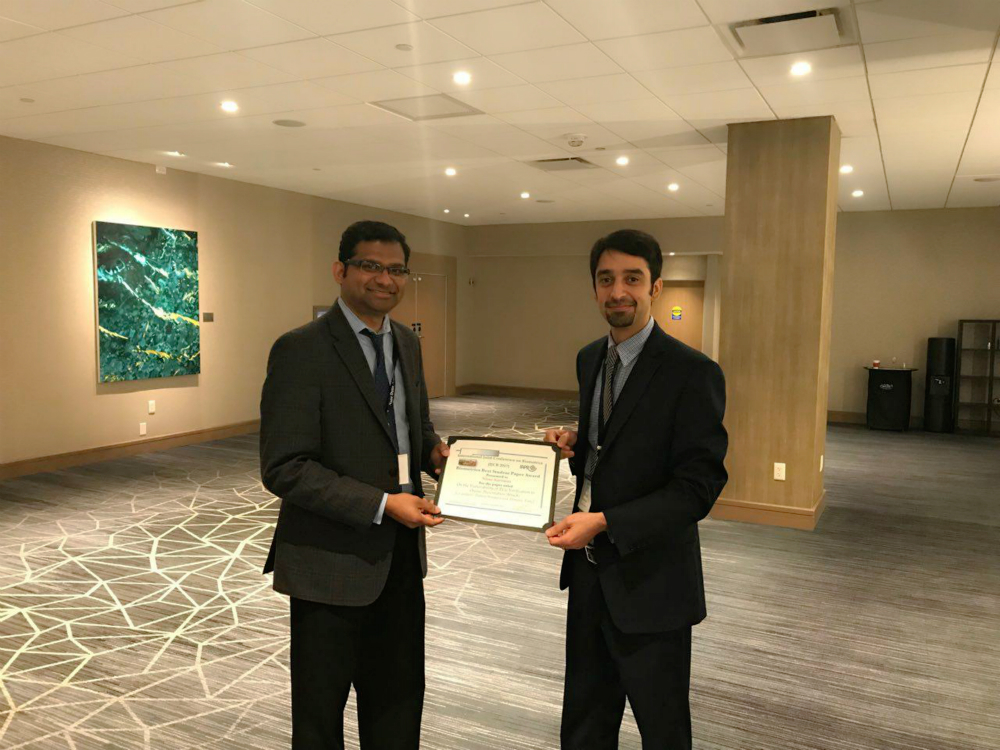
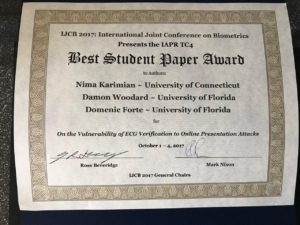
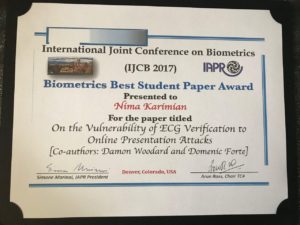
A paper from UConn fourth year PhD student Nima Karimian has won the best student paper award at the recent IJCB 2017 conference in Denver.

The Conference

The International Joint Conference on Biometrics (IJCB 2017) combines two major biometrics research annual conferences, the Biometrics Theory, Applications and Systems (BTAS) conference and the International Conference on Biometrics (ICB). The blending of these two conferences in 2017 is through special agreement between the IEEE Biometrics Council and the IAPR TC-4, and presents an exciting event for the entire worldwide biometrics research community.

The Paper

The paper, “On the Vulnerability of ECG Verification to Online Presentation Attacks,” examined the use of Electrocardiogram (ECG) as a secure biometric modality. ECG has long been regarded as a biometric modality which is impractical to copy, clone, or spoof. However, it was recently shown that an ECG signal can be replayed from arbitrary waveform generators, computer sound cards, or off-the-shelf audio players. The award-winning paper is one of the first in the field to seriously question the security of ECG verification, and goes a long way towards debunking the assumption of its security.

The paper developed a novel presentation attack where a short template of the victim’s ECG is captured by an attacker and used to map the attacker’s ECG into the victim’s, which can then be provided to the sensor using one of the above sources. The authors’ approach involved exploiting ECG models, characterizing the differences between ECG signals, and developing mapping functions that transform any ECG into one that closely matches an authentic user’s ECG. Their proposed approach, which can operate online or on-the-fly, is compared with a more ideal offline scenario where the attacker has more time and resources. In the experiments, the offline approach achieved average success rates of 97.43% and 94.17% for non-fiducial and fiducial based ECG authentication. In the online scenario, the performance is degraded by 5.65% for non-fiducial based authentication, but is nearly unaffected for fiducial authentication.

The work was supported by US Army Research Office (ARO) under award number W911NF16-1-0321.

Embedded System Competition Award


A UConn team of students competed in a MITRE-sponsored embedded systems security capture the flag competition this semester and got first place. The team was led by UG ECE students Brian Marquis and Patrick Dunham with grad student Chenglu Jin and two CSE UG students.

UConn Chapter of HKN wins the Outstanding Chapter Award (2015-2016)

The IEEE-HKN Board of Governors has conferred on the UConn Chapter of HKN (Eta Kappa Nu: the electrical engineering honor society) the 2015-2016 IEEE-HKN Outstanding Chapter Award. This award is presented to IEEE-HKN chapters in recognition of excellence in their chapter administration and programs. Recipients are selected on the basis of their annual chapter report. Winning chapter reports not only showcase their chapter’s activities in an individualized manner, they provided multiple views and instances of their work, which really brought their chapter’s activities to life. Of critical concern to the Outstanding Chapter Awards evaluation committee in judging a chapter are activities to: improve professional development; raise instructional and institutional standards; encourage scholarship and creativity; provide a public service, and generally further the established 

goals of IEEE-HKN.


The UConn Chapter is one of 21 chapters selected for their outstanding performance and the value they bring to their members, peers, and university.

Engineering Alum’s Gift To Help Keep UConn Safe

UConn has installed a new system that can detect gunshots and explosions, and send live video feed to officers’ cellphones. (Sean Flynn/UConn Photo)

During active shooter events, the speed with which first responders get information is key to saving lives. Thanks to a donation from a UConn engineering alum, UConn police could learn about an event in a matter of seconds.

Robert Hotaling ’01, an electrical engineering alum and the founder of Verbi Security, is donating an intelligent gunshot detection and IP device unification platform to UConn. His company’s system detects gunshots or explosions, sends information to campus police through an automated system in a matter of seconds and links the location to maps and video cameras.

“That, to me is the difference here; we’re a mobile first solution. We leverage mobile devices to get instant notifications,” Hotaling said.

Hotaling was inspired to donate the system when a student worker made a routine alumni donation call. After considering the request, Hotaling decided to give something more than just money.

“I said ‘I could give you some money, but I’m the founder of this company, I’ve got this tech, and I could make a donation of that tech.’ If it wasn’t for that student, I might not have thought about the donation,” Hotaling said.

The platform, which Hotaling said is worth roughly $175,000, uses military grade intelligent shot detectors to search for specific sounds.

“The sensor listens, but not for the sound of

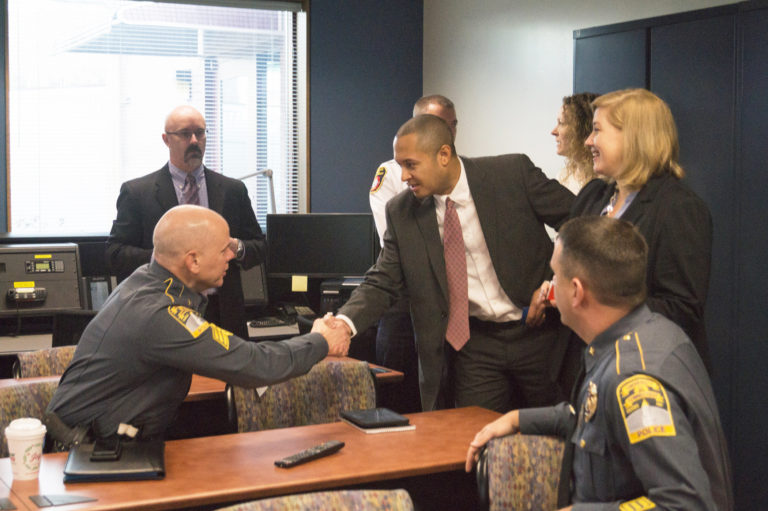
Electrical Engineering Alum Robert Hotaling ’01 meets with members of the UConn Police. (UConn Foundation Photo)

the human voice. The on board processing algorithm uses fuzzy logic to look for the acoustics of a gunshot or an explosion,” Hotaling said.

Hotaling stressed that there won’t be an invasion of privacy with the system.

“There are no privacy concerns here, all it’s doing is looking for the gunshot,” he said.

UConn has not had a problem with shooters, but recognized that the donation could enhance campus security.

“We’re using it to be very proactive,” says Hans Rhynhart, UConn’s interim director of public safety and chief of police. “This is a great opportunity to test a brand new system that has the potential to be really useful to our community.”

The system can notify officers in a variety of ways, including text messages, iPad notifications and text to speech automated phone calls- which officers are trained to look for.

“The officers get the notification, then click on the cameras in the zone and can get a live feed of what’s going on there,” he said.

The system is also capable of sending alerts to students, faculty and UConn employees with the same sort of fast turnaround.

Hotaling said that he’s excited by the chance to give back to UConn.

“I walked those halls,” He said. “I love UConn, I loved my time there, and I’m so happy to be a part of this process.”

Black Hats, Cyber Bots, Zombies, And You

The UConn Comcast Center of Excellence for Security Innovation houses researchers working to combat malicious hackers (Istockphoto).

By Colin Poitras, UConn Communications
This story originally appeared in UConn Magazine.

Cyberattacks come in all shapes and sizes. Experts say it could be only a matter of time before they pose a real threat to our daily lives. The electronic devices in our world today are interconnected like never before. Our cars are no longer machines but rolling PCs with different components constantly talking to one another. Our watches are telephones. Our telephones are high-speed computers. And with all this increased convenience comes greater vulnerability. In the constant rush to get new products to market, security can be an afterthought.

chandyFortunately, a crack team of cybersecurity specialists, led by John Chandy, an electrical and computer engineering professor, and Laurent Michel, an associate professor of computer science and engineering, is working to protect our information. UConn’s Comcast Center of Excellence for Security Innovation is advancing research to strengthen the nation’s electronic information networks and training a new generation of hardware, software, and network security engineers to protect the integrity of everything from small consumer electronics to the complex computer systems running our major industrial, financial, and transportation systems.

Secured behind passcode-protected entry doors, the Comcast lab is embedded deep inside one of UConn’s main academic buildings. Getting there can be an adventure.

If you visit the lab via the building’s main door, you must go down a set of stairs, along a long hallway to the rear of the building, then it’s a quick left, quick right, another left, up a ramp, through some fire doors, past the locked doors of several large humming mechanical rooms, another right, another left, yet another right, and finally a quick left and you are there. Or you might be. It’s hard to be sure because there is absolutely no indication of where the lab is on any of the directional office signs. Even next to the lab’s main door there is only a small 9- by 6-inch plaque in letters slightly larger than what you are reading here.

FBI Alert Number I-031716-PSA: Motor Vehicles are Increasingly Vulnerable to Remote Exploits
“researchers could gain significant control over vehicle functions remotely by exploiting wireless communications vulnerabilities”

WHITE HAT HACKERS

Talk to Michel or Chandy for a few minutes and you begin to get a sense of what life is like in their world of electronic espionage. And if you leave feeling a little paranoid, well, that’s to be expected.

Michel will tell you that the world is filled with hackers and malicious machines

known as zombies, or computer bots, which hackers have seized via remote control and without their owners’ knowledge or permission. Those machines are constantly scouring the Internet trying to steal information from your, my, and everyone else’s computers. From the moment you open your laptop and connect to the Internet, your computer is likely getting assaulted by malicious attacks, Michel says. If your computer’s security is good and you keep current with all the latest security updates, chances are you’re successfully fending off most of them… for now. But hackers are a relentless and mischievous bunch. All it takes is one click on a bogus email, one click on an infected website, and the black hat hackers are in.

The good news is that amid the piles of green motherboards, electrical wiring, testing equipment, and computer consoles, Chandy, Michel, and a team of about a half-dozen very talented graduate and undergraduate students are playing the role of said hackers. Here, however, they are the good guys. Michel likes to describe the team as “ethical hackers,” white hats probing ever deeper into Comcast’s hardware and computing systems to expose potential vulnerabilities.

The battle between the white hats and the black hats is constant. Cybersecurity is an ever-shifting landscape as new technologies, system updates, viruses, worms, and attack strategies emerge on the Internet.

“John and I are constantly on the lookout for what’s happening,” says Michel. “What are the new vulnerabilities? What are the latest attacks? To do this properly, you have to be like a surfer. You have to be on top of the wave, not behind it. You have to keep moving and always stay a little bit ahead.”

If the lab is successful at breaking into a system, that’s a good thing. Exposing a vulnerability in the lab gives vendors the opportunity to correct a problem before a product goes to market or to fix a problem if the product is already in circulation.

If the research team fails to get into a system, well, that’s okay too. That means the system’s designers are on top of their game and did a great job protecting the system’s integrity and locking it tight.

Since it opened, Chandy says the lab has made significant discoveries that helped vendors and saved consumers considerable headache. But because of the often secretive nature of the lab’s work and its basis in security, the limelight of commercial success doesn’t always extend to the lab’s cubicles and workbenches.

When students find a potential vulnerability in a system, the lab immediately notifies the vendor or system provider so the weakness can be addressed. A lot of times, news of the discovery stops there. Chandy recounts a time when he and other lab members heard of a significant system vulnerability being discussed at a national cybersecurity conference. It sounded familiar. Chandy turned to his colleagues and whispered, “Didn’t we find that months ago?” Such is the nature of the business.

“The lab we have here is pretty unique for a university,” says Chandy. “A lot of times, the way we get into these systems is not necessarily through back doors. I would call them testing and debugging phases,” Chandy says. “One of the things a vendor wants to do when they release these systems is they want to test it. So they leave the interfaces open so we can do just that.”


FBI Alert Number I-091015-PSA: Internet of Things poses opportunities for cyber crime
“devices with default passwords or open Wi-Fi connections are an easy target for cyber actors to exploit”


THE INTERNET OF THINGS

Some of the latest technology on the market involves what Chandy calls the Internet of Things. People used to have a personal computer that did one job. A watch that did another. A telephone that had its uses and a TV or thermostat with separate functions. Now, with the Internet of Things, all of those devices are capable of interacting and talking to one another. You can turn up your home thermostat from work using your smart phone. You can check your email on your watch and pay your bills through your TV.

But with all that convenience and interconnectivity comes increased vulnerability. Keeping your information safe on all those different platforms is this team’s task.

“We’re mainly looking at things from a hardware level, those devices that are going out in the field and whether they are properly protected. We try to come up with scenarios that make sense from an attacker’s perspective,” says Chandy. “We take on the role of the hacker because if we can do it, that means a hacker can do it, too.”

As an academic lab, the Comcast Center is also a place of learning. The testing that is done here is not a matter of repetitive trial-and-error assaults, but a more deliberative, targeted, scientific process.

“Think of it like a game of Clue,” says Michel. “It’s not like we try something just to find out if it works or not. As we attempt an attack, we gather evidence along the way. That evidence may betray something about the platform, the device, the software that we are trying to test. Once we have that information, we regroup and discuss what we have learned and its implications, and then we try to develop more experiments and high-end scenarios so we can learn more. So it’s not like we have this dictionary of twenty different attacks and we try them all sequentially. It’s a much more principled approach.”

The students working in the lab operate in silence. A young woman types away intently on her keyboard. A bearded student in a New York Giants T-shirt sighs heavily, steps away from his computer for a brief break, then returns. Focused. Once again engrossed with the task before him at his work station. Two sage green walls in the rear of the lab are covered with black ink diagrams and hastily scrawled text.

An eviscerated teddy bear sits on a desktop.

“Stress relief, John?” a visitor asks, pointing to the multicolored wires ripped out of the bear’s abdomen.

“Side project,” Chandy answers with a sly grin. Then he explains that even a children’s toy as innocuous as a teddy bear can be a personal security threat. In this case, the interactive bear has a small computer inside that Chandy’s lab found lacked authentication protection. It could be hacked, potentially exposing the owner’s and other bear owners’ personal information with a few strokes of cyber sleight-of-hand.

“The students here are developing skills that none of them had a year ago,” says Chandy. “The skills they are developing would make them great hackers. But it is also making them great engineers.”


Lisa wasn’t looking forward to the confrontation. Her aging mother, bedridden with different ailments and dependent on care, was really angry this time. For months she had suspected Sarah, her live-in nurse, was stealing her money. And now, the latest bank statement confirmed it. On top of it all, Sarah always seemed to be on her iPad when her mother needed her. The chest pains were back. The small automatic defibrillator under her mother’s skin activated twice in the past two months. The stress wasn’t good.

Lisa enters the house. She eyes Sarah, who is standing, her back to her, at the kitchen counter – again, on her computer. Lisa walks into her mother’s room, careful to speak softly so their conversation won’t be overheard. Within a few minutes, Lisa notices her mother’s color start to change. She seems to have trouble breathing. Sweat builds on her upper lip. She tells Lisa she feels strange, like her heart is racing out of control. The device in her chest keeps vibrating, sending sharp shocks into her heart muscles. The shocks are getting stronger. Her mother cries out in pain. Lisa calls frantically for Sarah. No response. Her mother goes limp.

Back in the kitchen, Sarah quietly shuts down her iPad and walks toward the bedroom.


CSI CYBER — UCONN

More than 20 faculty members and more than 100 graduate students in the schools of Engineering and Business are conducting research through the Connecticut Cybersecurity Center at UConn. They are examining cryptography and cryptanalysis; data security and privacy; information fusion and data mining for Homeland Security; and trustable computing systems.

The academic research building that houses the Comcast Center of Excellence for Security Innovation houses two other major cyber- security labs. The Center for Hardware Assurance, Security, and Engineering (CHASE) contains some of the most advanced equipment available to conduct security analysis on nanoelectronics. Its research focuses on counterfeit device detection and preserving the integrity of silicon microchips, the very cornerstones of the worldwide computer industry. The building also is home to the Center for Voting Technology Research (VoTeR Center), which investigates new technologies to ensure the integrity of the electronic voting process.


International Conference on Complex Systems Engineering (ICCSE 2015) Held in UConn

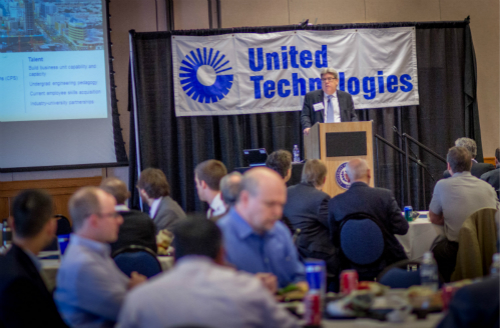
The University of Connecticut (UCONN) organized a two-day international conference on complex systems engineering (ICCSE 2015) on November 9-10, 2015 at the UConn’s main campus in Storrs, CT. The conference organization committee was led by Dr. Krishna Pattipati as the general chair and Dr. Shalabh Gupta as the program chair. The conference was focused on latest developments in analysis and modeling of complex systems that are built from, and depend upon, the synergy of computational and physical components, the so-called cyber physical systems. The conference featured talks by plenary speakers from industry and academia, panel discussions, technical paper sessions, student poster sessions and industry exhibits. The conference was a 2nd year initiative by the recently established UTC Institute for Advanced Systems Engineering (UTC-IASE). The conference was financially co-sponsored by UTC and Aptima and technically sponsored by IEEE-Systems Man and Cybernetics Society. The conference served one of the institute’s goals of making it a hub for world-class research, project-based learning by globally-distributed teams of researchers, and industrial outreach activities.UTCmeeting3_1

There were four plenary speakers, viz., Dr. Michael McQuade (Senior Vice President of Science and Technology at UTC), Dr. Edward Lee (Robert S. Pepper Distinguished Professor in the Electrical Engineering and Computer Sciences (EECS) department at U.C. Berkeley), Dr. George Pappas (Joseph Moore Professor in the Department of Electrical and Systems Engineering at the University of Pennsylvania), and Dr. Chris Paredis (Program Director for the Engineering and Systems Design (ESD) and Systems Science (SYS) programs at the National Science Foundation). Dr. Michael McQuade outlined the mega-trends that are impacting systems engineering and highlighted technology and talent needs of the industry and more specifically of UTC. Dr. Edward Lee provided an overview of the need for models with time and concurrency requirements, model-based design and analysis, domain-specific languages, architectures for real-time computing, schedulability analysis, and modeling and programming of distributed real-time systems. Dr. George Pappas gave a talk on formal synthesis and analysis for supervisory control of hierarchical hybrid systems using linear temporal logic. Dr. Chris Paredis spoke about the theoretical foundations for Systems Engineering, the role of modeling in Systems Engineering  and gave the audience a glimpse of opportunities for research in Systems Engineering and model based systems engineering (MBSE) being sponsored by NSF.

In addition to the plenary speakers, many representatives from industry and academia presented their latest research along three tracks of embedded systems, complex networked systems: control and inference, and model based systems engineering and applications. There was an education panel where educators from UConn, Stevens Institute of Technology, and Worcester Polytechnic Institute and UTC exchanged lessons learned and discussed the standardization of Systems Engineering education. The conference was truly international with representation from Asia, Europe and North America. More than 80 people participated in the conference which led to a healthy exchange of ideas. Planning for next year’s conference on the Avery Point campus of the University of Connecticut is already underway.